I began my career at a global IT company, then moved to a mobile game company where I worked for several years as a representative at their US branch before leaving the company. I never imagined I’d visit Palestine twice in a single year, and I certainly never expected that after returning to the US, my green card application would be denied, forcing me to suddenly return to Korea. When I received the initial review opinion from the immigration office and was asked to submit additional documents, I thought it was just a standard, routine procedure. But I remember having dinner with my immigration attorney, who was also my senior from university. He was utterly flustered, probably never expecting the application to be denied. The attorney, who was also a former branch manager like me, said it was the first time in his career as a lawyer that someone with my background had been denied a green card. He was very apologetic, but I felt like fate was pointing me back to Korea.
Meanwhile, living in the area known as Silicon Valley, I naturally built friendships with some of the world’s top talent and got to know various startups there. This unique experience allowed me to understand the upcoming IT trends. It was a place overflowing with news: waking up to stories of startups securing massive investments from venture capital firms, being acquired by major corporations, or hitting it big through IPOs. It felt like being at the epicenter of IT, where it wasn’t uncommon to see founders you’d just had business meetings with featured in TechCrunch articles. It was also common to use newly released devices at the US office or send them to the Korean headquarters for testing game apps before new digital devices launched. I still remember when Apple’s iPad first came out, we bought ten units to send to headquarters. I brought one back to Korea on a business trip, and when I pulled it out on the subway, people around me stared in amazement.
The year 2015, when I returned to Korea with my family, was marked by the establishment of startup support centers nationwide under the banner of “Creative Economy.” Every government ministry was tasked with supporting startups, leading to the creation of numerous government support programs. I joined the Gyeonggi Creative Economy Innovation Center in Pangyo, one of 17 support centers nationwide. Looking back now, I realize how incredibly fortuitous it was that I ended up in the startup world – something I couldn’t have known at the time. First, the field of startup acceleration itself was unfamiliar in Korea, and relevant laws were just being established. It was a time when few companies were engaged in such work. Suddenly, the government declared it needed to pursue a ‘Creative Economy,’ shifting the goals and focus of every government organization toward startup support. This created an urgent need for a large workforce and startup experts. However, creating and operating startup support programs is a specialized field requiring know-how. The problem was that they suddenly had to discover startups and hastily put together support programs, and there seemed to be a severe shortage of practitioners capable of handling that work. In the case of the Gyeonggi Creative Economy Innovation Center, a team was formed and tasked with operational duties, consisting of general administrative civil servants dispatched from Gyeonggi Province and a KT Task Force team. Specialized personnel were recruited for roles requiring expertise, and I was hired as one of them.
At the time, I wondered why they sought out and hired someone like me. The Innovation Center needed expertise in helping startups enter global markets. I had returned to Korea after working at a Palestinian startup accelerator. I attended a startup networking event, which led to my connection with the Innovation Center. Gyeonggi Creative Economy Innovation Center I was responsible for helping Korean startups expand globally and assisting global startups in entering the Korean market. I planned and operated various startup accelerator programs, Demo Days, and exhibitions. One memorable project was the VR (Virtual Reality) Film Festival. After Facebook acquired Oculus, a VR headset company, interest in the VR market surged, and many VR contents were produced. However, noting that the hardware devices were expensive and not easily accessible, we created a VR experience zone on the first floor of the Gyeonggi Creative Economy Innovation Center and hosted a VR film festival where people could experience VR contents. Kaleidoscope, a VR startup accelerator, brought its World Tour to Korea, hosting an event that drew over 1,000 visitors. They demonstrated Oculus Rift and HTC VIVE headsets, and dedicated 360-degree VR cameras. We screened various independent VR film content and successfully hosted Korea’s largest VR film festival to date. We invited director Sophie Ansel of Out of the Blue, a work based on 3D live-action footage from the ocean depths.
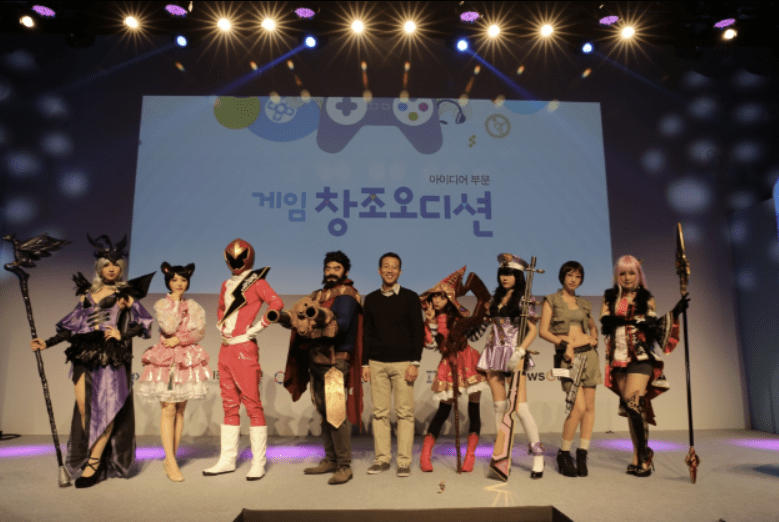
At the Game Creation Audition event hosted by Gyeonggi Province, leveraging my extensive experience working at a mobile game company, I invited global publishers as judges to provide domestic indie game companies with opportunities for global expansion. By collaborating with the crowdfunding platform, Wadiz, I encouraged users to pre-purchase games online, simultaneously providing investment and promotion for indie games. During the audition program, I recall receiving positive feedback from participants for inviting an active news anchor to professionally train the pitches. This enabled the founders, who were developers by background, to present confidently without nervousness on the somewhat daunting stage of a public audition. Furthermore, in line with the game audition concept, I invited game cosplay teams, allowing the audience to enjoy impressive performances on stage.
I also planned and personally led a customized program where promising Korean startups visited Silicon Valley together. Knowing from my previous work in Silicon Valley that similar tour programs were abundant but often focused solely on global top-tier companies or, at best, centered on Korean-speaking employees of Korean descent, I designed this tour program primarily around tech startups I advised or American startups I had personal connections with. Much like the leader of the popular reality show ‘Law of the Jungle,’ I guided the founder group, sharing my own survival experience in Silicon Valley. I sought to provide opportunities for more vivid advice by recruiting startup mentors who were not retired entrepreneurs whose profession was startup mentoring, but rather those who had actually started companies themselves or were current founders and venture capitalists.
For the first stop on that initial tour, we visited Samsung Research America (SRA), established with a $250 million investment from Samsung Electronics. Beyond its various research departments focused on developing new technologies for Samsung Electronics products, SRA also invested in numerous innovative startups through an organization called the Global Innovation Center. Following a warm introduction by the campus tour manager, Amit Garg, Senior Manager at GIC (Global Innovation Center) – a former Google engineer with venture capitalist experience – explained how Samsung Electronics attracts top talent in Silicon Valley and leverages that talent to invest in numerous innovative startups. Richard Chun, Senior Manager of New Technology Sourcing for Samsung Electronics’ Visual Display Business, gifted us copies of the book ‘Startup Nation’ and shared his Silicon Valley experiences with Korean entrepreneurs. We also met with Claire Chang, founder of the startup accelerator IgniteXL, who gave a lecture on Silicon Valley startup culture. She was already collaborating with numerous Korean government agencies to bring many Korean startups to Silicon Valley. I also met the Head of US Operations for Zenly, a French startup that developed a location-based service (LBS) app for sharing real-time locations with friends. Our connection deepened when I later assisted Zenly with the registration paperwork for its location-based service business in Korea. In 2017, I witnessed the process of Zenly being acquired by the popular US social app Snapchat.
On the second day, I visited Google’s Mountain View office to meet Dr. Jinho Kim, a software engineer at Google headquarters. I toured Google facilities, including the Town Hall meeting space, learning about Google’s open organizational culture. I also met serial entrepreneur Paul Kim, who was preparing to launch a startup in Silicon Valley. Paul Kim, CEO of a startup in Silicon Valley. He explained the service needed by sports coaches at his daughter’s soccer club to manage game schedules and shared his vision for turning this niche need into a large market. Korean entrepreneurs were amazed by this founder’s approach of commercializing solutions starting from small, local needs. Additionally, they visited Moloco, now Korea’s largest Ad Tech startup. Founded in Palo Alto by CEO Ahn Ik-jin, a former Google software engineer, the team met with other co-founders during CEO Ahn’s business trip to Korea, observing their collaborative synergy. Then, at a Paris Baguette on University Avenue, I met Eneko Knorr, CEO and serial entrepreneur of Ludei, a Spanish startup providing HTML5 development tools for app developers. We shared vivid stories about his startup journey from Spain to Silicon Valley and his efforts to secure investment from Asian VCs. For the final stop on our startup tour, we visited the headquarters of Bluestacks, a mobile marketing startup based on Android app virtualization technology that I consulted for when establishing their Korean branch. We heard from John Gargiulo, Director, about how Bluestacks can grow based on its core values of Drive, Get It, Smart & Humble. We learned the know-how of a global startup with offices in major cities across the US, India, China, Korea, and Europe.
On the third day of the visit, the schedule focused on local venture capital firms. We visited the KIC (Korea Innovation Center) Silicon Valley office, met with the manager running the KIC Accelerator Program, and met with Sean Ryu, former head of SK Telecom Ventures. We gained his insights on how VCs find, evaluate, and ultimately invest in startups. He advised that since Silicon Valley is an extremely competitive market, Korean startups must first focus on their products and services.After that, I headed to the Storm Ventures office, where I commuted daily during my five years working in Silicon Valley before returning to Korea and joining the Gyeonggi Center for Creative Economy and Innovation. There, I met with Seo Sung-hoon, a senior executive dispatched from the Korea Development Bank (KDB), and heard his views on the cultural differences between Korean and American venture capital. The highlight of the tour was meeting Chade-Meng Tan, a former Google engineer who became a self-made Silicon Valley celebrity. Chade-meng Tan, a self-made Silicon Valley celebrity and former Google engineer. He is better known for taking photos with many famous people who visited Google headquarters in the past. Meeting him in person, I heard directly about his journey to founding the Search Inside Yourself Leadership Institute and the Billion Peace Practice Foundation. Though I’m not a celebrity myself, I felt a bit nervous but still took a photo with him, leaving a record of my visit to Silicon Valley.
On the other hand, when evaluating startups based on metrics like the number of support cases or investment amounts secured, there were instances where the support centers resorted to slapdash administration to meet targets. This included double-counting the startups’ own support achievements and investment successes as the center’s own accomplishments, or even retroactively labeling startups that had already secured investment as ‘incubated companies’. Some startups also received duplicate program support from multiple centers, with each center claiming the corresponding achievements as their own. On March 10, 2017, the day a sitting president in South Korean history faced the judgment of impeachment through a Constitutional Court ruling, morale among employees at the Gyeonggi Creative Economy Innovation Center plummeted. There was anxiety that the center might soon close its doors. My contract ended that year, and I left in June, experiencing the brief two-year rise and fall of the creative economy firsthand. It gave me an indirect sense of the transience of power.
Years later, when I revisited the Innovation Center for a business meeting, it had transformed into a sparsely visited support center. The VR demo room installed on the first floor had been converted back into a meeting room, and the once bustling first-floor coworking space—where numerous startup demo days and events had lined up—was dark and eerily quiet. The political campaign slogan “Creative Economy” faded away, and President Park Geun-hye faced an unprecedented impeachment trial, leaving her administration marked by failure. Yet, since then, support and interest in startups have only grown stronger. It’s fortunate that many unicorn startups now compete on the global stage. I am grateful to have been able to contribute, even in a small way, to the startup ecosystem in its early days.
 택배기사핸디맨 블로그
댓글 남기기