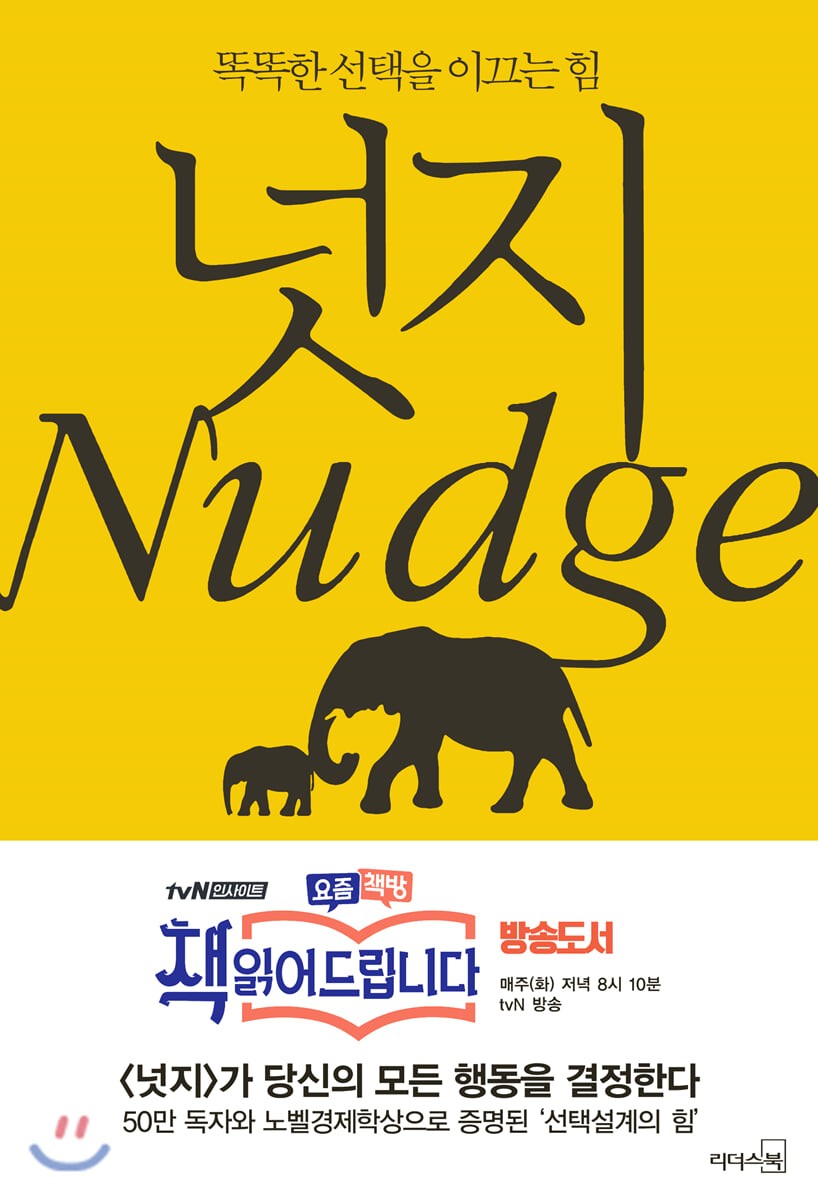
The title of a book is truly important. The word ‘Nudge’ translates to ‘to poke someone in the side’ in Korean, an expression unique to English that’s difficult to convey clearly in a single word. Given Korea’s cultural emphasis on reading between the lines and indirect communication, the act of poking someone in the side might feel somewhat excessive, leaving no suitable equivalent. Regardless, to preserve its unique connotation, the Korean title was kept as 《넛지》. Perhaps because it was written by a Nobel laureate in economics, the content was somewhat challenging, but the themes of ‘choice architecture’ and ‘liberal interventionism’ were fascinating. It clearly explains the phenomenon of guiding the public toward specific choices through vast examples like U.S. public policy and health insurance using the term ‘nudge’.
I deeply resonated with the point that while people believe themselves to be ‘Econs’—smart, rational decision-makers—they are actually just ordinary ‘humans’ who struggle with simple division and forget anniversaries. After all, this is our reality: we pride ourselves on making rational choices, yet spend hours shopping for a single outfit while making major decisions like stock investments or bank loans irrationally in just a few minutes. The book explains why humans make irrational choices by connecting them to our nature, and among these, ‘loss aversion’ stands out most. The desire to avoid loss is about twice as strong as the joy of gaining a profit. If you lose 1,000 won in stocks, it takes over 2,000 won in gains to offset that psychological pain. This explains why stock investing was so stressful. I was also struck by how much difference the ‘default setting’—applied when no choice is made—can make. I realized that monthly subscription auto-payment systems for music or games are also a form of nudge strategy. The field of ‘nudge marketing’ was particularly fascinating compared to policy design; the idea that a simple survey alone can stimulate consumption was so compelling I wanted to apply it immediately in my work. It made me think more deeply about how to gently guide customers toward purchasing.
Realizing that things I took for granted might actually be the result of someone’s meticulous design makes the world look a little different. I became aware that I, too, might be unknowingly being nudged. With the doubt that even my own thoughts might not be entirely my own, I resolve to look at the world critically once more.
 택배기사핸디맨 블로그
댓글 남기기