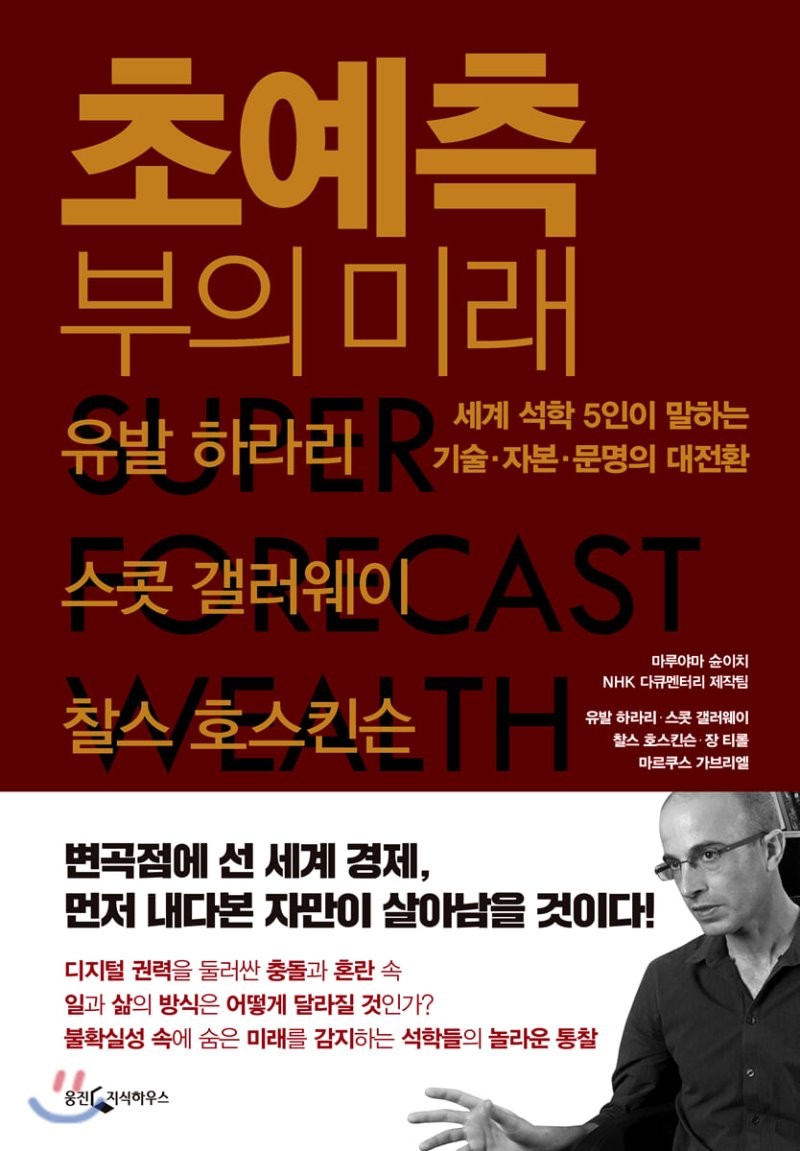
My interest in the book 《Superforecasting, The Future of Wealth》 arose because, as the end of the long tunnel of the COVID era came into view, I began wondering, ‘How will the world change after we pass through this tunnel?’ Wise individuals who foresee the future had, of course, been posing and organizing such questions long ago, even publishing books on them. I read it thoroughly with a humble mindset, eager to learn a thing or two from the top experts in each field.
Closing the book, I began to see the shifting currents of our changing times, shaped by the COVID era. I deeply resonated with the explanation that immense personal data and power have concentrated in the hands of the American IT giants known in Korea as ‘FANG’ (Google, Apple, Facebook, Amazon), and that even governments struggle to control them. I vaguely recalled hearing that the CIA office is in the same building as Google’s San Francisco headquarters. It suddenly occurred to me: perhaps it’s there to monitor whether Google properly manages personal information. Recalling the timeless truth that power corrupts, I couldn’t help but worry about what would happen if Google’s motto, ‘Don’t be evil,’ were to crumble. After all, the enemy is often within, and even a minor employee error could trigger a major disaster at any time.
Facebook (now Meta) also focused on growth over revenue models in its early days, offering free services while collecting vast amounts of personal data. It later earned astronomical sums through targeted ads based on that data. After going public, it acquired competitors like Instagram and WhatsApp, leading to accusations of market monopolization. I was fortunate enough to witness this process up close. While the company’s growth pace was astonishing, the openness of the American market that enabled such innovation was even more remarkable. Had this been South Korea, they would likely have faced sanctions through various regulations and investigations by now. The dominance of these companies, protagonists of the Fourth Industrial Revolution, accelerated further through the COVID era, with Amazon recently even formalizing its entry into the Korean market. Charles Hoskinson’s argument that we must adopt blockchain technology, dubbed the ‘Second Internet Revolution,’ to liberate ourselves from these borderless IT giants was quite radical. When I heard his lecture on the Cardano project at a conference a few years ago, I honestly found it difficult to grasp. But recently, after revisiting a basic blockchain lecture, his vision began to take shape for me.
Of course, opposing views are equally strong. Arguments that cryptocurrencies, seemingly dreaming of complete anarchy, will ultimately fail, and that government regulation is essential, do make sense when recalling the 2018 cryptocurrency frenzy. But as has always been the case when new technologies transform the world, laws and institutions are the last to change. Ultimately, I found myself pondering what choice to make during this time of change. The right answer is to ride the wave of change—neither too fast nor too late. So today, while making my early morning deliveries, I’m listening to blockchain lectures and investing in the future.
 택배기사핸디맨 블로그
댓글 남기기