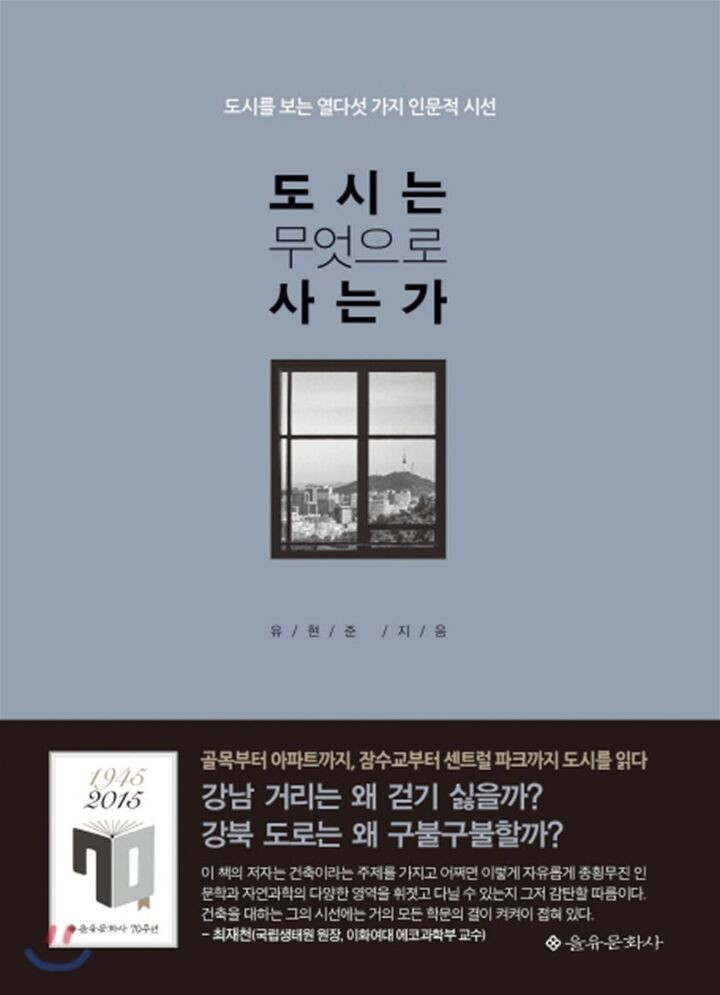
I picked up another book by Professor Yoo Hyun-jun to read, timed with its publication. Having read his previous book about homes (Where to Live), encountering this one about cities felt like my perspective expanding from the small units of architecture to larger ones. Thanks to this, I moved beyond the practical concern of ‘which neighborhood is best to live in’ and began viewing the neighborhood I chose through an architectural lens. Borrowing the author’s perspective, I began to understand why some streets become places people want to walk while others remain deserted.
Based on the formula that streets become destinations when urban amenities and natural park spaces connect seamlessly, I was surprised to learn the author planned a project linking Apgujeong Rodeo Street and Seoul Forest. It was also fascinating to learn that Garosu-gil in Sinsa-dong gained prominence due to the relocation of its gateway (the rabbit hole) connecting to the Han River. Ultimately, I grasped the essence: streets that provide diverse events and spaces for rest, tailored to the pace of human walking, become popular.
The interpretation that religious architecture gains power through space was also impressive. Structures designed to make many worshippers face one direction, like the ziggurat temple or the pulpit of a grand cathedral, demonstrate that the spatial design itself creates power. Seeing the recent situation where gathering in one space has become difficult due to restrictions, I thought an era has arrived where communities must be maintained solely through faith and the influence of leaders, without the imposing presence of architecture. For so-called ‘church-goers,’ spatial constraints may pose a significant obstacle, but it could also become an opportunity for only the truly devout to remain. The author’s statement, “Buildings were constructed by humans to worship God, not because God lacked a home,” reminded me of the words spoken by the Lord God to King David in the Old Testament.
It was truly regrettable to hear the observation that, despite Seoul being an ancient city, it lacks the timeless beauty of European cities because its wooden structures were destroyed by invasions. The popularity of Bukchon, where hanok remain, among foreign tourists likely stems from the same context. The explanation that we should not fixate solely on the hardware-like restoration of Sungnyemun (Namdaemun), which was lost to fire, but rather view it from the software-like perspective of its location and architectural spirit, was deeply comforting. Thanks to this, I could shake off the guilt of having lost our national heritage and imagine a flexible future. The controversial demolition of the Japanese Government-General building was also the right decision, prioritizing the restoration of Gyeongbokgung Palace. Hearing that the stone structure’s characteristics made relocation and restoration impossible felt like a weight lifted from my mind.
Recent reports indicate that Gangbuk’s housing price growth rate has surpassed Gangnam’s. While this is evidence of South Korea’s severe imbalance in development, I hope that Gangbuk’s alleyways and streams will be beautifully restored, transforming into charming streets that people worldwide will want to visit.
 택배기사핸디맨 블로그
댓글 남기기