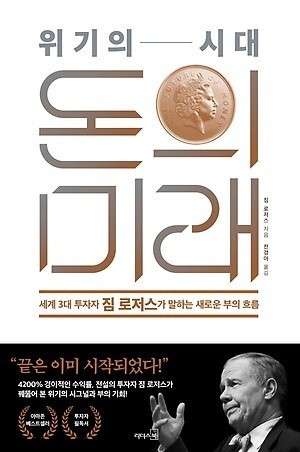
Jim Rogers, one of the world’s top three investors, warns about bubble economies in his book The Future of Money in Times of Crisis. Having predicted major economic crises like the dot-com bubble and the subprime mortgage crisis, he now says the impending crisis will be incomparably larger and more severe than any past one, making his warning sound particularly serious.
As with past economic crises, the U.S. crisis appears poised to negatively impact the entire world. While China could previously absorb the fallout through rapid growth, analysis suggests even China now carries heavy debt, making sustained high growth difficult. Moreover, the assertion that the economic downturn caused by COVID-19 is merely the beginning was particularly shocking. Understanding various economic phenomena—such as the US-China trade war brought to the surface by former President Trump, America’s low-interest-rate policy, and quantitative easing aimed at stimulating the economy by printing dollars—became much clearer. In short, a ‘good opportunity to buy low’ arrives amidst crisis.
The author, who argues that the center of economic growth has shifted from the US to China, achieved financial freedom and retired at age 38. He then traveled the world by motorcycle to witness the reality firsthand. His conclusions, born from such experiences, resonated deeply. It was astonishing to see him formulate investment strategies by looking ahead to Russia’s open-door policy, Africa benefiting from Chinese infrastructure investment, and even Korea’s era of reunification. While most seniors become conservative and often criticize the younger generation, Jim Rogers, even past 70, maintained a balanced perspective. He critically examined mainstream media like CNN and BBC, and made a point of checking news from five countries daily. As an old advertising slogan put it, age was just a number to him.
It was somewhat surprising to learn that his college major was history, given his strong entrepreneurial spirit evident from childhood—picking up empty bottles to sell, then hiring his younger brother to sell peanuts and drinks at baseball games. During his time studying philosophy and economics at Oxford and later working at a Wall Street securities firm, he found history and philosophy greatly aided his investment work. Because history always repeats itself. Through this book, I learned that bubbles eventually burst, that for the prepared, that period becomes an opportunity, and that opportunities exist in overseas markets unseen by the masses. The fact that his ultimate reason for wanting to make money was to gain ‘freedom’ strikes me as a clear truth that remains unchanged even as times change.
 택배기사핸디맨 블로그
댓글 남기기