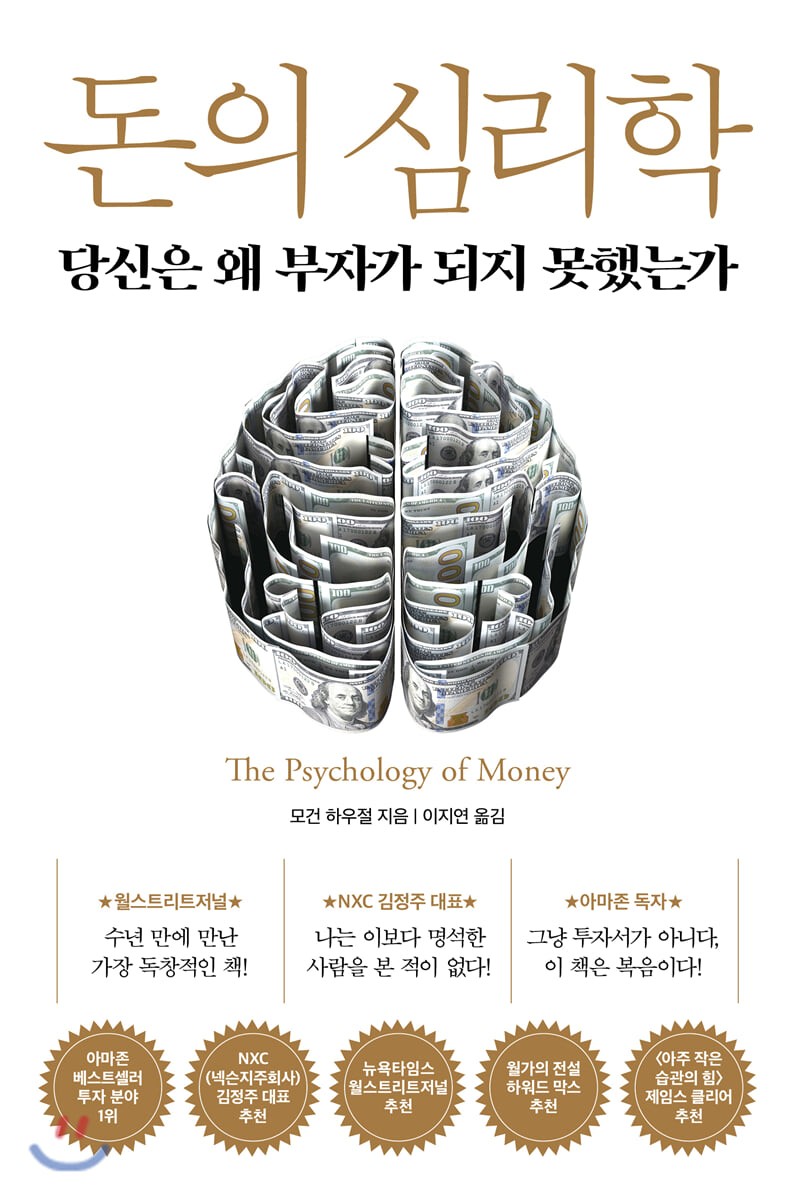
If 『The Philosophy of Money』 is a book containing the sayings and wisdom left behind by the sages of wealth from the past, then 『The Psychology of Money』 felt like a guidebook explaining how to become wealthy based on practical advice. Starting the first chapter with the sentence, “No one is crazy. They just make absurd decisions because they lack financial experience or are ignorant,” made me reflect on my own level of financial knowledge.
Explaining the magic of compound interest, it was fascinating to learn that the secret to legendary investors like Warren Buffett’s success lies in “surviving in the market long enough to accumulate compound interest.” It also highlighted how the accumulation of ‘tails’—small, consistently generated revenues—enables one to attempt new projects (the ‘body’) that can yield significant sales. Furthermore, the author’s argument that while everyone gets a chance to become rich, most fail to maintain their wealth, and the only way to stay rich is through consistent management with humility and a touch of paranoia, was very persuasive.
The reason to save is to be able to change jobs with peace of mind and to seize good investment opportunities, which I understood ultimately means to enjoy ‘financial freedom’. While having money doesn’t guarantee happiness, I deeply agreed that money can provide many conditions for happiness. I also remember the sharp observation that people who envy a Ferrari sports car aren’t interested in the owner; they’re just thinking about how cool they’d look driving it. It’s a paradoxical yet clear truth that bigger houses or expensive jewelry don’t earn genuine respect or praise.
The author defined wealth as ‘monetary assets not converted into tangible goods,’ likening it to an unpurchased car or jewelry. This passage brought to mind the English word **‘Gentle.’** Its hidden meaning is said to be **‘Power under control.’** The self-restraint to buy but not purchase, and the humility to possess but not flaunt, are precisely the core of managing wealth. Despite his great success, the author cited ‘buying a house without a loan’ as one of his most foolish decisions. He explained that despite low interest rates at the time, he avoided borrowing because he disliked the mental constraint of paying monthly interest. This choice was the opposite of those who borrow to invest in stocks; he and his wife chose a freer life instead.
Living a debt-free, liberated life—a frugal existence where he can buy anything yet finds satisfaction in not buying—and his approach of letting compound interest work its magic long-term, even if returns are below market average, has made him another role model. Working as a delivery driver in Incheon, I’m still far from reaching that level, but grateful to have work, I start collecting packages today with the sunset behind me!
Please refer to the video of Kim Mi-kyung TV’s interview with the author. https://youtu.be/PWBChswoAQU
 택배기사핸디맨 블로그
댓글 남기기