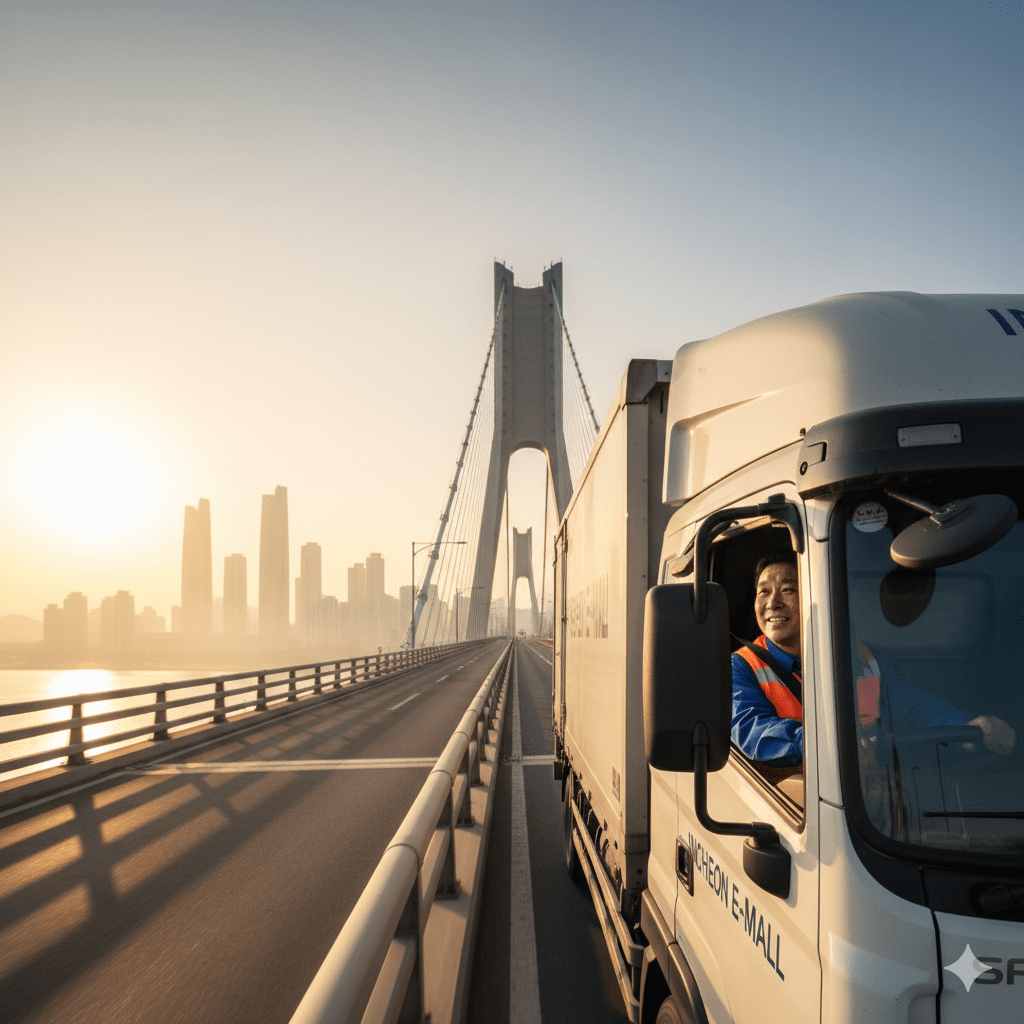
In 2019, while performing the daily routine of parcel delivery, I found the overwhelming sense of futility—like hitting a rock with an egg—more taxing than the physical labor itself. Though parcel delivery is a simple job anyone can do, I personally realized it demands a level of patience not everyone possesses. At first, I was clumsy at sorting, misread addresses leading to wrong deliveries, and struggled to find items when boxes collapsed in the cargo hold while driving. I had to endure every hardship a rookie driver faces. I doubted whether I could ever bounce back and felt frustrated, thinking that beyond just a career break, returning to my original field might be impossible forever. Above all, despite having learned that no job is inherently inferior, the loss of self-esteem from seeing myself delivering packages with my hat pulled low was like a dark tunnel – a feeling that even the lofty phrase ‘life at the bottom of society’ couldn’t fully capture. If only there had been hope at the end of that tunnel. But in the repetitive cycle of collapsing from exhaustion late at night after drinking makgeolli, sleeping, and then heading back to work at dawn the next day, there was no room for such luxury. At 7 a.m., hearing the mechanical sound signaling the conveyor belt’s start and beginning the sorting work, finding hope in a worker’s life—where you become just another part of the machine, praying only to finish deliveries without incident—was incredibly difficult.
I remember when I was first assigned a delivery zone and started with the minimum volume, earning around 2 million won a month. Later, as one or two drivers quit and my territory expanded, my monthly pay rose to around 4 million won. But I realized it was impossible to earn more than that alone. Even working six days a week until late at night, there was a limit to how much I could deliver daily, and the territory rights belonged to the agency owner. Couples often work together in delivery, and teamwork is crucial. Since it’s physically demanding work shared between partners, it’s difficult to work together without consideration and understanding. I’ve actually seen drivers who started out as close friends end up arguing and parting ways. I later learned that another method to increase volume and efficiency was hiring assistants. There was also a government-supported program where hiring seniors entitled you to partial wage subsidies.
During my time at Hanjin Express, I covered Dongchun-dong, Yeonsu-dong, and Okryeon-dong in Incheon. At CJ Korea Express, I crisscrossed the alleys of Juam 8-dong and low-rise apartment complexes. Countless incidents happened along the way. Early on, unfamiliar with driving, I caused fender benders or damaged outdoor units on building exteriors. Once, a gust of wind opened the cargo door, hitting the side mirror of a passing car. I recall climbing over ten flights of stairs when a high-rise elevator broke down, delivering packages by crossing over to the adjacent building line from a rooftop, and even having to review CCTV footage after a resident, who had mistakenly eaten delivered baby cheese as a snack, denied responsibility. There were disputes over misdelivered premium kimchi due to incorrect addresses, and redelivering ten 20kg sacks of rice or five boxes of pickled cabbage after misdelivery. Countless episodes flash through my mind.
Learning the parcel delivery business structure and directly experiencing the agency owner’s role and the driver’s hardships was a huge learning experience. I also came to understand the difference between delivery and return collection, as well as the ‘collection (shipping items)’ work. Outbound drivers visit clients to collect new goods, which has the advantage of shorter working hours compared to deliveries that visit hundreds of locations. Of course, there’s the downside of late finishes due to loading work. The structure involves the agency owner finding new clients, signing corporate contracts, and hiring outbound drivers. I saw limitations in income from deliveries alone and began focusing on the outbound side. However, it was never easy for an individual driver to attract new corporate clients. So, I kept an eye out for opportunities while doing deliveries, and on weekends, I supplemented my income by doing regional deliveries through a delivery app. But the lack of rest led to frequent mistakes during weekday work, eventually putting me at risk of being let go. Then, by chance, I saw an ad on Karrot Market selling the franchise rights for a dawn side dish delivery agency. Though slightly skeptical, after contacting the seller and confirming details with the main office, I acquired the franchise rights for the entire Incheon area. Since the per-delivery fee was higher than regular courier services, I became convinced that with effective marketing, I could grow the business. Starting in July 2020, I woke up at 5 a.m. six days a week, driving over 100km across Incheon, visiting nearly every neighborhood. However, sleep deprivation led to drowsy driving, and in October 2020, I caused a major accident, crashing into the wall of the Seonhak-dong underpass. Even though the right side of the car was badly damaged and a tire blew out, instead of calling a tow truck, I changed the tire myself with a spare and finished the delivery. My sense of responsibility for my business was so strong that I worried more about customer complaints from delivery delays than the accident itself.
I also earned delivery fees by moving free furniture listed on Karrot Market. It was through a coffee factory owner I met during one such job that I secured a crucial parcel collection contract. My prediction that online sales would increase as COVID-19 prolonged was spot on. Seizing this opportunity, I became a Lotte Express collection driver, living a ‘one-person, multiple roles’ life: delivering side dishes at dawn, working as a helper during the day, and handling collections at night. Especially during that year of dawn deliveries, watching the sunrise every morning changed my perspective. I developed a sense of pride in being responsible for someone’s breakfast. After deliveries on Yeongjong Island, crossing the Incheon Bridge and sharing the ocean views via Instagram Live became both a daily ritual and a joy. Sometimes I even mixed in English during the broadcasts.
In November 2020, at the height of COVID, a call from an American friend led to a video interview with the co-CEO of the global company ‘Agora’. I was hired as the Head of Business Development for Korea starting January 2021. Seeing me in my delivery driver uniform during the interview in an underground parking lot, he laughed heartily. He highly valued my honesty in sharing my failure experiences without reservation. Then, in February 2021, as the ‘Clubhouse’ craze swept through, Agora’s technology received explosive attention. My firsthand experience as a delivery driver of the ‘shift to the online era’ gave me insight, leading to the achievement of securing major contracts with large corporations in Pangyo. When Facebook rebranded as ‘Meta’ and the metaverse boom took off, Agora’s platform played a pivotal role. Investment-wise, it also bore fruit. I recovered shares invested years prior to secure seed money and rigorously managed cash flow based on the principle ‘Assets = Capital + Debt’. We converted money earned from delivery services into investment assets immediately, managing the portfolio by selling only what was necessary on paydays. Watching discarded boxes turn into cash, then into cryptocurrency, growing in value felt like leveling up items in a game.
I’ve now escaped the self-pity of longing for past glory. My side role as an ‘Incheon delivery driver’ is incredibly dear to me. Every day, I collect coffee products and help residents move their belongings, finding small happiness in ‘delivering happiness.’ I feel warmth seeing snacks and notes left at doors during early morning deliveries, and I find happiness beyond monetary value in the warm cup of rice a resident gave me after helping move furniture late at night.
I now know that the sweet mixed coffee brewed by the boss at the recycling center tastes better than any espresso. One day, my son asked, “Why do you keep doing deliveries, Dad?” I answered, “Because delivering happiness is truly enjoyable and fun.”
 택배기사핸디맨 블로그
댓글 남기기