One of the ads symbolizing Generation X that comes to mind is for the men’s cosmetics brand ‘Twin X’. It featured two male actors and an idol singer posing the profound question “Who am I?” against a black-and-white screen, filling the entire frame with the letter ‘X’ – a truly striking visual. Even now in 2022, its intense visual composition remains highly impressive. Despite being an era when men’s cosmetics ads were unfamiliar, the message of ‘X’ conveyed by the two men with rebellious expressions has stayed with me for a long time.
Researching this term, which refers to the early 20s generation born in the 90s, revealed that the original foreign ‘Generation X’ referred to the post-World War II baby boomers. The Twin X advertising agency imported this term to target early 20s consumers, and its concept became a huge hit in South Korea. I, too, considered myself part of Generation X and felt a distinct cultural pride that set us apart from the democratization generation of the ’80s cohort. Undoubtedly, we are the generation that lived through countless changes firsthand: the start of the CSAT generation in 1994, the 1997 IMF financial crisis, and the Y2K panic in 2000. During my university years, I too attended gatherings out of curiosity as the venture boom began, and I have passionate memories of attempting a street magazine business with friends during my sophomore year.
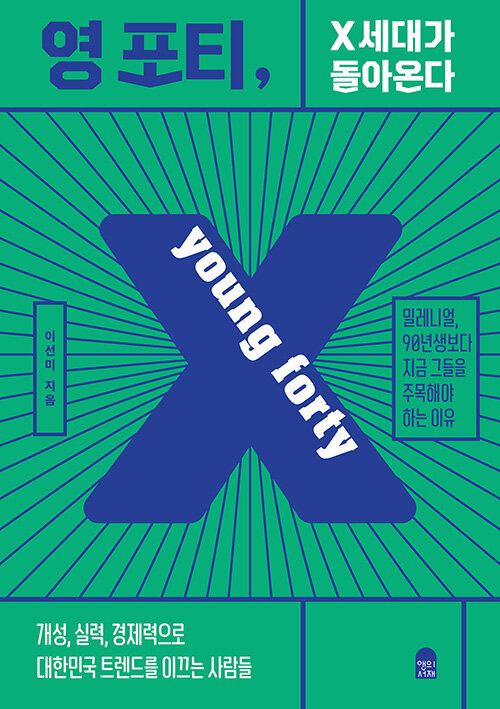
The author classifies this generation, now middle-aged, as ‘Young Forty’. Having navigated the IMF crisis, they grew into talent suited for the global era by surviving through sheer capability. Unlike the activist generation, they possess strong individualistic tendencies, unhesitating in consumption for themselves and shaping new trends. They are also ‘unconservative middle-aged individuals’ with strong humanities backgrounds and creativity, producing diverse cultural content like K-pop. Within companies, they are key team leaders handling both operational and managerial roles, young executives, or entrepreneurs who built major IT and gaming corporations. Regarding the mobile version of ‘The Land of Wind,’ cited as a successful case of Young Forty marketing, I recently found myself collaborating with that company on their new metaverse project (ZEP), providing real-time communication solutions. As a Young Forty myself, this feels like a strange twist of fate.
Yet, they also stand at the epicenter of conflict, caught between the older generation and the MZ generation, as the main players in an aging society. With the presidential election just days away, I feel this acutely. Expectations and concerns intertwine over how much the politically progressive Forties—caught between the conservative 50s and 60s generation and the relatively politically disengaged MZ generation—will unite to determine South Korea’s future direction. The 40s are the backbone of our society, the generation most actively engaged in economic activity, and the one bearing the weighty responsibility of passing the leadership baton to the next generation. That’s why, even today, I wake up at 4:30 a.m. to upgrade myself and prevent my thinking from becoming outdated, leaving my thoughts on my blog.
 택배기사핸디맨 블로그
댓글 남기기