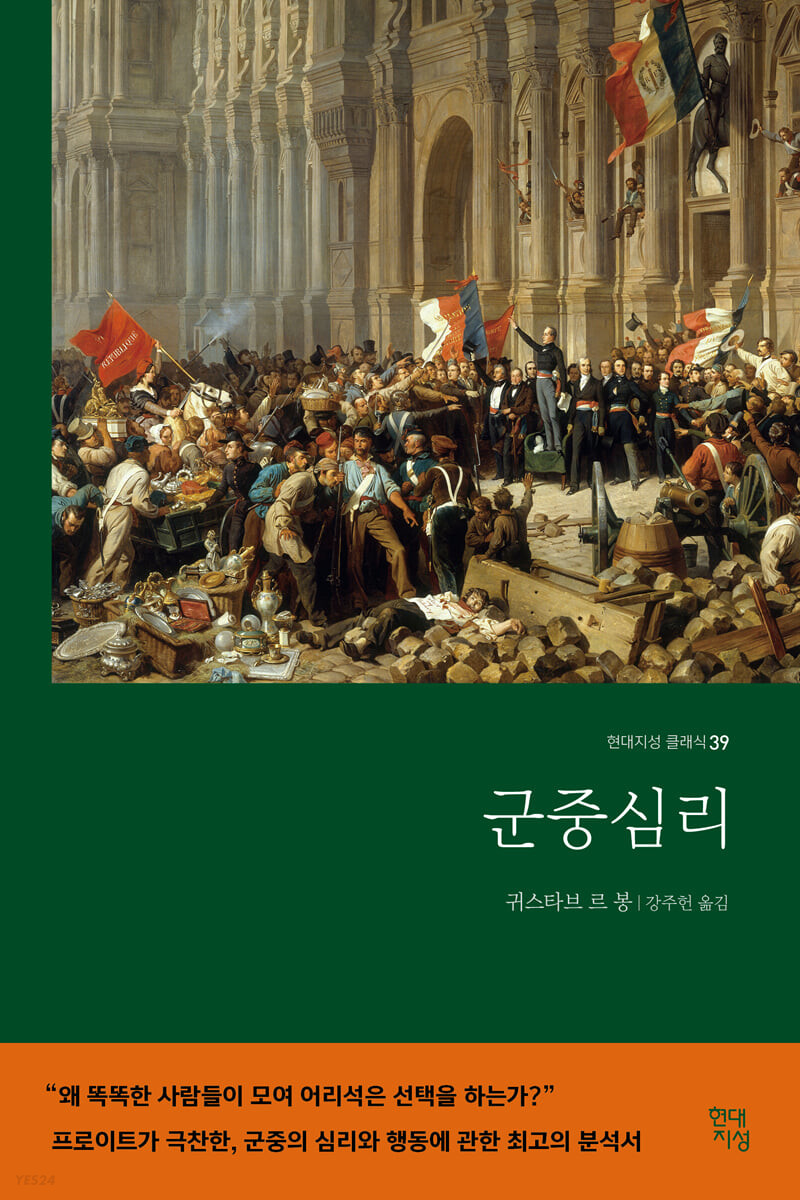
Throughout my reading of this book on crowd psychology, I found myself questioning whether it was truly written in 1895. It felt like a manual for understanding contemporary crowds, their psychological traits, and behaviors—so much so that I wondered if the author might still be alive today. While it’s true that individuals gather to form crowds, once a crowd is formed, the personalities of each individual disappear and a new collective personality emerges. They think emotionally rather than rationally, dominated by the unconscious, appearing in many large and small events throughout history, sometimes heroically, sometimes as villains. Whether it’s jurors frequently appearing in American courts, lawmakers debating fiercely in Congress, or citizens gathering in Gwanghwamun Square chanting slogans, they are not thinking and acting rationally based on individual reasoning. Instead, they are captivated by provocative words or images, leading them to make highly emotional and extreme judgments. The book explains that these outcomes possess unique characteristics in each nation, becoming entrenched as manifestations of history and culture.
During the last presidential election campaign, one term frequently used by candidates was ‘matador,’ a foreign word meaning black propaganda. In Spanish, it originally referred to the bullfighter who lures the bull out and then stabs it in the forehead with a sword. In politics, it has come to mean “a strategy of creating and spreading unverified, poorly substantiated, or entirely false information to put an opponent in a difficult position.” I was surprised to learn that black propaganda and opinion manipulation emerged precisely as methods to study and exploit Gustave Le Bon’s theory of crowd psychology, and that many 20th-century dictators used them to incite the masses. I was surprised again that such an outdated tactic still works in South Korea in 2022.
It was shocking to learn that the moment a crowd transforms with a specific purpose and consciousness, they act like a new entity with intellectual capacity far lower than the sum of their individual intellects. This holds true regardless of whether the group consists of highly educated PhDs or low-educated laborers. Understanding that those who incite crowds know precisely how provocative words or images can easily excite them, turn them violent, and lead them to make irrational decisions—and that these individuals cleverly exploit this crowd characteristic to achieve their own ends—helped me finally understand many social phenomena I’d long been curious about. It was also a regrettable reality that once individuals become part of the crowd, even if their decisions were made in a moment of excitement or aggression, confirmation bias sets in once a decision is made. Consequently, they stubbornly support their own flawed decisions to the end.
While a little rational and logical thinking and investigation would make it easy to understand, the moment one becomes part of the crowd, those abilities vanish, and they simply follow whatever the leader presents. This made me think it resembled the behavior of fanatical cult members. Indeed, there’s an anecdote from the French Revolution where a man, swept up in the crowd’s fervent support, swung the blade on the guillotine to behead criminals. He reportedly didn’t fully understand why he did it, yet somehow felt he was doing something righteous. It occurred to me that some of those who participated in the mass murder of Jews in Nazi concentration camps might have similarly been swept up by Hitler’s propaganda, feeling a sense of righteousness rather than guilt while carrying out those acts. This book also details specific methods for inciting the masses using crowd psychology. What surprised me was how these methods, though delivered through slightly different media forms today, are ultimately conveyed through easily accessible broadcasts, internet portals, and SNS services.
I agreed with the author’s analysis that differences between crowds stem from historical and cultural differences, and that these differences ultimately arise from disparities in education. I realized that those who incite ignorant crowds often chant slogans about social equality while actually controlling things from outside the system. I could see examples in the political arenas of the US and Korea where people claim to represent the vulnerable but actually use them to destroy the existing order. I personally witnessed in the U.S. how its immigrant policies, shaped by such values, led to weakened borders and increased crime, followed by LGBTQ+ preferential policies culminating in the legalization of same-sex marriage. I recognized similar processes unfolding in South Korea, such as granting local election rights to permanent residents after three years of stay, or the Democratic Party pushing for comprehensive anti-discrimination legislation.
Having visited many countries worldwide, I learned their histories and cultures. This book, written from a sociological and psychological perspective, analyzes crowd psychology and critiques France’s flawed rote-learning education system at the time. Yet, it didn’t feel like someone else’s problem to me. Why? Because historically, exploiting crowd psychology to devise election strategies for the benefit of a minority, using any means necessary—including illegal campaign tactics—to seize power has been a recurring pattern. Still, I believe hope remains for South Korea because Christians, like the 3.5% of salt that prevents the sea from becoming rotten, endure. That’s why I rise at 4:30 a.m. today to begin another day.
 택배기사핸디맨 블로그
댓글 남기기