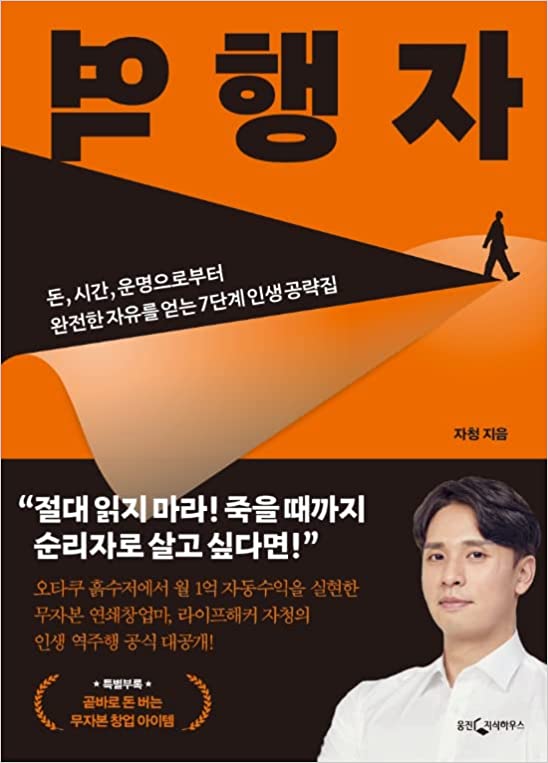
The book The Reverser by author Ja-cheong, whom I discovered through YouTube, shared common ground with MJ DeMarco’s The Millionaire Fastlane, which I read around the same time. Both authors achieved self-made financial freedom at a relatively young age and are active as a prominent YouTuber and an investor, respectively. The former explains how to hack life like using a cheat code to level up (life hacking), while the latter details how to get on the fast overtaking lane of life rather than the slow lane of just following along, based on their own experiences.
Jacheong devoured over 200 books on history, psychology, and sociology in his twenties before expanding his ventures from relationship counseling to reunion services and eventually a marketing company. He turned ‘how to make money’ itself into content, creating the channel ‘Life Hacker Jacheong,’ and gained public recognition by appearing on the popular channel ‘Shin Saimdang.’ While the book’s content doesn’t introduce groundbreaking business ideas, I find it truly remarkable that a young man in his 20s built a business from scratch with no capital, leveraging knowledge and platforms to brand himself as an ‘icon of success’. His approach of training the brain through reading and writing, then presenting a practical ‘7-step model’, felt exceptionally fresh.
MJ DeMarco, author of “The Millionaire Fastlane,” also successfully sold his internet business at a young age. He now runs the “Fastlane Forum” while investing in stocks and real estate. Much like the radio program “Escape at Two: Cultwo Show” or the YouTube channel “Shin Saimdang,” which share listeners’ stories, he has built a content platform that continuously reproduces success stories, publishing them in books to create a virtuous cycle. Reading the diverse success stories of members featured in the book sparks such curiosity that you’ll want to join the forum yourself.
Meeting these two authors with completely different backgrounds through their books reaffirmed an ‘open secret’: while paths to success vary, the principles are similar, ultimately boiling down to **‘cultivating small achievements into major results through powerful execution’**. On the other hand, the cultural differences in how each country views success were also fascinating. In Korean society, the ‘fast lane’ can easily be perceived as an unequal shortcut, while in American society, a ‘cheat code’ risks being seen as an unjust foul play. Ultimately, I concluded that to gain true recognition, one must prove the value of their success in a way that aligns with the grammar of their own society. To find my own formula for success, I continue reading and writing today, rising at 4:30 AM to start the day energetically.
 택배기사핸디맨 블로그
댓글 남기기