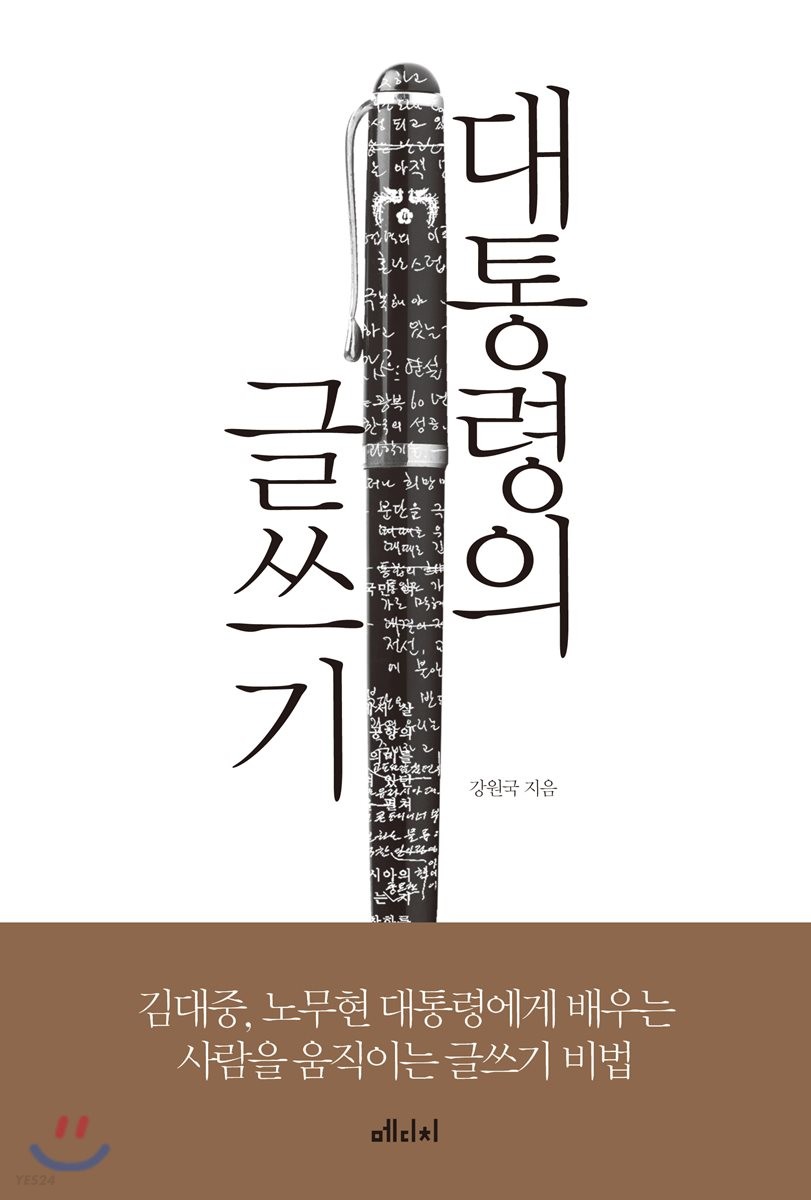
Author Kang Won-guk’s The President’s Writing shares the affection for words and the secrets of writing that moves people, drawn from his unique experience as speechwriter for two former presidents, Kim Dae-jung and Roh Moo-hyun. In a democratic nation, the president is the head of the executive branch who presents policy directions through speech and writing and makes the nation’s most critical decisions. In the diplomatic arena, a single word can either strengthen alliances or provoke tension, making the weight of those words truly immense. The importance of speeches becomes strikingly clear when one realizes that even after leaving office, a president is judged by their past words and writings.
While everyone naturally develops preferred expressions and structures when writing, it was remarkable how the author, as a speechwriter, rigorously set these aside to faithfully reproduce the styles of both presidents. It is said that President Roh Moo-hyun did not adopt former Minister Yoo Si-min’s draft because he needed a secretary who could best articulate his own thoughts, not merely someone who wrote well. I sensed the anguish of a secretary who, to express another’s thoughts, observed every move and gesture of his superior while setting aside his own ego.
The author explains that the two were ‘similar yet different, and different yet similar’. President Kim Dae-jung favored a style that logically structured his arguments with clear beginnings, developments, climaxes, and conclusions, kindly explaining everything from background to ripple effects. President Roh Moo-hyun, on the other hand, preferred compressing core messages into a single word or sentence within a multidimensional structure to deliver them with impact. Perhaps because I also tend to convey key points concisely in sales meetings, President Roh’s compressed speech style remains more memorable to me.
Of course, historical controversies and conflicting assessments coexist regarding the actions of both presidents. Decisions like dispatching troops to Iraq or signing the Korea-US FTA during their terms caused internal conflicts within their camps, and perspectives on the process leading to their tragic endings after leaving office remain divided. Some remember them as the embodiment of democracy, while others recall them as figures with ideological biases. The attitudes of those around them during the investigations and the phenomenon of posthumous deification—these complex facets of modern history offer profound lessons.
Coincidentally, both passed away in the same year, 2009. As citizens of later generations, we can peer into the weight of their struggles in the heavy seat of the presidency through the speeches they left behind. Given that the weight of words is proportional to a person’s influence, I ask myself: how much weight do my words truly carry? With the resolve to train my writing daily to increase that weight, I start today energetically with my dawn blog.
 택배기사핸디맨 블로그
댓글 남기기