
On the flight to Phnom Penh, disconnected from the world for a moment, I connect deeply through thought alone. Originally, we planned to send only the children on a short-term mission trip, but in the end, the whole family is leaving together. It’s already been 20 years since the brother who served as the general secretary during the English worship services at Muhan Church left to become a missionary in Cambodia. After years of fellowship, I finally set foot on that land. Just as my connection with a Palestinian missionary I met at San Jose Onnuri Church led to an unexpected journey, I was filled with excitement wondering what divine plan awaited this time.
Before Lunar New Year, when parcel volumes peaked for the year, my heart felt heavy asking colleagues to cover for me. Yet this trip became a precious opportunity to redefine life’s priorities amidst a busy routine and reflect on the past few years. Especially through meeting this missionary—one of countless missionary entrepreneurs serving globally with the BAM (Business as Mission) vision—I wanted to see how God is moving people in Cambodia and what opportunities exist to participate in that ‘Kingdom Business’. It was also a precious time for the whole family to come together as one—with my eldest son preparing for college entrance exams, my second son adjusting to high school, and my youngest enjoying beach sand play.
As soon as I landed at Phnom Penh International Airport and connected to the airport Wi-Fi, a welcome message arrived. Stepping out of the exit, I saw the missionary walking toward me wearing sunglasses. After exchanging warm greetings and getting into the car, my eldest son, seated beside the missionary, immediately launched into a barrage of questions. Answering his basic inquiries about Cambodia’s history, politics, and economy must have been quite a task for the missionary, who was juggling driving and explaining. Economically, the most intriguing point was the phenomenon of ‘dollarization’, where the dollar is used routinely alongside the national currency, the ‘riel’. Beyond simply weighing economic gains and losses, I realized that currency independence is a truly significant issue when viewed from the perspective of how much the people trust their government.
But my real interest wasn’t in restaurants or tourist spots. It was in the story of living alongside Cambodians for the past 20 years, and the process itself of recreating traditional dyeing techniques as a natural dyer to build a business. As the founder of ‘Goel Community,’ the story of discovering the product idea, organizing a team, and creating the goods was truly remarkable. It was even a source of pride that a Korean had achieved such success in this unfamiliar land. Of course, hearing that the burnout experienced during this process had reached the point where treatment in Korea was necessary was deeply painful. But what I discovered on this trip that was even more astonishing was that the missionary receives absolutely no sales revenue from Goel Community and is not involved in its management.
True to Handong University’s motto, ‘Learn to Give to Others,’ he simply gave away the knowledge of natural dyeing techniques for free, empowering locals to become self-reliant. It was ‘God’s business management’—a concept difficult to grasp through conventional business values. Witnessing this genuine BAM (Business as Mission) case, where the goal is building a ‘sustainable community’ over product profits, deeply moved and challenged me. While Goel Community was already known through media (KBS broadcast featuring Goel Community), hearing directly from the missionary the true reason for preserving traditional dyeing techniques and meeting the employees who make the products revealed the business’s real meaning. Aware of the uncomfortable truth that fast fashion, mass-produced using low labor costs in Southeast Asian countries, hides environmental pollution and offers little benefit to local economies, the missionary was using this business to help people within the Cambodian community and share Jesus’ love and the gospel within it.
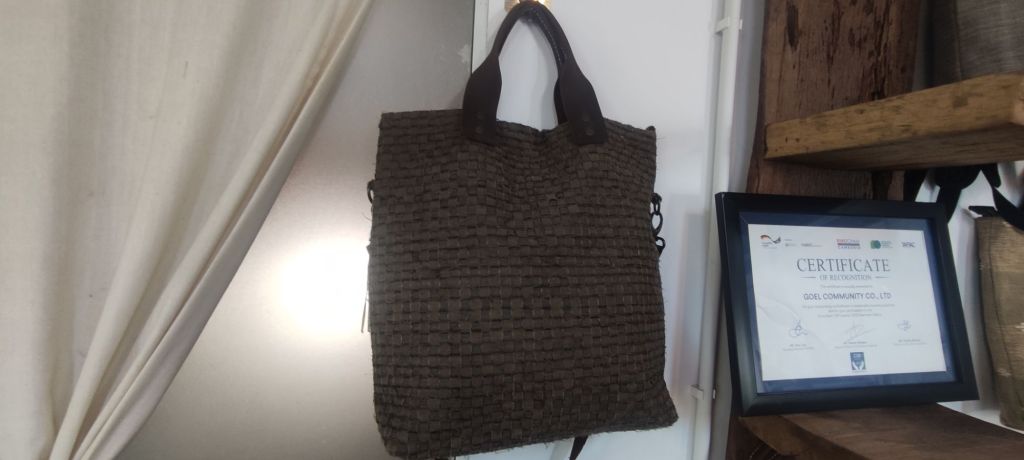
So, through this trip, I learned about BAM missionary work and was able to purchase products displayed at the Goel Community store. Particularly noteworthy was a bag made using Goel’s techniques with fabric that evoked a similar feel to the woven fabric they had previously supplied for Chanel. I was able to purchase this bag. Additionally, I was able to purchase a backpack on behalf of the CEO of Equalsum, a Korean HR tech startup, who had placed an order. I look forward to Goel Community’s 2024.
 택배기사핸디맨 블로그
댓글 남기기