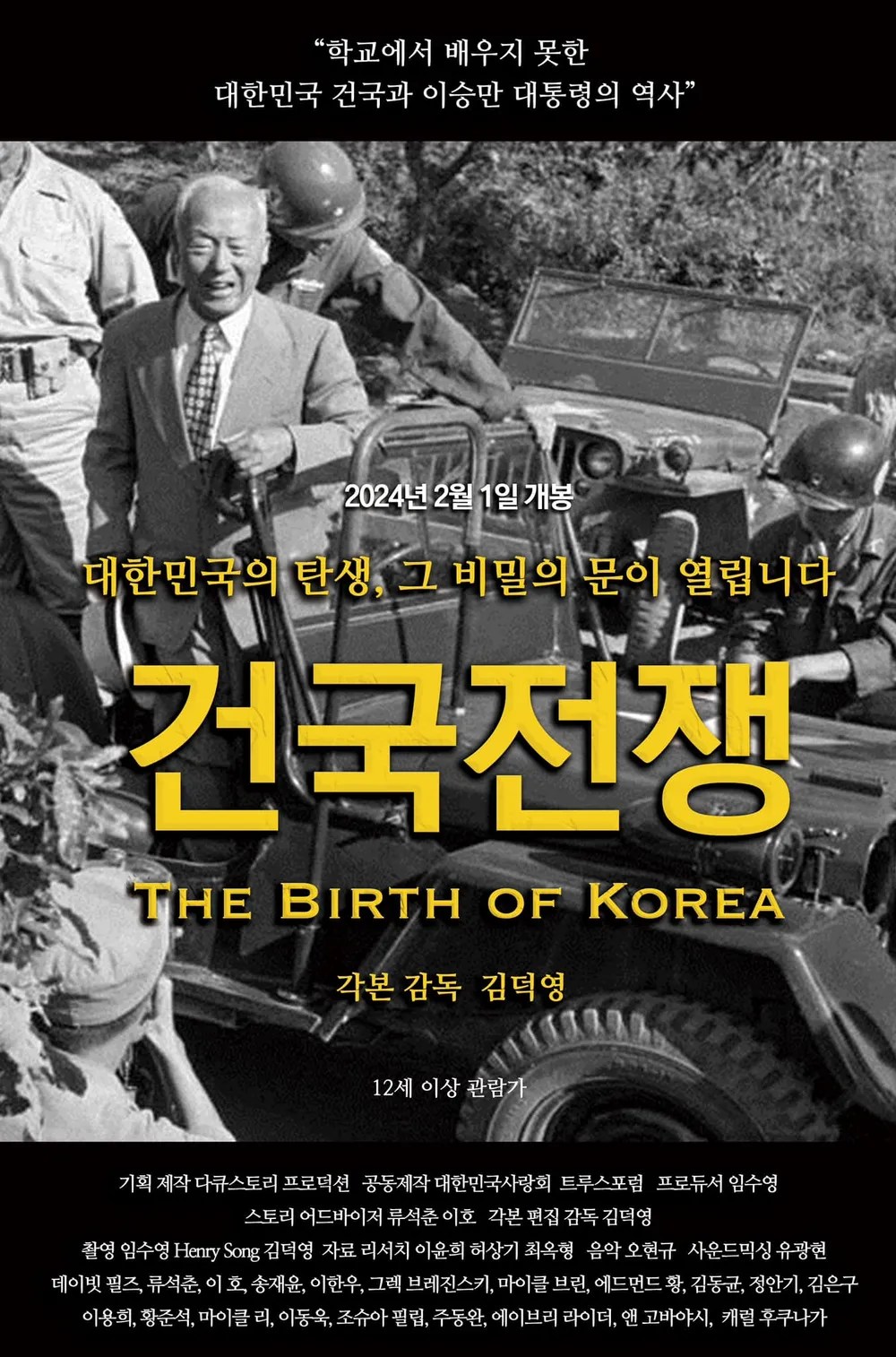
This was an excellent documentary for learning the correct perspective on the founding history of the Republic of Korea and President Syngman Rhee. Unlike commercially driven films that create fictional narratives based on facts through directorial interpretation, documentaries are records produced using historical archives and objective testimonies, making them far more trustworthy. Since it features actual individuals appearing and giving interviews rather than actors performing, there were no compelling storylines or dramatic twists. However, as I learned previously unknown facts about President Syngman Rhee and aspects of the founding history that someone might have intentionally tried to erase, I felt like I was confronting a colossal truth while watching the film.
Setting aside other perspectives on Korea’s modern and contemporary history, which includes the Japanese colonial period, I realized I had never properly learned Korea’s modern and contemporary history or world history through public education. I mainly only learned historical events and dates for the purpose of solving exam questions. I learned how South Korea’s political system began as a liberal democracy after Liberation on August 15th, and which figures designed the nation. This documentary prompted me to consider what might have become of South Korea if a different president, not Syngman Rhee, had taken power. During the imperialist era, when the Korean Empire was undergoing annexation by Japan due to the Katsura-Taft Agreement, President Syngman Rhee met with President Roosevelt to request American assistance. Later, during the mid-to-late Japanese occupation period, he authored Japan Inside Out in the United States, warning of Japan’s impending invasion of America. After liberation, he engaged in diplomatic efforts to secure international recognition for the Provisional Government of the Republic of Korea. Following the Korean War armistice, he released anti-communist prisoners of war despite U.S. opposition, diplomatically pressuring the U.S. and ultimately securing the U.S.-Korea Mutual Defense Treaty. These are just a few of his many achievements.
I also learned that the March 15 election fraud, which directly caused the April 19 Revolution, was manipulated to ensure the Liberal Party’s Lee Ki-boong won the vice-presidential election. This occurred after Democratic Party presidential candidate Cho Byeong-ok died of a heart attack during the campaign, leaving Liberal Party candidate Syngman Rhee as the sole candidate and effectively elected. This manipulation was not directly linked to President Syngman Rhee. Given that his victory was virtually assured, he had no reason to order election fraud. Furthermore, based on post-protest government records of President Syngman Rhee’s statements and video footage showing him shedding tears while viewing students injured during the protests in the hospital, I believe he genuinely knew nothing about the election fraud. Meanwhile, the electoral system at that time, allowing the president and vice president to be elected from different parties, was a contradictory system akin to President Trump and Vice President Biden working together in the White House. It also became clear that the April 19 Revolution erupted amid a chaotic political situation where numerous opposition forces were active in South Korea, following the collapse of the economy due to reduced US aid. Indeed, the interview with Professor David Fields, Associate Director of the East Asian Center at the University of Wisconsin, resonated deeply. He assessed that the protests by the people, enraged by the unjust election rigging, were the result of a growing democratic consciousness fostered by President Syngman Rhee’s implementation of compulsory elementary education and women’s suffrage.
However, I wondered if the tragic history of the Korean War—where Chairman Kim Il-sung met with Kim Gu at the North-South Joint Conference, and upon returning, Kim Gu advocated for the withdrawal of both US and Soviet forces, leading to the eventual US withdrawal and the subsequent North Korean invasion—could truly have been prevented.
I do not believe Mr. Kim Gu deliberately ignored the situation after seeing that North Korea was preparing for war with Soviet support, but it was likely because he was that ignorant or insensitive to the international diplomatic situation. While political leaders cannot be judged solely by diplomatic skill, the fact that President Syngman Rhee was the only South Korean president in history who could deliver a speech in English before the U.S. Congress without an interpreter made me reflect on his diplomatic prowess again in 2024. And seeing President Syngman Rhee’s image during a motorcade in Manhattan, New York, filled me with emotion and pride as a South Korean citizen.
The story of the War of Founding, about an elderly man who loved the Republic of Korea and its people so deeply, made me feel ashamed of myself while simultaneously grateful and proud to be a citizen of Korea. I also learned that he was educated by American missionaries at Baejae Academy, became a Christian while reading the Bible during his five years in prison, vowed to become a missionary after going to the United States, and earned his doctorate in just five years at Harvard and Princeton Universities. After the documentary ended, my eldest son asked me, ‘Was President Syngman Rhee a Christian?’ That question made me feel I had done well to watch this film with my children, and it gave me confidence about which direction to set for his college path.
 택배기사핸디맨 블로그
댓글 남기기