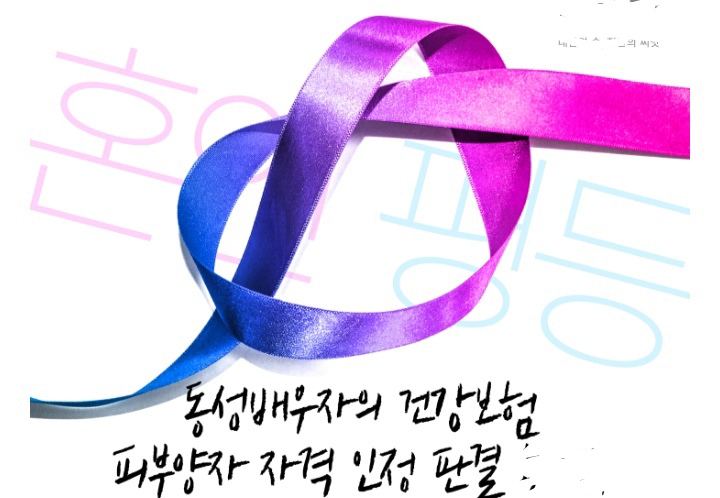
The Supreme Court’s recent decision to allow same-sex common-law partners to qualify as dependents for health insurance premiums has had a profound impact on the Christian community because the Constitution defines marriage as between a man and a woman, and the ruling by Chief Justice Cho Hee-dae and the majority of the Supreme Court effectively legalized same-sex marriage. The ruling that only one member of a same-sex couple in a common-law relationship pays health insurance premiums and the other is recognized as a dependent is in conflict with Article 36 of the Constitution, but it is also unfair because it means that the loss of health insurance premiums will be covered by the households of ordinary couples.
While civil rights groups and some liberal media outlets in support of same-sex marriage were celebrating with headlines that read “Love Won,” churches and conservative organizations that uphold Christian values saw it as a serious blow to their values and morals. I, too, was puzzled by the standard by which the court recognized same-sex couples claiming to be in common-law marriages, and my heart was heavy with the knowledge that going forward, when many same-sex couples use this ruling to assert their right to avoid paying health insurance premiums, the vast majority of ordinary families will have to pick up the slack and follow the law.
In addition, a press conference was held by Christian organizations to discuss the Supreme Court’s past ruling that banning religious gatherings during the coronavirus outbreak was legal, which violated Article 20, Freedom of Religion, and Article 103, Freedom of Conscience of Judges. Through the course of the lawsuit, it was revealed that the government’s ban on gatherings was based on media announcements as if the coronavirus was spreading from church gatherings, and on statistics that were largely distorted and manipulated without any accurate basis. However, the Supreme Court stood by its position that public interest took precedence over religious freedom.
According to the research and statistics recorded in the Coronavirus and Church Shutdown book, out of 22,391 confirmed cases (as of September 15, 2020), the number of confirmed cases of church-related outbreaks was 2,635 out of a total of 2,512, or 11.22%, excluding heretical churches. However, if the infected people visited several places before being confirmed and then gathered in one place for a church meeting while infected and were tested, the proportion of infected people would naturally be higher, so if we discount it by half, it is about 5. And if you exclude the rallies for political struggles and the struggle against the demolition of church buildings, the number of infected people due to religious gatherings is 1,261, so the actual share is 2.82%. And when we look back at the different results every time we tested for corona, the people who were hiding without being tested, and the inaccurate movement tracking based on mobile phone location, we realize that it was a completely unscientific and loophole-filled quarantine policy.
After all, the previous government had shut down all the churches in the country based on inaccurate statistics and a low infection rate, and even a lawsuit to cancel that was based on reasonable evidence was ruled legal by Supreme Court justices appointed by the chief justice who had been appointed by the previous government. And when I heard that the justices who had retired shortly after making this ruling, Kim Seo-sun and Noh Jung-hee, were the same ones who had ruled that same-sex partners should be recognized as spouses as health insurance dependents, the puzzle seemed to come together.
I remember in the early days of the coronavirus epidemic, Korea praised its quarantine policy as K-quarantine, saying that masks were unavailable in the U.S. and that the initial response was too poor. Then, when I heard that the Korea Centers for Disease Control and Prevention was upgraded to the Korea Health and Welfare Agency and the K-quarantine budget was expanded to 1.8 trillion won, I wondered where all that money was going. I also wondered what happened to the QR code check-in information that was recorded at that time, and I wondered how much public interest was promoted by controlling religious freedom for quarantine.
Recently, as Donald Trump became the leading candidate for the U.S. presidential election again, I was searching for news and came across a video of an executive order issued by President Trump in the past. When I saw that President Trump even held a press conference saying that “places of worship are essential and should be opened immediately”, I understood why Christians in the US support the Republican Party. I got up at the crack of dawn to write this blog because I believe that while each country may have a different history, environment, and people, Christian values are the same everywhere in the world, and I want to make sure that faith is the most important thing in Korea.
 택배기사핸디맨 블로그
댓글 남기기