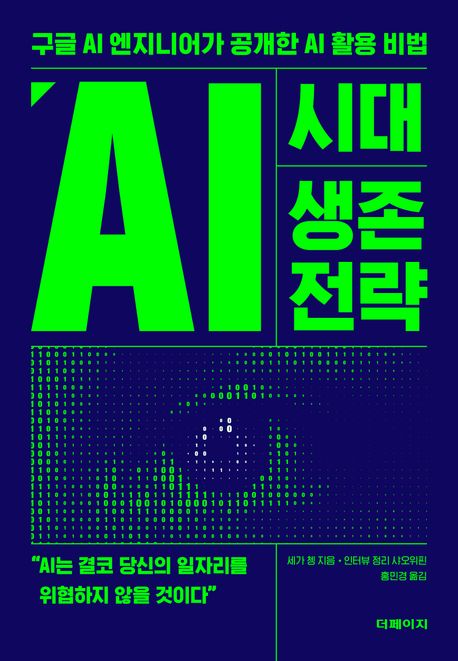
I deeply resonated with the words of Sega Cheng, author of ‘Survival Strategies for the AI Era’ and former Google engineer, who stated that writing is the most essential skill in the AI era. While it seems obvious that there’s a difference between the speed of thought when writing by hand and the speed of thought when typing, actually writing reveals that the depth of thought itself changes. Moreover, whenever I write blog posts, I feel that writing on paper expands the breadth of my thinking infinitely and fosters creativity. This is because when typing, I subconsciously know I can delete characters anytime, so I jot down thoughts quickly. But when writing by hand, I think slowly as I write.
Especially since Sega Cheng is Taiwanese, he understood Asian educational culture well and recognized the problems with rote memorization education, which isn’t vastly different from Korea’s. His objective explanations about American educational culture, built on diverse races and cultures, were highly persuasive. The American education discussed here refers to university education, which is also why countless talents worldwide flock to the US. Perhaps the author himself is a software engineer and entrepreneur who succeeded through that very American education. Reading his book felt like having a conversation with him, likely because he wrote every word himself without AI assistance. It didn’t feel overly logical or formulaic; instead, it seemed like he was sharing stories with readers, weaving through his thoughts and experiences.
On the other hand, books like ‘Physics in Every Moment’ prove their theories or enhance credibility by citing claims from scientists or professors at a higher level than themselves, especially in fields like space science or earth science. They establish a hypothesis, set specific constant values, prove that hypothesis using complex mathematical formulas, and then present it as a law, effectively compelling the general public to accept that law as fact. For instance, seeing how they naturally lay the foundation of evolutionary theory to explain the extinction of life on Earth, or subtly introduce the concept of an infinite universe to describe lightless black holes, made me wonder if the extinction of life and the existence of black holes are truly facts. Instead, seeing polar bear populations—known to be at risk of extinction—actually increasing, and even the creation of the concept of white holes as a relative counterpart to black holes, made me feel something was off.
Ultimately, tracing back, concepts like evolution or black holes are merely built upon theories believed to be absolute truths in science—like dinosaur fossils whose authenticity is unclear—or theories like the theory of relativity. Furthermore, attempting to prove Earth’s phenomena solely through mathematical formulas without directly exploring the planet is like telling one lie to cover another. It’s akin to calculating Earth’s curvature mathematically while claiming flight management systems with onboard computer programs automatically handle calculations during aircraft operations, so there’s no need to worry. Any hint of dissent or doubt is silenced by invoking the authority of Einstein and Dr. Stephen Hawking.
Now, we’ve entered an era where AI models aggregate the opinions of such authoritative scientists and professors to indoctrinate the general public. People no longer question or seek answers themselves; they ask convenient AI models and believe their answers are definitive truths. However, what I realized through Sega Cheng’s book is that AI models also suffer from hallucination issues. On the internet, overflowing with false information, fakes can be disguised as truth and spread to the masses. Therefore, to find correct thinking and truth in the AI era, I resolved to leave my thoughts in my diary today, read books, and keep records. I woke up at 5 a.m. and started my day energetically.
 택배기사핸디맨 블로그
댓글 남기기