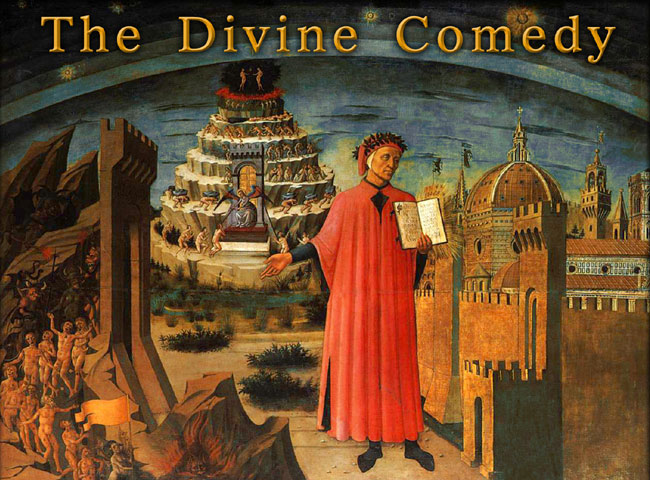
I knew the English title of the Western classic ‘Dante’s Divine Comedy’ was ‘Divine Comedy,’ and upon looking it up, I discovered it uses the Japanese translation title directly. I wondered if a Korean translation might have rendered it as something like ‘The Sacred Comedy’. That work was an epic poem written by the Italian poet Dante Alighieri of Florence as he successively visited Hell, Purgatory, and Heaven. It satirized the society and culture of his time, drawing on various stories from the Bible and the author’s imagination. It was structured as the protagonist Dante recording what he saw and felt while visiting Hell, guided by his mentor Virgil. It felt like watching the movie ‘Along with the Gods’. Perhaps the original manga ‘Along with the Gods’ drew inspiration from the Inferno section of Dante’s Divine Comedy.
The structure of hell, descending through nine funnel-shaped underground levels according to the weight of sins, was based on ancient worldviews. The detailed depictions of horrific and gruesome scenes where sinners endured punishment for various crimes committed in the world seemed like they could fill an entire movie if produced as an AI video. The punishments endured by sinners guilty of lust, greed, avarice, anger, heresy, violence, fraud, forgery, and deceit were utterly horrific. Knowing such dreadful punishments awaited before committing sin would surely deter anyone from sinning. Finally, the description of Lucifer, half-buried in the ice floor of the ninth underground level, was also terrifying. The detailed depiction of one of the three betrayers held in his enormous mouth being Judas Iscariot, who betrayed Jesus, was also very explicit.
Reading the book, I realized that the message the author sought to convey through the horrific scenes of hell and conversations with sinners was not spiritual content but mere entertainment. This is because the author engaged in dialogue with the sinners from the perspective of a spectator who could tour hell and return, rather than fostering self-reflection or a sense of caution regarding sin. The atmosphere was so different from a pastor’s account of a hell experience that I couldn’t shake the feeling it was a comedy, as suggested by its original English title. Perhaps the author had only imagined the real hell, heaven, and the non-existent purgatory. If he had truly grasped the horrors of hell, he couldn’t have described it so matter-of-factly. Seeing how deeply Japanese literary scholars studied Dante’s Divine Comedy, I wondered if it might stem from Japan’s indigenous beliefs. It struck me as a cleverly crafted fictional epic designed to reinforce the Catholic worldview of purgatory. So, today too, I rose at dawn, resolved to discern truth from falsehood through the Bible, and began my day energetically by writing this blog post.
 택배기사핸디맨 블로그
댓글 남기기