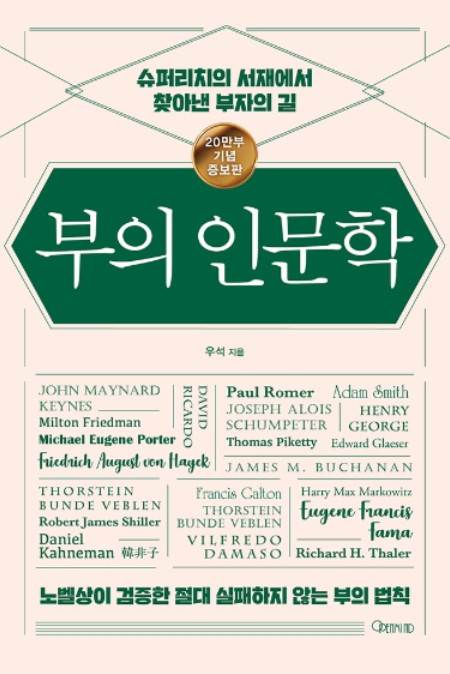
Retiring young has become a dream for many people. Enjoying financial freedom and living a relaxed, abundant life has become a symbol of success, and the term ‘FIRE tribe’ has even emerged, suggesting anyone can live that way. The Humanities of Wealth is also one such book. The author emphasizes that reading is the fastest path to becoming wealthy, having realized his own investment philosophy through the countless giants featured in the book. He also states that success requires developing multiple distinct thought structures and accurately understanding one’s investment tendencies.
Like the author who follows the philosophy of genius economists Keynes and Warren Buffett—that concentrating on a few stocks for long-term investment is more advantageous than diversification—I too have focused my investments on a select few stocks for several years now. This approach has yielded good returns recently, coinciding with the KOSPI’s rise. The author explains that he combines short-term trading with long-term investing, leveraging his extensive reading of economic and investment literature and adding experiential knowledge. While it may seem simple on the surface, this approach was impossible without a vast amount of reading and consistent real-world investment practice. It sounded similar to me saying that I could succeed by waking up at 5 a.m. every day during my time as a delivery driver, making dawn deliveries across all of Incheon while listening to audiobooks for 10 hours a day.
Particularly, the author seemed to analyze and invest in global issues, big and small, based on his extensive historical knowledge. Throughout the book, I was struck by his remarkable diligence and effort. He explained seemingly obvious answers—why real estate skyrockets under left-wing governments, how innovative companies ride globalization waves to grow, and which cities attract talent—with remarkably realistic and clear logic. Applying his reasoning to places like San Francisco or Austin, Texas, where global talent converges, made it crystal clear why innovative companies cluster in such cities. Moreover, his argument that one should invest in such ‘superstar cities’ was closely tied to his investment philosophy.
Meanwhile, the author’s values could be glimpsed through the names of successful investors he mentioned, like George Soros and Charlie Munger. However, as I encountered the records of these individuals who amassed immense wealth through economic crises, what struck me was that they did not fear or believe in God. A life of acquiring worldly wealth, retiring early, and living leisurely is enviable to anyone. But ultimately, someone must sustain the economy through labor, and someone must play the role of rescuing those who couldn’t climb the ladder of wealth.
Seeing his investment philosophy—praising investors who win auctions for prime brothel real estate or inflate stock prices with fake tech rumors before cashing out as “true masters”—left me with mixed feelings. Ultimately, it was a book that made me ask, “Who the hell is actually raising the cows?”
 택배기사핸디맨 블로그
댓글 남기기