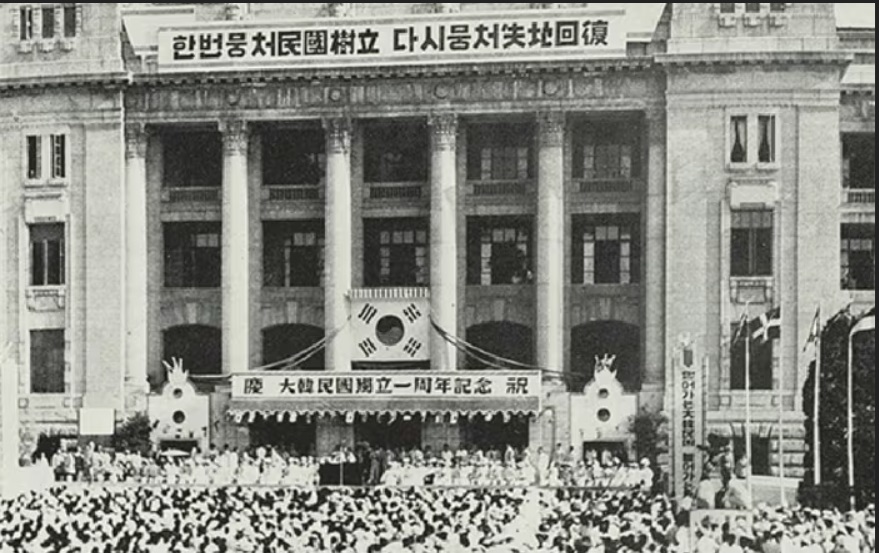
I realized that the reason why the opposition backlash against Ahn Chang-ho, the newly appointed head of the National Independence Hall, was so intense was not simply because of his perception of history, which was that August 15, 1948, should be seen as the real Liberation Day. I also realized that the Moon Jae-in administration’s deletion of the word freedom from the constitution and the eventual designation of 2019 as the centennial because of its view of 1919 as the founding year was also intentional. In the end, it was all about differences in how we perceive Syngman Rhee in Korean history.
On one side, Syngman Rhee is revered as the founding father who defended South Korea from communism and established the country on August 15, 1948, based on the three pillars of a nation: sovereignty, territory, and people; on the other side, he is perceived as a failed president who failed to cleanse the country of pro-Japanese factions, ruled dictatorially, and then fled to Hawaii. However, the fact that he overcame slavery and class differences during the Joseon and Japanese periods with land reforms after liberation, enlightened the people through general education, and introduced nuclear energy, which allowed Korea to move into the industrialization era, is the biggest reason why Korea is the country it is today. In addition, the U.S.-Korea Mutual Defense Treaty, which prevented Korea from going to war, is the biggest foundation for the national security that we take for granted. If you watch the relatively objective documentary, The Founding War, you can see that it was President Syngman Rhee who laid all these foundations.
On the other hand, there are things that are incomprehensible when we look at the past actions of Dr. Kim Koo, who strived for national independence and tried to establish a single government by bringing North and South Korea together after liberation. I don’t know if it was out of naivety or betrayal of his people that he went to the North-South Conference at the invitation of Kim Il Sung but ended up being taken advantage of, and when he saw North Korea preparing for war and came back and said that there would be no war, I don’t know if it was out of naivety or betrayal of his people. And his refusal to participate in the establishment of the government of the Republic of Korea also makes me question his political stance. It’s also worth considering that he was a well-known terrorist who committed dozens of murders and political assassinations on both the Japanese and the political side.
Although it is explained in detail by experts and video footage in the Founding War documentary, the 4.19 fraudulent election was not directly related to Syngman Rhee, who had already been elected president, but was perpetrated by his entourage while he was blindfolded during the vice-presidential election process. This was evident in his tearful appearance as he met and comforted injured students in the hospital during the protests, and I wondered why it had not been reported in the media until now. Even in his exile in Hawaii, he lived a life unlike any other dictator, earning the respect of the locals, and when he died without ever returning to his homeland, I wondered how he could have been treated so poorly when he was so instrumental in building the Republic of Korea.
Just as Jesus Christ, who was utterly sinless, endured such persecution, I realized it was due to his spirit of sacrifice—humbling himself to the very end and refusing to claim any credit for his deeds. This made me feel infinitely sorry and grateful. Perhaps, after being sentenced to death in Hanseong Prison and miraculously saved by American missionaries, he resolved to dedicate his life to Korea while traveling to the United States. President Syngman Rhee unexpectedly became the central figure of this Liberation Day, prompting me to reflect once more on the meaning of liberal democracy.
 택배기사핸디맨 블로그
댓글 남기기