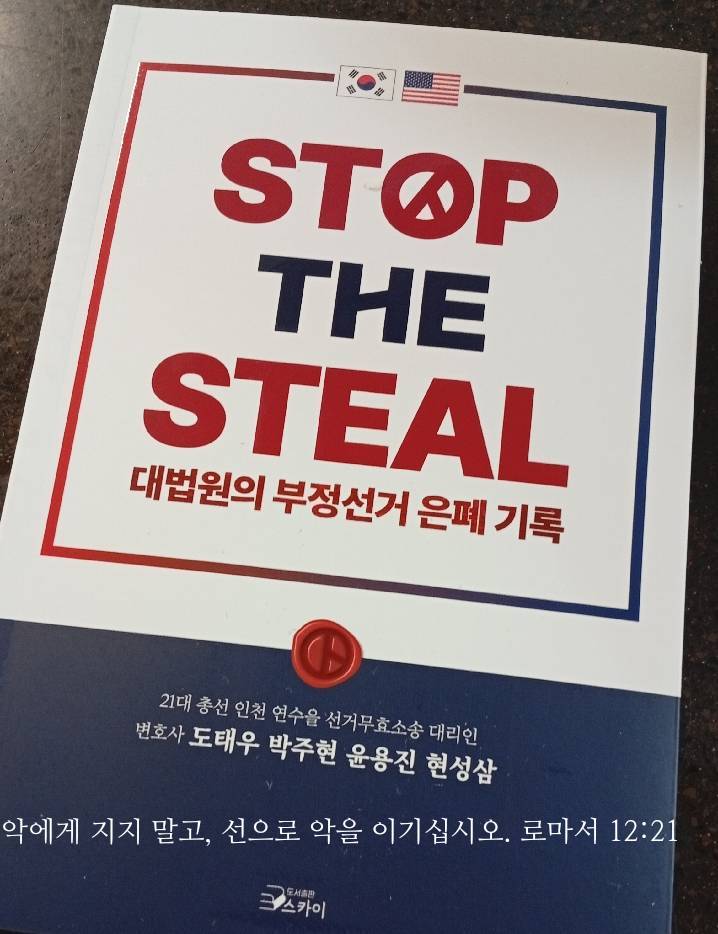
The slogan “Stop the Steal” was the central theme of a campaign launched by U.S. President Trump during the 2020 presidential election, in which he raised allegations of electoral fraud. I never imagined that I would encounter this powerful message—calling for an end to actions that undermine the integrity of elections—once again in the current political climate of South Korea. Just as the entire nation felt bewildered when martial law was declared, countless observers both at home and abroad who encountered this slogan must have watched with deep curiosity to understand why this message erupted at rallies opposing the impeachment of South Korea’s president. As I meticulously reviewed records documenting election management practices both within and outside the judiciary, along with the reasonable suspicions surrounding them, the doubts I had previously harbored through fragmented news reports and media coverage gradually transformed into a firm conviction regarding the concrete nature of the issue. Coincidentally, the fact that the very district where I am based—Songdo (Yeonsu-eul) in Incheon—was at the center of heated controversy during past lawsuits challenging election validity and recount processes weighs even heavier on my heart. This went beyond a mere local aberration; it served as a grave warning regarding a crisis of fairness throughout the national system and the massive structural vested interests lurking behind it.
As time passed and through a series of constitutional crises, the true nature of the forces threatening our system—which had been secretly infiltrating every corner of our society—was exposed, providing an opportunity for countless citizens to become aware of the essence of our times. It appears as though the massive civilizational war between the liberal democratic camp and the humanist-totalitarian camp—which has persisted since the founding of the Republic of Korea in 1948—is finally racing toward its endgame. This is because the current situation is not merely a temporary power struggle between the ruling and opposition parties within the country, but rather a proxy war in which the dynamics of the global competition for hegemony, flowing beneath the surface, are being projected onto the stage of South Korea. By linking the trend—in which leadership grounded in biblical values and conservative principles secured re-election in the recent U.S. presidential election and has begun to reshape the international order—with the grave declarations regarding the current domestic situation, we can gain a deeper understanding of this context. The issue of systemic erosion of fairness is one that could not be achieved without massive international solidarity and meticulously planned public opinion manipulation; we must recognize that the movement to defend the system against this threat was likewise decided upon with a solitary and rigorous macro-level perspective.
However, as the true nature of this massive force comes to light, some mainstream media outlets—bound by big capital and ideological frameworks—are hesitant to report the truth fully, while politicians quick to make strategic calculations are eager to obscure the essence of the matter. While one-sided legislative attempts continue to exploit the chaos caused by the ongoing indictments of key public officials, there are even signs within certain quarters of the political sphere of efforts to secure a permanent system of vested interests through a restructuring of the power structure. This follows the same pattern as the scenarios of election interference and political destabilization by external forces that have recently shaken Western societies, demonstrating that South Korea is by no means immune to such threats.
Through the teachings of countless independent journalists and intellectuals who risk their lives to expose the darkness of our times, I have witnessed the true nature of anti-establishment ideologies that have penetrated not only politics and society but also deep into the religious community. The question of why there are still those who seek to drag this land down that path—despite the ideology having already been proven a failure historically—ultimately points to the human heart. I have come to realize that a sense of being a “chosen people”—where one considers oneself righteous while labeling others as unjust—an attitude that justifies the lesser evil through hatred of opponents within partisan logic, and the cowardice of turning a blind eye to the truth in the face of group pressure ultimately become ideological traps that oppose the Creator.
While we have lived far too complacently within the confines of material abundance and peace over the past several decades, moral values throughout society—including those of faith—have deteriorated, and the very foundation of the rule of law has silently crumbled. To pastors who encourage compromises on the truth under the pretext of avoiding controversy within the church, to those who stubbornly deny crises in national security, or to those who dismiss calls to defend the system as merely a sensational means of profit, this warning may seem like a mere waste of time. Despite repeated investigative reports—broadcast by leading investigative journalism programs and media outlets—regarding allegations of violations of the law of large numbers, declarations of conscience by insiders, and specific mechanisms of manipulation, there are still those who choose to turn a blind eye.
However, a sense of crisis is setting in that the so-called “criminalization of thought and prayer”—a trend recently warned against by conservative leaders in the West, in which even inner faith and the act of prayer are controlled by ideological guidelines—may soon reemerge on South Korean soil. Therefore, someone must become a watchman blowing a trumpet atop the crumbling walls to protect South Korea from the evil spiritual enemies seeking to destroy this great community. Carrying that mission in my heart, I rise at dawn once again today to pray for my country, leave a record of the truth on my blog, and begin a day full of hope with vigor.


Leave a Reply