I learned in school that Copernicus’s heliocentric theory overturned the existing geocentric model—it posits that the Earth orbits the Sun while simultaneously rotating on its own axis, rather than the Sun revolving around the Earth. Thanks to advances in science and technology—including the development of astronomical telescopes, spaceflight, the moon landing, and, more recently, the exploration of Mars—many people now firmly believe this theory, and private companies like SpaceX are even competing with NASA. Born on a planet called Earth, which exists among the galaxies in the infinite universe, I often wondered just how great God must be—the One who created this infinite universe, whose vastness is almost impossible to imagine.
However, the order of creation described in the Book of Genesis—beginning with the creation of light, followed by the seas and the land, the plants on the land, the sun and moon in the firmament, and finally the animals and humans—often did not align with what I had learned in school, or seemed inconsistent in many ways. Therefore, the explanation offered by theistic evolution—that God’s creation of the world is a beautiful spiritual story, while science, as explained by the theory of evolution, must be understood separately from a rational perspective—seemed the most logical. Since the Bible makes no mention of the universe and does not clearly explain the sun and moon—which are said to govern day and night—I found it difficult to understand the burning sun 150 million kilometers away, the moon whose far side I have never seen, and the stars, as I had learned in earth science class. I believed there must be symbols and hidden meanings beyond human comprehension; as I watched the sun rise every day, I would sometimes fall into the illusion that it was rising right before my eyes, and as I watched the sun set below the horizon, I would feel a sense of longing for the sunlight of the past that would never return.
Meanwhile, while making early-morning deliveries, I was often surprised by how enormous the sun appeared as it rose above the horizon, marveled at the sun emerging from between the clouds, and frequently experienced the sensation of being literally sucked into the gigantic sun as I drove westward. Furthermore, living on Earth—a planet smaller than a speck of dust within the infinite universe—I was acutely aware that, among billions of people, I was always an incredibly small and insignificant being. The thought that humans are smaller than dust in the universe led me to perceive myself as an infinitely worthless being, and I experienced how this sense of futility weighed heavily on me during difficult times of depression.
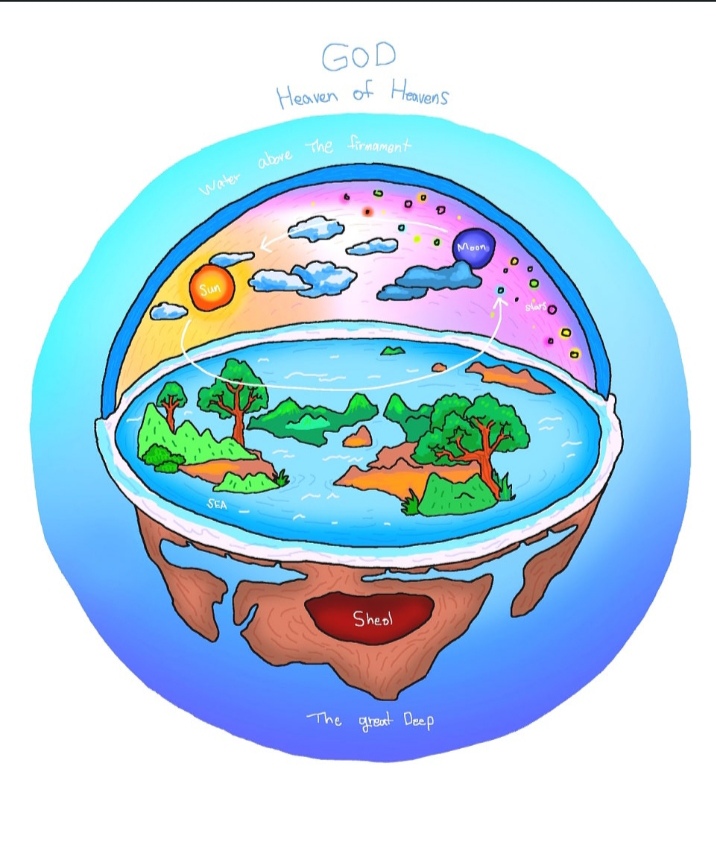
However, after watching—rather than simply skipping past—a bizarre YouTube video claiming that “the universe doesn’t exist,” I felt as if a jigsaw puzzle with over a thousand pieces had suddenly fallen into place. The explanation that the Earth is covered by a spherical dome, with continents spread out flat around the North Pole and the entire circumference encircled by Antarctic ice sheets, struck me as both amusing and absurd at first. However, upon hearing the claim that no one in history has ever crossed the Antarctic and the explanation that, under the Antarctic Treaty, no one is permitted to visit beyond the Antarctic ice sheets, I found it a bit strange. I immediately used an AI search to find some evidence supporting the fact that the Earth is round and cautiously left a comment on that YouTube video. However, as I looked at phenomena and data that were difficult to explain using common sense if the Earth were round, I gradually became more confused. And as I viewed these unbelievable videos and photos, I began to explore the subject further. Interestingly, I learned that the man who laid the foundation for modern cosmology was Georges Lemaître, a priest of the Catholic Society of Jesus. He was the scholar who first proposed the Big Bang theory and had a profound influence on 20th-century science. I also discovered that the Society of Jesus, a Catholic religious order founded in the 16th century, has expanded its influence worldwide through education and missionary work. Ultimately, the explanation was that Lemaître’s Big Bang theory became the cornerstone of cosmology, leading to space exploration by organizations such as NASA.
As an example of the Earth’s surface being flat, there was a video showing that when you zoom in with a modern telescope or camera on a ship’s sail disappearing beyond the horizon, the ship—which was previously invisible—becomes visible. I found myself rethinking everything I had learned so far: the idea that if you fly in one direction, you eventually return to your starting point; the rotation of the constellations; gravity pulling objects toward the center of the Earth; and the spherical images of Earth taken from space. In fact, looking at flight paths in the Southern Hemisphere, it seemed odd that flying across the South Pole—much like crossing the North Pole—would require traveling a long way around a distant continent when a shorter route was available. Furthermore, it seemed more natural to understand the concept of gravity not as a force pulling objects toward the center of a spherical body, but rather as a process where objects of high density and low density swap positions with one another. Additionally, when watching a video that refuted the explanation that constellations rotate around the North Star because the stars are fixed and the Earth rotates, there was footage of stars passing by sideways—filmed by an actual pilot while flying above the clouds. Finally, as I looked again at the images of the round Earth supposedly taken in color from outer space, I couldn’t help but wonder how on earth they were able to capture it from that exact position at such a perfect angle.
However, the explanation that in the world created by God there is water above the firmament and the sea—water below the firmament—and that in the heavens, the plasma Sun and Moon, which govern day and night, rotate and emit light above the Earth’s flat surface, which possesses a magnetic field, was very novel. It was argued that the moon wanes every full moon due to the sun’s speed—which is faster than the moon’s—and that the four seasons can be explained by the varying distances between the sun and the Earth’s surface as the sun rotates in a spiral pattern centered on the North Pole, illuminating only part of the Earth’s surface. This was explained through a video demonstrating that the phenomenon could be replicated using experiments with magnetic metals and superconductors, as well as a simulation showing that a high-speed Sun catching up to the Moon could account for solar and lunar eclipses. Additionally, there was an interpretation suggesting that stars of various patterns emit light from within the water above the firmament through the phenomenon of acoustic luminescence, in which light is generated by high-frequency sound waves in water. In short, it struck me that this view aligns exactly with the biblical account (Genesis 1:16), which describes the world God created as consisting of the firmament between the waters, the flat earth within that firmament, and the two luminaries and stars that govern day and night.
In fact, the moon landing footage—which seemed impossible given U.S. aerospace technology in the 1960s—and the archival footage of the president speaking on a landline phone still look somewhat awkward even today. For example, there were pointed out inconsistencies such as the American flag fluttering on the moon’s surface, inconsistent shadows, the lunar module ascending into the sky without propulsion, and footage of astronauts hopping lightly that, when played in fast forward, appeared as if they were walking normally. Furthermore, a search on the independent media outlet Rumble easily turned up videos related to the moon landing that were allegedly filmed in the Nevada desert. Most significantly, an interview video of Buzz Aldrin—in which he seemed to imply, in response to a young girl’s question about why humanity hasn’t landed on the moon since then, that he had never actually been there—left a strong impression on me. However, the context surrounding that statement appeared to require further verification. Furthermore, through videos purporting to expose the truth, I came across footage showing wires visible in several places during space station filming, scenes of repairs being postponed inside NASA’s large water tank, and explanations that various phenomena appearing to be weightless could be replicated inside a zero-G aircraft. I also heard testimony from some airline pilots stating that they do not separately calculate the Earth’s curvature during flight or landing.
Although I don’t know the reasons or motives behind these claims, I thought it was either a deception carried out systematically over a very long period of time or that I was completely mistaken. Meanwhile, as I went through the materials based on these suspicions and watched videos from the independent media outlet Rumble one by one, the movie The Truman Show came to mind. And as I watched the protagonist eventually reach the edge of the world and escape the set, I decided that I, too, must verify things for myself and live a free life. So, today, I woke up at 4:30 a.m. to write this blog post and started my day with vigor.
“God made two great lights—the greater light to rule the day and the lesser light to rule the night. He also made the stars.” (Genesis 1:16)


Leave a Reply