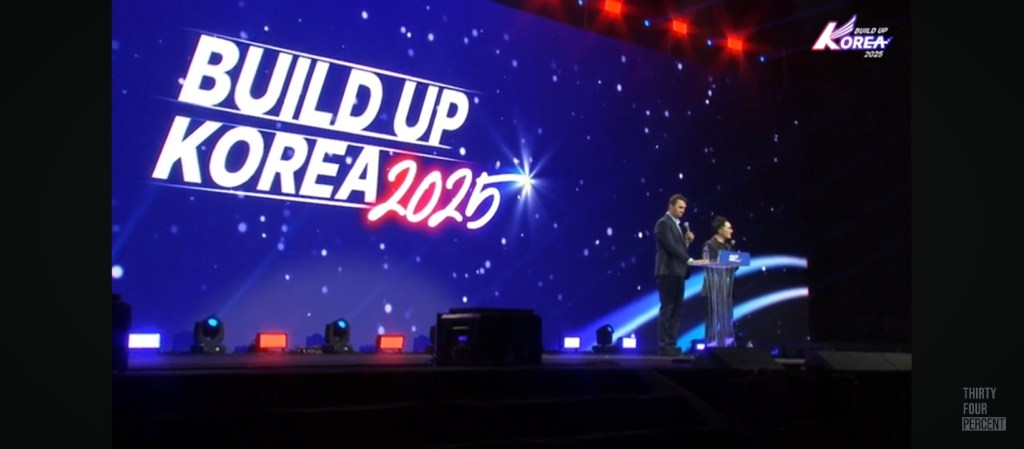
I attended the “Build Up Korea 2025” conference, now in its third year. This event, dedicated to passing on the core values of liberal democracy and the market economy to future generations, was packed with Christians from across the country and many patriotic citizens who love their nation. Notably, at the previous conference, Donald Trump Jr.—the eldest son of a prominent U.S. political leader and head of the Trump Organization—attended in person, drawing international attention. What was truly remarkable was that the person who spearheaded the planning and operation of this massive international event—which brought together thousands of people—and secured speakers with global influence was Kim Min-ah, the CEO of a media startup. Arriving at KINTEX in Ilsan with a sense of wonder that a young leader of a small independent media outlet had achieved a level of global solidarity that even large established institutions or entrenched corporations would find difficult to pull off, I found countless citizens already lined up in long queues to receive their admission passes.
Although the official schedule began at 10:00 a.m., I was deeply moved to see the vast majority of participants arrive an hour and a half before the event started and wait in an orderly fashion. I could see the fiery passion in the eyes of the fresh-faced teenagers, the seasoned elders, and the parents who had come holding their young children’s hands—even though it was a weekday—as they filled the auditorium. They were all true worshippers who cherished the value of freedom, and I was able to once again experience the deep spiritual bond and sense of belonging I had felt at the Handong University parents’ retreat last month. The messages delivered by domestic and international pastors and conservative influencers who took the stage varied according to their respective areas of expertise, but their essence converged into a single, powerful current. Representative Kim Min-ah introduced the spiritual rallying cries of American Christians, followed by the vivid testimony of Pastor Rob McCoy, who fought fiercely to defend the constitutional right to worship during the pandemic. Hearing his confession that he had come to support sister churches at home and abroad that had strived to preserve the essence of their faith despite institutional pressure, I deeply realized just how severe the challenges are facing the freedom of religion and conscience that we enjoy today.
Global figures attending the conference shared a strong message of national security and conservatism grounded in Christian values. The issues of security vulnerabilities in election computer networks—which have surfaced during every major global presidential election in recent years—the constitutional truths surrounding the storming of the U.S. Capitol, and the controversies over the integrity of South Korea’s elections and the pros and cons of radical immigration policies were by no means isolated incidents; rather, they were organically interconnected amid a massive tectonic shift in global governance. Listening to the speakers’ presentations, I realized that the international community perceives South Korea’s systemic crisis index as far more grave and serious than what our citizens personally experience. I was particularly moved by Kang Min Lee’s speech, in which he diagnosed the root of South Korea’s systemic crisis as spiritual decay and “materialism,” and, drawing on multifaceted statistical data, sharply highlighted the reality of the breakdown of the nation’s unique spiritual identity, faith, and the family. Charlie Kirk, the final speaker, shared that immediately upon arriving at Incheon International Airport, he paid his respects at Liberty Park, where General MacArthur’s statue stands, and visited the DMZ. He emphasized that just as the United States is a nation founded on Christian values, South Korea is the only partner in Asia that shares those spiritual values. This resonates with the historical miracle of Syngman Rhee, a young man sentenced to life imprisonment at the Hanseong Prison in 1899, who, after his conversion through the Bible, wrote his book *The Spirit of Independence* while in prison until his special pardon in 1904. With the help of American missionaries, he studied at Harvard and Princeton, returned to Joseon, and founded this nation with Christian values as its cornerstone.
Suddenly, I was overcome with deep regret and reflection, wondering why I had no memory of ever having properly learned about such a proud and clear Christian history of the nation’s founding in mainstream churches or schools. Amid the rapid political upheavals of recent years, by the time many patriotic citizens—myself included—awoke to the reality, the foundations of the system had already been significantly shaken. Millions of citizens took to the streets to warn of the collapse of the constitutional order and to raise their voices against bills—such as the Comprehensive Anti-Discrimination Act, the “Yellow Envelope Act,” the Grain Act, and amendments to the Commercial Act—that threaten to undermine family values and corporate autonomy while leaving national assets defenseless against foreign capital. Yet their efforts were insufficient. Under the long-established legislative and judicial strongholds and the influence of global cartels, the vulnerabilities in the election management system remained unaddressed, and even when citizens voluntarily engaged in fair election monitoring activities, they were frequently blocked by institutional barriers. When I realized that even the direction of national security and the exercise of public authority were operating in a way that stifled the people’s legitimate voices—amid an ambiguous framework of cooperation with foreign forces—the reality seemed nothing short of a situation where I was besieged on all sides.
However, as I quietly meditated on the Word during my early morning prayer, what surged into my heart like a massive wave was the almighty power of the Lord God, who recreates the dry bones of despair—which seem utterly impossible to human eyes—into an army. I imagined that majestic vision from the Book of Ezekiel, where the dry bones in the valley fit together, tendons sprouted, muscles and skin covered them, and finally, when the breath of life from heaven was breathed into them, they sprang to life as a mighty army. Last summer, in the pure passion of patriotic citizens who never ceased marching in the streets to defend sovereignty even under the scorching sun, and of young people who waved flags and cried out for the restoration of the system even amid sudden downpours, I had already witnessed the prelude to the miracle of dry bones coming to life. They were not people moved by any political reward or a mobilization order from a specific figure in power. It was a pure patriotic movement in which ordinary citizens—who had begun to raise their small voices from their respective positions in resistance to the suppression of freedom—have now formed a massive historical solidarity and are voluntarily standing up against the contradictions of the system.
I, too, am contributing to this sacred march of resistance and awakening toward freedom by posting daily entries on my blog, awakening the souls of those who have fallen asleep in the digital public sphere, one by one. I believe that these small records and actions of mine are, in fact, the existential process through which tendons attach to dry bones, muscles form, and the skeleton takes shape. And when the Creator’s divine breath is breathed into this solidarity, we will become a mighty army that no one can defeat. The very embodiment of that army is the weeping worshippers I saw at the Handong University Parents’ Retreat and the thousands of patriotic citizens who filled this Build Up Korea event. In the sparkling eyes of the students from the Christian International School—who sang praises with vigor on the conference stage and debated global issues in fluent English—I gained the conviction that the “New Republic of Korea 2.0” is already being perfectly prepared. Now, the question posed by this era is, “Will you join the ranks of this great reconstruction?” and my resolute and glorious answer is but one: “Yes, God! Here I am.” Build Up Korea!
But sanctify Christ as Lord in your hearts, always being ready to give an answer to anyone who asks you to give the reason for the hope that is in you. (1 Peter 3:15)


Leave a Reply