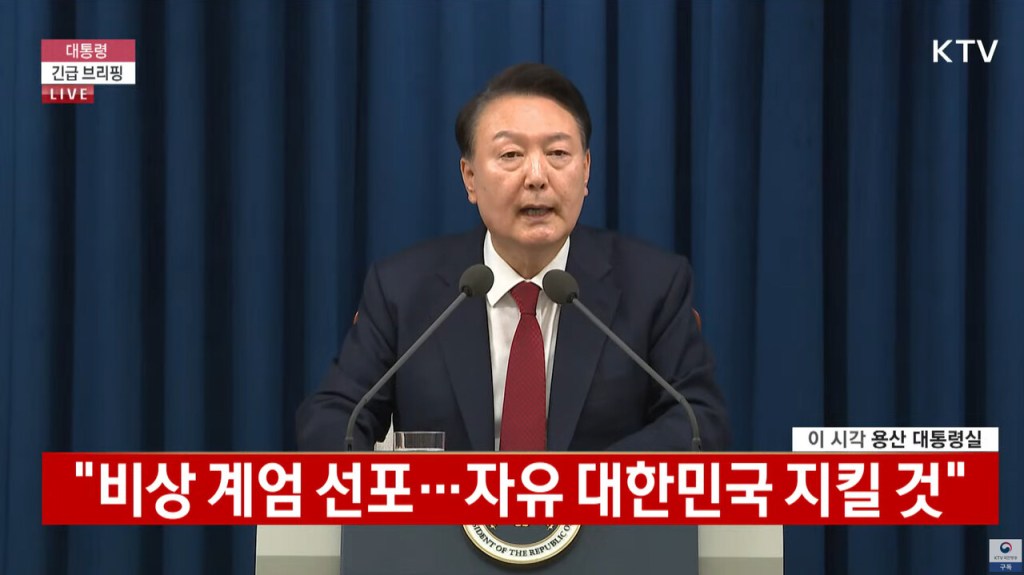
Time has passed since the declaration of the national state of emergency—an upheaval unprecedented in our constitutional history—and I have found myself reflecting deeply on the spiritual changes that have taken place in my life and within my heart during that time. The most sacred change is that my trust in God’s existence and the Word of the Bible has become even more steadfast. I no longer dismiss the mystery of creation recorded in Genesis as merely a metaphorical story from the distant past, but have come to believe in it fully as a historical and tangible reality. Rather than blindly following the plausible logic of the world before my eyes or the claims of secular authorities, I have filled my storehouse of knowledge by personally exploring the principles of nature and history. In particular, instead of unconditionally accepting existing macro-level earth science theories or mainstream historical perspectives, I have examined the essence of these matters one by one through the lens of biblical providence and intuition.
As a result, the sky, the sun, and the moon’s movements that I encountered every day began to look different, and I gradually came to realize the spiritual mystery of how the immense dynamics of the waves and the constellations in the night sky operate within the Creator’s intricate order. One thing I became certain of is that this marvelous created world was not formed randomly through chance and long periods of evolution, but was fully and perfectly fashioned in the moment of God’s sovereign creation. I came to understand the seven days of creation not merely as a symbolic period, but as a time of holy order established by the Creator, and I was able to completely break free from the secular framework that posits the universe as having expanded infinitely by chance or that non-living matter evolved into living organisms over long periods of time. Even behind the achievements in science and technology that material civilization boasts, we have clearly recognized the limits of humanity—which cannot transcend the expanse and order of creation revealed in the Bible—and have broadened our spiritual perspective.
Next, our perspective on current affairs has shifted beyond simple partisan logic (left versus right) to the essential standard of “right and wrong (righteousness and unrighteousness).” I came to understand the values lurking behind political ideologies and realized that they are directly linked to an individual’s innermost beliefs. As a Christian who fully trusts in God’s righteous work of creation and redemption, I deeply realized the truth that one can never compromise with communist ideology, which is based on materialism. In fact, while the majority of Christians claim to oppose communism, in actual discourse they are often indifferent or spiritually ignorant. These people may sometimes be our closest neighbors or family members, and I saw that there are spiritual forces at work behind the scenes that cloud their spiritual eyes and paralyze their discernment. Jesus’ solemn words—“This kind can come out by nothing but prayer”—crossed my mind. As I came to face head-on the false theological trend that seeks to cleverly separate the Gospel from social responsibility; the Pharisaical perspective that condemns others based on ideological standards while ignoring the essence of the head of state’s security policies; and the movements of transnational religious sects that advocate religious pluralism while secretly undermining the purity of the church, my view of the leaders guiding our era changed completely.
Finally, as I gained a macro-level, spiritual perspective on the world, a spirit of “forgiveness” began to sprout in my heart in place of anger. At first, I realized that the root of the crisis threatening the constitutional order and the fairness of the electoral system was not merely a fragmented issue stemming from individuals affiliated with a specific study group within the judiciary or corruption within parts of the election management body. When I confronted the reality that this was a massive national security crisis—and a crisis threatening the overthrow of the system—facing the entire Republic of Korea, my chest felt tight and anger welled up inside me. When martial law was first declared, many expected that decisive legal action would be taken immediately against those suspected of leaking top-secret information that threatened the nation’s survival or those who had violated the Constitution. This was because we earnestly hoped that emergency measures would be taken to investigate risks to the fairness of the election management system, that the true nature of the forces manipulating the system behind the scenes would be exposed to the public, and that the anti-state movements undermining the constitutional order would be eradicated in one fell swoop.
However, as I witnessed the subsequent judicial and political battles—namely, the one-sided testimonies aimed at framing the head of state on charges of insurrection, and the series of events leading to the rapid passage of legislation establishing a special tribunal, backed by immense legislative power—I came to realize just how relentless the organized counterattack by the powerful forces seeking to obscure the truth truly is. It was a truly regrettable reality to see the macroeconomic crisis deepen to the point where state funds and the foreign exchange liquidity of private companies had to be urgently mobilized to defend against the foreign exchange market’s volatility caused by sudden external variables and political instability. Furthermore, the reality that even church leaders who had been calling for social truth and spiritual awakening were subjected to judicial detention has become a painful reminder that compels us to reflect on the current state of human rights and religious freedom in our society.
Nevertheless, looking back, the urgent international security intelligence and sudden emergency measures faced by the head of state at the time required a level of decisiveness that would have been difficult to explain without close behind-the-scenes security cooperation and intelligence sharing with global allies. This aligns with recent trends in global hegemony, where transnational sanctions are linked to the eradication of drug trafficking networks to exert strong external influence in order to dismantle cartels undermining electoral fairness. Perhaps, through those decisions, South Korea managed to break free from the epicenter of international security risks surrounding A-WEB’s advanced electronic vote-counting system and reached a critical turning point in revealing the true nature of the election integrity crisis to the world.
In that process, I came to understand that behind the head of state becoming a political scapegoat and walking the harsh, narrow path of impeachment and criminal liability lay a macro-level decision: to safeguard the future of the younger generation and the enduring freedom of South Korea—even at the cost of enduring fierce backlash from transnational globalist forces, including the Chinese Communist Party—rather than taking the easy route of mere political reckoning. I finally came to truly grasp the anguish of a leader who silently shouldered that burden, even while foreseeing the immense catastrophe that would befall him.
Coincidentally, at the Christmas service I attended, the pastor shared that the essential message of Christmas is “forgiveness.” Jesus Christ, who bore all the sins of humanity and died on the cross, offering His blood, offered a prayer of mercy for human ignorance even in His final moments, saying, “Father, forgive them, for they do not know what they are doing.” As I meditated on that great prayer of forgiveness—which He could proclaim only because He fully knew the entire spiritual order and the outcome of history—I tried to empathize, even if only a little, with the heart of the leader standing alone in solitude. I felt deep gratitude upon hearing that he is finding spiritual comfort by reading the Bible amid the solemnity of his solitary cell, and I intuitively sense that the eternal hope contained in the recent Christmas message—and the time of “the glory that is to be revealed to us”—is not far off. Rising again today at dawn to dispel the darkness and writing these words of truth, I earnestly pray that the spirit of Jesus Christ’s complete forgiveness and peace may dwell in the hearts of all who celebrate this Christmas.
“I consider that the sufferings of this present time are not worth comparing with the glory that is to be revealed to us.” (Romans 8:18)
 Deliveryman's Blog
Leave a comment