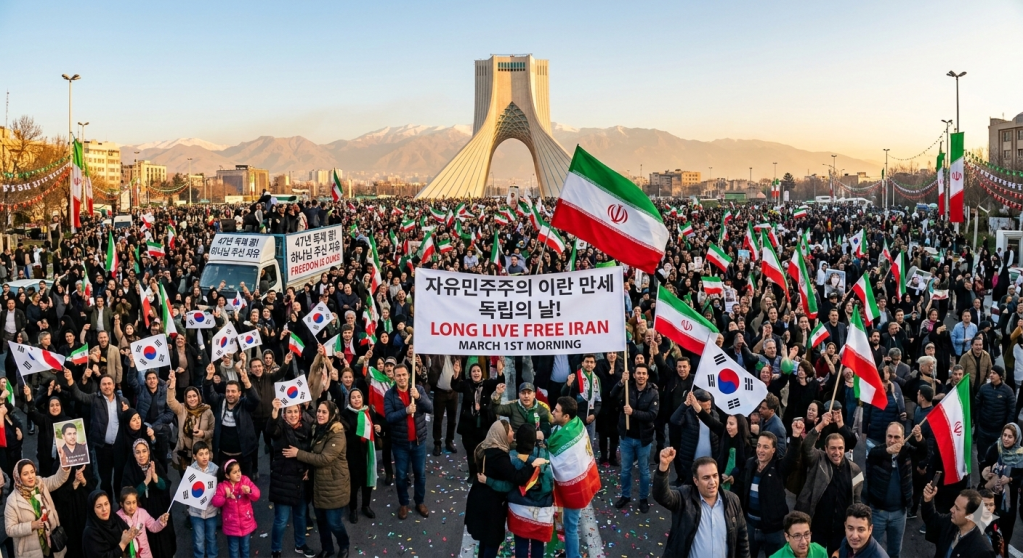
On March 1st, citizens poured into the streets of Iran, rejoicing at the news of the death of Supreme Leader Khamenei, who had ruled as a dictator for 47 years. It made my heart swell, thinking that perhaps Korea on March 1st, 1919, looked just like this. The scene of citizens spontaneously rushing into the streets shouting “Long live Korean independence” overlapped with the sight of Iranian citizens embracing each other, dancing, and reveling in their freedom. It made me reflect once more on the preciousness of the freedom God has given us.
However, it was disappointing to see that in South Korea, this joy, jubilation, and gratitude were met with indifference, treated merely as events in a distant country across the sea. Instead, witnessing the president’s remarks that seemed to blame America, I felt as though I were seeing another dictator who does not rejoice at the death of a tyrant. I sense that evildoers are connected among themselves, and the forces manipulating them from behind the scenes are always entities that steal, kill, and destroy. Those who do not rejoice in freedom are precisely the forces of darkness and their minions.
I imagined what might happen if, in the Republic of Korea, a free democracy, dictatorial forces were to step down or be removed, and patriotic citizens were to undertake a ‘second founding’ following the vision of becoming Asia’s only Christian nation. I wondered if freedom could be proclaimed and its power used to heal the land of North Korea—a living hell where darkness reigns and human rights abuses are most severe. I also worried whether the churches and believers of South Korea would be able to fulfill that mission when such a day arrived.
A hundred years ago, the Republic of Korea was also living under Japanese colonial rule, oppressed and deprived of religious freedom. They must have bitterly regretted their own insensitivity and ignorance to the international situation at the time, experiencing firsthand the consequences when the people and the nation lacked strength. I recall the period that followed the sudden joy of independence on August 15th, brought by Japan’s defeat, only to endure a chaotic time resembling civil war with terrorists like Kim Gu and communists until the Korean War. After navigating that turbulent era, through God’s intervention, the Republic of Korea government was established in 1948 under President Syngman Rhee. Yet now, we witness the current reality where forces that have persistently threatened liberal democracy appear to have succeeded in seizing control of South Korea through fraudulent elections in 2025. It feels like we’ve regressed to an era of oppression akin to Japanese colonial rule, leaving us filled with profound sorrow and injustice.
I thought this might be a warning for the sins of the Korean church: its indifference toward the 20 million compatriots oppressed in North Korea, and its constant chanting of ‘false peace’ and ‘grace’ alone. The Korean church felt lukewarm like the church in Laodicea, divided and corrupt like the church in Corinth, and had lost its first love and become formalistic like the church in Ephesus. I sensed a crisis, as if God were about to remove the lampstand. I can almost see the sorrowful eyes of Jesus rebuking the Korean Church for turning a blind eye to the suffering of North Korean defectors. So today, too, I begin the day energetically, praying through dawn prayer for the strength to push through the storm.
 택배기사핸디맨 블로그
댓글 남기기