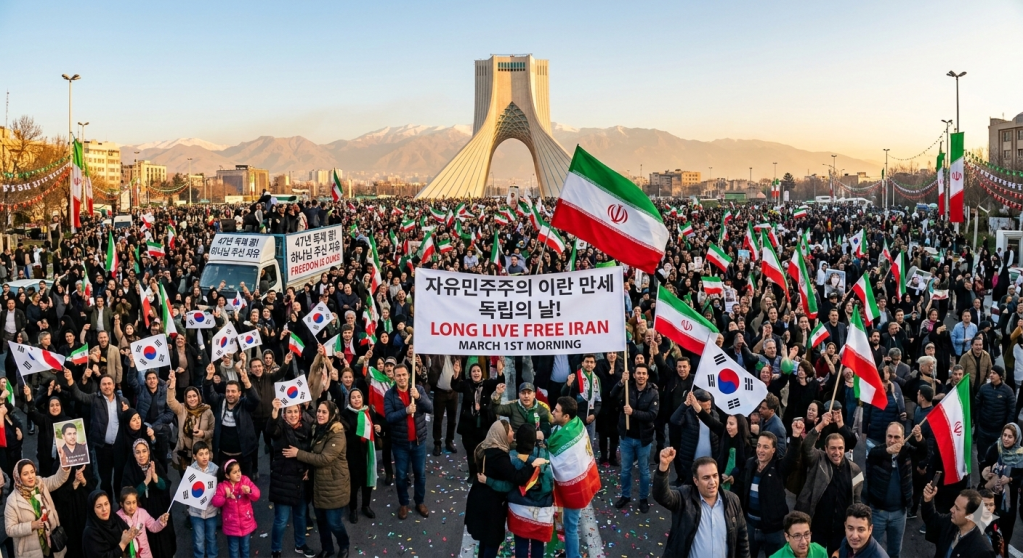
On the occasion of March 1st, I heard news that in Iran—a country long governed by a rigid regime—citizens have poured into the streets to celebrate freedom following the news of the Supreme Leader’s passing. Seeing this scene, I was suddenly overcome with emotion, thinking that Korea on March 1, 1919, must have been just as passionate. As the historic scene of citizens spontaneously rushing into the streets to chant “Long live Korean independence!” overlapped with the current image of Iranian citizens embracing one another and reveling in their freedom, I was once again led to deeply reflect on just how precious the value of freedom—a gift from God to humanity—truly is.
However, I felt a sense of regret that within South Korean society, people seemed somewhat indifferent to this historical joy and the preciousness of freedom, viewing it merely as an event in a distant country. On the contrary, observing the ambiguous diplomatic statements and attitudes displayed by the established power elite in foreign relations, I could not help but feel deep concern about the current political climate, which does not prioritize the values of freedom and human rights. I sense that forces that suppress human rights and freedom are ultimately interconnected in their efforts to protect their vested interests, and that behind them always lies a dark force seeking to undermine human dignity and destroy the community. Those who do not rejoice in true freedom are precisely those under the influence of that ideological darkness.
I imagined what kind of history might unfold if, in the Republic of Korea—a liberal democracy—these authoritarian forces were to step aside, and patriotic citizens were to achieve a “second founding” guided by the spiritual vision of being Asia’s only nation embracing Christian values. A sacred question arose: Could the value of true freedom be proclaimed, and through its full power, could it heal and restore our compatriots in North Korea—the most closed-off land on earth, where human rights abuses are most severe? At the same time, I was also concerned about whether the churches and believers of South Korea would be fully prepared to shoulder that weighty mission when such a turning point in history actually arrives.
One hundred years ago, South Korea, too, was oppressed under Japan’s brutal colonial rule and forced to live without freedom of faith or thought. Reflecting on our ancestors, who were unaware of the rapidly changing international situation at the time, we must have experienced firsthand—in the most painful way—the tragic consequences that ensue when a nation and its people lack the strength to defend themselves. Subsequently, the joy of gaining independence following Japan’s defeat on August 15, 1945, was short-lived. Until the outbreak of the Korean War, the nation endured a period of extreme turmoil—effectively amounting to a civil war—due to the extreme polarization among national leaders, who were locked in ideological conflicts during the post-liberation political landscape, and the subversive activities of communist forces. Amid that chaos, through God’s providence, the Government of the Republic of Korea was established in 1948 under President Syngman Rhee. However, forces that have continuously threatened the liberal democratic system to this day appear to be seizing control of the nation through recent election processes and political turning points. This makes me feel deeply aggrieved and sorrowful, as it seems we are regressing to the harsh era of oppression of the past.
Perhaps this reality is a stern warning regarding the sins of the Korean Church—namely, its failure to stand in deep solidarity with the suffering of the 20 million compatriots groaning under oppression in North Korea, and its complacency in proclaiming only a “false peace” and cheap “grace” devoid of justice. The Korean church today is neither cold nor hot, like the church in Laodicea in the Bible; it is divided, like the church in Corinth; and, having lost its first love and fallen into formalism, like the church in Ephesus, it faces a spiritual crisis on the verge of God removing its lampstand. I can vividly picture the Lord’s sorrowful gaze, filled with regret toward a church that has turned a blind eye to the tears and suffering of North Korean defectors. That is why, even today, through dawn prayer, I seek the spiritual strength to weather the fierce storms of this age and begin the day with vigor, dedicated to defending the truth.
 Deliveryman's Blog
Leave a comment