At 4 a.m., I awoke in the still darkness and opened today’s Scripture. Matthew 7:7—“Ask, and it will be given to you; seek, and you will find; knock, and the door will be opened to you”—resonated deeply with me. Suddenly, a passage from a pastor’s sermon came to mind. He explained that the sequence of these three steps—asking, seeking, and knocking—holds profound spiritual meaning in itself, embodying the process of sanctification through which humans draw closer to God with an increasingly active and earnest heart. Reflecting once again on the fact that, among the countless gifts humans can ask of God, the most noble and essential spiritual gift is the Holy Spirit, I went to my place of early morning prayer and knelt down.
Even as I continued praying, the turbulent news from around the world found its way into my silent prayers. I heard that U.S. military actions against Iran had temporarily subsided, and that President Trump—true to the character he displayed in his book *The Art of the Deal*—had once again opened negotiations. I earnestly prayed for a swift end to the war that threatens both financial markets and innocent lives. At the same time, I felt deeply relieved to hear that the people of Iran were standing up for their freedom and resisting the Revolutionary Guards of the authoritarian regime on their own. I began to hope that a change of government and democratization could be achieved without direct military intervention by the U.S., and I prayed that the 5,000 U.S. Marines deployed to the Strait of Hormuz would firmly secure that strategic location, thereby completely blocking the channels through which Iranian crude oil flows to China via illegal routes. For China—which had been circumventing international sanctions by importing crude oil from Iran and Venezuela via small vessels and settling payments in yuan—I was convinced that if even this core supply chain were severed, its economic system, built on debt and bubbles without a solid foundation, would begin to crack even more rapidly.
In fact, having traveled frequently to Shanghai on business for many years, I have witnessed this massive downward spiral firsthand. Observing the sharp decline in foreign visitors, the flight of Western capital, the collapsing real estate bubble, and the frantic efforts of wealthy Chinese to move their assets overseas by any means necessary, I felt the structural limitations of the communist planned economy acutely. Nevertheless, it was disheartening to see that certain political factions in South Korea and a significant portion of the public still seemed unable to wake up from their excessive “China-centric macroeconomic fantasy.” This was despite the fact that some of the very figures and stakeholders who had been promoting that fantasy had long since safely transferred their actual assets and their children to advanced Western nations. What is truly ironic is the harsh reality that even China’s core elite—who spearhead anti-American indoctrination—actually want to send their own children to study abroad in the United States and other free nations.
Currently, South Korea is also experiencing a significant erosion of the real purchasing power of ordinary citizens due to a sharp increase in exchange rate volatility and rising fuel costs. Yet, I cannot help but sigh deeply when I see macroeconomic illusions—such as unconditionally welcoming the strengthening of taxes on multi-homeowners through simple adjustments to official real estate appraisal prices, or optimistically concluding that the economy’s fundamental strength has fully recovered based on a temporary rebound in the KOSPI caused by external factors. What is even more concerning is the fact that there are those who mistakenly believe the economy is booming, even amid structural risks where the safety net provided by the won-dollar currency swap system has effectively weakened and dependence on the won-yuan swap has become abnormally high. Thinking of Christians who give thanks for unconditional peace without clearly recognizing this crisis in financial diplomacy weighs heavily on my heart, and I prayed for their spiritual discernment. It is as if, even in a crisis where the head of the household has lost his job and the family’s foundation is crumbling, they blindly believe that “all this suffering is simply an unconditional blessing”; I felt a mix of sorrow for their pure faith and a sense of solemn reverence.
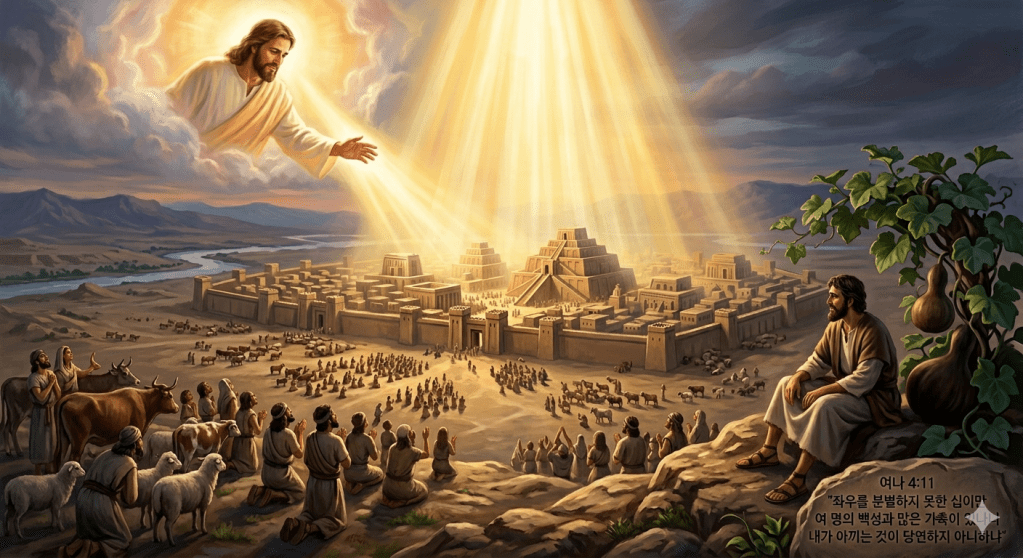
Then, suddenly, a solemn reflection crossed my mind: “Could it be that my lack of faith stems from the spiritual pride lurking within me? Or have I been trying to judge the world solely through my own subjective and biased perspective?” As I opened the Bible—the food of the Spirit—the Book of Jonah caught my eye. It was the scene where, after God’s stern judgment had been proclaimed against the people of Nineveh—from the king down to the lowliest—they all put on sackcloth and sincerely repented, causing God to withdraw His judgment; yet the prophet Jonah, on the contrary, grew angry and furious at the outcome of that righteous mercy. In the presence of that holy Word, I examined my own spiritual condition as if looking into a mirror. I realized that, like Jonah, rather than remaining alone in a place of anger and judgment toward the world, I must meditate on God’s immense love and compassion—a love that cherishes even the 120,000 wandering souls who cannot yet fully discern right from wrong, as well as their livestock, with tears in His eyes. I firmly resolve to lay down the sword of judgment and to live diligently, quietly fulfilling my duties in the place God has granted me—whether in the privacy of my home or at my workplace.
“But the LORD said, “You ‘pitied’ the shrub, for which you didn’t work and which you didn’t raise; it grew in a night and perished in a night. 11Yet for my part, can’t I pity Nineveh, that great city, in which there are more than one hundred twenty thousand people who can’t tell their right hand from their left, and also many animals?” (Jonah 4:10~11)


Leave a Reply