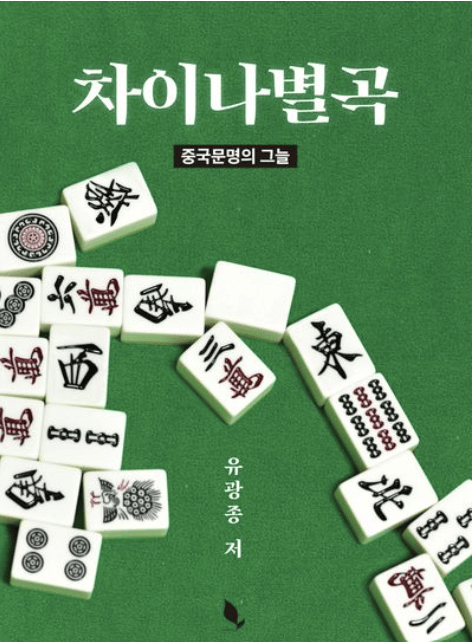
I listened to a lecture by Director Yoo Gwang-jong on the “Talent Investment” YouTube channel—which I enjoy watching from time to time—where he, alongside Dr. Lee Chun-geun, provided a candid analysis of China and offered a very incisive outlook on its future. Afterward, I bought and read his book, *China Variations*. As a veteran journalist with over 10 years of experience as a China correspondent, he demonstrated a deep understanding of the country. I, too, work at a Chinese-American company and collaborate closely with Chinese colleagues, so this book felt like a guidebook to me. I gained a great deal of insight into their mindset, how they work in a corporate setting, and how they interact with others.
It wasn’t until I read the explanation for why mahjong tiles were featured on the book’s cover that it became clear to me that mahjong is a game that encapsulates the Chinese psyche. Director Yu explains that mahjong is not merely a form of entertainment, but a psychological battle where memory, strategy, luck, and probability all come into play simultaneously—as well as a social act that strengthens relationships. I saw parallels in how players hold their tiles without easily revealing their true intentions, read their opponents’ hands while biding their time, and—while relying on luck when necessary—never lose sight of their calculations until the very end. Upon reading the interpretation that the character “發” on the cover symbolizes money and growth, “中” represents self-centeredness, and “白” signifies a duality where the exterior appears clean but the interior remains inscrutable, the subtle cues, calculations, and relationship management I’d frequently encountered at work were reorganized in my mind. Just as silence reigns at the mahjong table and a single tile can turn the game upside down, I was left with a strong impression that Chinese society is driven more by hidden cards than by spoken words.
As Dr. Lee Chun-geun noted, I came to believe that it is difficult to understand China as a single nation; rather, the correct perspective is to view it as a civilization in which multiple ethnic groups are bound together under Communist Party rule. Although it is a country composed of multiple ethnic groups, like the United States, it was not founded on the common values of Christianity; consequently, from its very inception, it has been deeply materialistic and driven by the belief that money is everything. China’s closed-off party culture, backroom politics, and the resulting bureaucratic corruption and graft were beyond imagination. Bribery and favoritism were considered perfectly natural practices, and it was explained that traces of this mindset even remain in the Chinese characters themselves.
From the perspective of the history of the Gospel, which dates back to Genesis, if we reexamine Chinese history by moving beyond the Chinese Communist Party’s “Northeast Project” and the colonial historiography of the Japanese occupation era, a completely different understanding becomes possible. This historical perspective holds that the Gospel, which began in Jerusalem, was transmitted through the Apostle Paul from Asia Minor to Europe; that the United States was founded by Puritans who crossed the Atlantic in search of religious freedom; and that the Republic of Korea—established on August 15, 1948, in Asia on a Christian foundation—was modeled after the U.S. Constitution, which is based on liberal democracy and the Ten Commandments. It is also a prophetic perspective that this Gospel will awaken the Chinese people through Korean missionaries and K-Culture, and that they will seek freedom from the oppression of the Communist Party, traveling through Central Asia and the Middle East before returning once again to Jerusalem.
Furthermore, the modern history of the past few decades—from the Chinese Civil War through the Cultural Revolution to the recent Communist Party regime that borders on one-man dictatorship—has, in my view, felt like a distorted “fake China.” As described in the book *The Discovery of Genesis*, the story of Noah’s Ark from the Bible is embedded within the Chinese character “船” (ship), and the interpretation that a people who once served the Supreme Being (上帝), sacrificed sheep, and considered this righteous—only to later alter their characters, removing the “heart” (心) from “love” (愛), and drift toward a civilization that worships other gods instead of God—was deeply regrettable.
As Director Yu explained, I could sense the reality of people’s hearts growing hardened when I heard stories from modern China about how people hesitate to help someone who has collapsed on the street for fear that they might suffer greater harm themselves. Seeing reports that President Xi Jinping, who attended the recent BRICS Summit in India, returned to Beijing earlier than scheduled, I must admit that the long-standing rumors about his health resurfaced. Although nothing has been officially confirmed, the combination of his short itinerary and sudden return made me realize that his time is not infinite, and I believe that Chinese civilization, too, will not remain frozen in its current system but will be able to revive itself.


Leave a comment