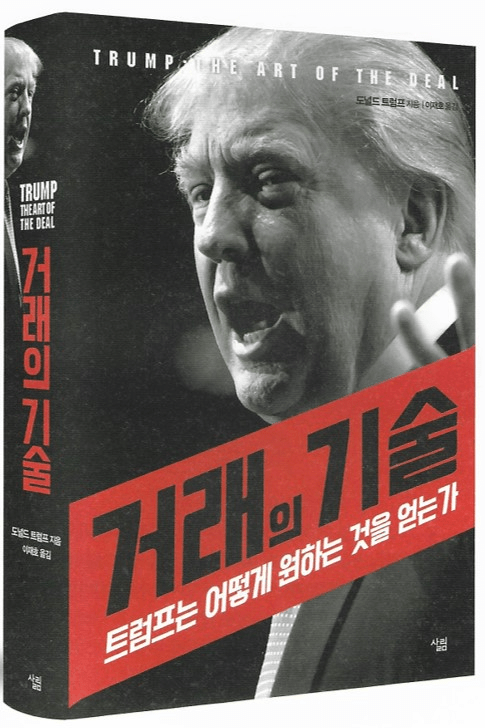
When Donald Trump became the Republican presidential nominee again, I imagine many people—like me—were searching for his autobiography, The Art of the Deal. Surprisingly, this is an old book co-authored by Trump and writer Tony Schwartz in 1987; upon checking, I found that a Korean translation was published in South Korea in 2016. I doubt even Trump himself could have predicted that the book would regain attention in 2024. And considering that, depending on the outcome of the U.S. presidential election on November 5, this book could become a historic work, I decided I, too, should write diligently for my own future.
The Art of the Deal is written from a first-person perspective and features anecdotes from Trump’s daily life and real estate development ventures, as well as quotes that offer insight into his personality and way of thinking. While it’s likely been somewhat embellished, given that it was written by a professional author, it was fascinating to read—almost as if I were perusing his old diary. From the story of how he made a fortune by acquiring and renovating New York’s historic Commodore Hotel, to the tale of Trump Tower, and the behind-the-scenes story of building a New York ice skating rink—these were all fascinating accounts that helped me understand him as a businessman.
As I read the book, I got the sense that his approach to business isn’t just about sheer resourcefulness, but is grounded in a few clear principles. Among these, the one that stood out to me first was the saying, “If you’re going to think anyway, think big.” He says that most people think small because they’re afraid of failure, afraid of making decisions, and afraid of winning. If you start with a small request, the other party uses that small line as a baseline and easily rejects it. Conversely, if you throw out a huge goal—one that’s hard to imagine—right from the start, the baseline for negotiation itself rises. The moment the other party responds with “That’s ridiculous,” the middle ground you originally sought actually begins to look like a realistic compromise. You’re going to think about it anyway. So his starting point was this: don’t waste your energy on small deals; instead, think on a scale that changes the game all at once.
The second principle is to maximize leverage. He says the best leverage comes when you hold something the other party desperately wants—or, better yet, something they absolutely cannot do without. In negotiations, the other party immediately senses it if you appear desperate. That’s why he emphasizes not showing any weakness. Leverage isn’t necessarily just about money. A position, permission, funding, or reputation that the other party desperately needs—or the absence of other options—all become sources of power. The key was to accurately identify the other party’s weaknesses and create a scenario where “I have what you need.”
The third principle is to broaden your options and focus solely on tangible benefits. He repeatedly stresses that you should never get fixated on a single approach. There are many paths to getting what you want, and most deals fall through partway through the process. That’s why he keeps multiple balls in the air at once. Even if one deal falls through, as long as other avenues remain, you can pressure the other party into feeling that “it has to be me or no one.” Ultimately, what matters more than the maximum demand you publicly state is the tangible benefit you actually secure. Even after presenting a grand goal, he would prepare multiple alternatives in advance; the flexibility to change course without hesitation when circumstances shifted was another pillar of his negotiating style.
Observing his character—tough on strong opponents yet merciful toward the weak—brought the word “gentleman” to mind. Once I realized that his harsh words were, in fact, thoroughly calculated language designed for negotiations with powerful opponents, I came to understand both his past remarks and the controversial “Ohio dogs and cats” revelation that became a hot topic during the recent presidential debates. I got the sense that his approach—thinking big, seizing leverage, and pushing forward while keeping multiple paths open—is being replicated not only in business but also on the political stage. It occurred to me that he might be waging this presidential campaign, staking everything he has—even his life—on the deal of a lifetime. And I believe this deal will serve as an opportunity for him not to gain money or fame, but to once again showcase America’s great values to the world.


Leave a Reply