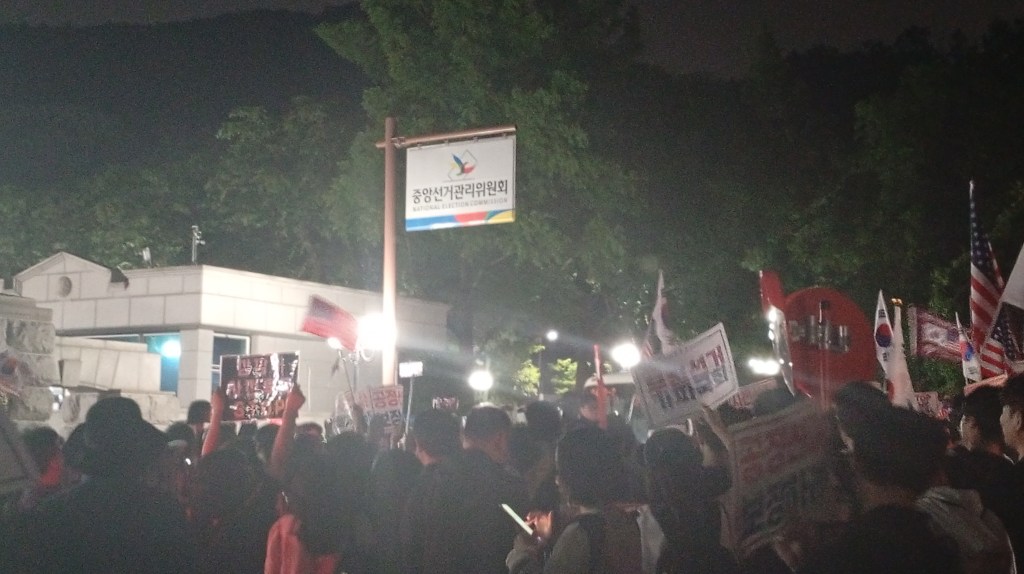
On my way home after successfully finishing my parcel pickup route, I came across a YouTube video featuring the heartfelt cries of students from the Free University and the intense atmosphere at the scene. Hearing the voices of young people on the screen appealing to citizens to fulfill their civic duty and gather in Gwacheon, I instinctively turned the steering wheel and headed toward the National Election Commission in Gwacheon via the highway. When I arrived at the scene, hundreds of citizens demanding transparency in the election management system had already surrounded the building. As I walked into the crowd of protesters holding signs, I happened to overhear a shocking conversation taking place among them.
“I was an election observer at an early voting site in Mullae-dong, and 80–90% of the voters were Chinese. I was so shocked that I only slept for an hour last night before coming here.”
A woman who had recently served as an election observer at an early voting site confided that she had witnessed large numbers of people of a specific nationality or speaking foreign languages (such as Chinese) in the voting lines. Deeply concerned, she said she couldn’t sleep and had come out to the plaza. Watching the people outside the building conversing in an organized manner, she expressed strong doubts about whether there might be loopholes in the procedures for granting voting rights and verifying identities. At that moment, a passage from *The Diary of the War Against Japan*—an audiobook she had been listening to intently—flashed through her mind, reminding her of the anguish of Admiral Yi Sun-sin as he grieved upon receiving a report that a key strategic position held by his forces had unexpectedly come under threat.
In fact, many experts have already pointed out the structural vulnerabilities inherent in the early voting system. Considering the security vulnerabilities of major telecommunications companies and the timing of the visa-free policy for a specific country—which was pushed through abruptly amid political turmoil—I could not shake the reasonable suspicion that this might be a sophisticated manifestation of what modern geopolitics refers to as “hybrid warfare” (acts of national power disruption employing non-military means). To verify these systemic flaws firsthand, I visited a polling station in Songdo on the first day of early voting to observe the atmosphere on the ground and assess how thoroughly the identity verification procedures—using the Mobile Pass app and other tools—were being enforced.
Turning my attention back to the plaza in front of the Gwacheon Election Commission, I found a peaceful public forum where hundreds of citizens had gathered in an orderly manner. Whenever speakers took the microphone and solemnly proclaimed the principles of electoral justice, citizens holding signs responded with enthusiastic applause and chants. The police officers manning the police lines also maintained a very mature culture of assembly, focusing solely on preserving order at the scene and ensuring smooth traffic flow without resorting to excessive enforcement. The resonant message from history instructor Jeon Han-gil, the speech by Kim Seong-won, CEO of an independent media outlet, and the lion-like speeches by the youth of the Free University were so intense and moving when heard in person that their sense of reality and emotional impact were incomparable to watching them on YouTube. In particular, when overseas figures—including Professor Morse Tan of the International Election Fraud Monitoring Team, who had traveled from the United States to Korea—took the stage to emphasize the importance of ensuring transparency in the electoral system, the crowd cheered and shouted cries of solidarity. They also announced their intention to report the results of their global election monitoring to the U.S. administration, based on detailed situation reports and rational statistical data.
After spending about an hour immersed in the rally’s fervor, on my way back, I was simultaneously overcome by a strong conviction and a sense of alarm regarding massive systemic distortions. The record-high overseas voter turnout—which is statistically difficult to explain—the vulnerabilities in mobile ID verification raised during early voting both within and outside electoral districts, and the potential security gaps that could arise when out-of-district ballot boxes are transported via postal service have already emerged as serious issues through CCTV footage preservation measures and citizen monitoring activities in various districts (such as Gangdong, Dongjak, Yeongdeungpo, and Eunpyeong). This is precisely why calls for comprehensive, transparent verification of data consistency across the entire national election administration are inevitably growing louder.
However, major mainstream media outlets have systematically ignored these legitimate reports and tips from citizens, or have cleverly framed them as sensational conspiracy theories, thereby obscuring the facts from the eyes and ears of the majority of the public. Whenever I confront the concrete circumstantial evidence collected nationwide—such as suspicions of pre-marked ballots found in certain regions, indications of duplicate voting, and controversies over the removal of ballots—I feel a sense of despair as if the very foundation of democracy is being shaken. Moreover, when I see snippets on social media where individuals whose eligibility to vote is unclear appear to be sharing proof of their votes, my heart aches at the thought that the people’s sacred rights, as guaranteed by the Constitution, are being violated.
Even though the mainstream media turns a blind eye to the truth and churns out distorted news, it is a great comfort to know that independent, vigilant media outlets are constantly emerging through alternative platforms like YouTube and X. Even as the entrenched interest cartel attempts to distort decision-making in key social and economic positions, startups armed with innovative business models and artificial intelligence (AI) technology are emerging to shatter existing unreasonable barriers to entry. Furthermore, even within church communities—the front lines of spiritual warfare—the true nature of pastors who had been misleading congregants through ideological bias has been exposed, ensuring that spiritually awakened believers are no longer swayed by reckless ideological toxins.
No matter how robust the system they have built may seem, the consciousness of countless citizens has already awakened to the truth, and deep within their hearts, they are welcoming the dawn of a new Republic of Korea. As we advance together into the realm of light, the true nature of the unreasonable power that has been hiding in the darkness will inevitably be exposed more clearly. By its very nature, falsehood and distortion cannot overcome the truth, nor can they suppress human freedom and conscience forever. Even if there are those who, unable to escape the graves they have dug for themselves and the shackles of sin, are rushing headlong toward destruction, the righteous God will surely intervene in His own time to restore justice to this land and bring this dramatic turnaround to its conclusion. Holding onto that conviction and hope, I rise early this morning as well to begin the day with vigor, leaving a record of truth on my blog.
 Deliveryman's Blog
Leave a comment