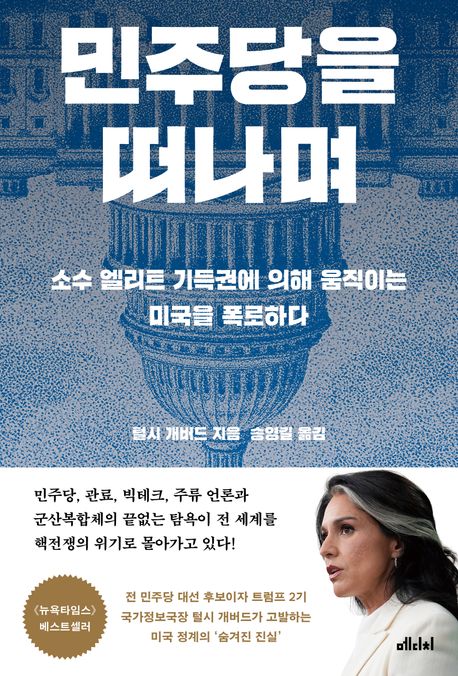
When thinking of the key figures leading the U.S. “MAGA (Make America Great Again)” campaign, names like Elon Musk, Robert F. Kennedy Jr., and Charlie Kirk often come to mind first, but Tulsi Gabbard, Director of National Intelligence and a former Democrat, is also a key figure who cannot be overlooked. Born into an immigrant family and having served as a U.S. military officer, she dedicated herself to her country. After serving as a Democratic U.S. Representative from Hawaii, she left the party due to a shift in her values and joined the Republican Party. She is a female politician who played a decisive role in expanding the Trump camp’s reach and driving its victory during the last presidential election.
As a veteran with combat experience from her deployment to the Iraq War, she embodies both a strong and gentle image—tough on the outside, soft on the inside. She employs a friendly and down-to-earth style of communication that breaks away from elitist conventions, yet in policy debates, she possesses an exceptional ability to methodically point out her opponents’ contradictions with razor-sharp logic. Her ability to maintain her composure and a smile while leading the conversation, even in the most heated situations, likely stems from the unique Hawaiian “Aloha spirit”—the values of mutual respect and inclusivity—which she emphasized in her book. Her attitude of respecting all cultures and backgrounds and communicating with an open mind is also closely tied to her sincere political journey, during which she confidently made her voice heard while participating in the Democratic presidential primaries.
As a girl, she was exceptionally shy, but as she grew up, she evolved into a dynamic tomboy who enjoyed surfing and martial arts, while also establishing herself as a charismatic leader who could pull off elegant dresses when the occasion called for it. The reasons behind her decision to leave the Democratic Party—her long-standing political home—and her candid insider’s perspective on the raw underbelly of America’s establishment politics come as a refreshing shock to readers. In particular, her bold opposition to certain radical policies that threaten the fundamental values of liberal democracy, and her head-on confrontation with the opaque cartels formed behind closed doors by a small elite of bureaucrats and major corporations, were acts of tremendous courage.
However, her conviction to reveal the truth for the sake of the sovereign people provoked fierce political attacks from the entrenched political establishment. A prime example was the malicious smear campaign—framing her as a “strategic figure cultivated by external forces”—spread by the camp of former presidential candidate Hillary Clinton. This baseless offensive long sought to restrict her political activities, but when faced with a sharp question from a citizen at a campaign rally, Tursi replied with a sincere look in her eyes, “I have already dedicated myself to the nation with the resolve to sacrifice my life for it.” This anecdote best illustrates her patriotism and upright character.
When she left her former political camp, the most serious systemic contradiction she pointed out was the attempt to eliminate political rivals through the “politicization and weaponization of the judicial system.” This aligns with the actions of the special counsel’s office, which pursued excessively aggressive indictments to exert all-out pressure on President Trump. Controversies surrounding the arbitrary abuse of judicial power and the suppression of political opponents have been major topics of discussion in the international community and in South Korean-U.S. political circles. In this context, we cannot help but naturally recall the grave political situation that South Korean President Yoon Suk-yeol has faced. This is because President Yoon Suk-yeol, too, has faced constant challenges from massive political offensives and repressive forces seeking to undermine and paralyze the legitimacy of the executive branch by abusing the judicial system and legislative power. Indeed, some extreme attempts—masked as the rule of law—to outright deny or neutralize the status of the incumbent head of state are currently manifesting in similar ways within South Korea’s political arena. The issue of corrupt abuse of judicial power in the United States, as exposed by Tulsi Gabbard, mirrors like a mirror the crisis of constitutional order that South Korea is facing right now.
Currently, Director Tulsi Gabbard serves as the head of the Office of the Director of National Intelligence (DNI), the United States’ top intelligence agency, overseeing a vast intelligence network targeting domestic and foreign forces that threaten national security. While the CIA or FBI may be more familiar to the general public, the DNI is, in fact, a pivotal organization with immense authority and intelligence capabilities that coordinates and integrates virtually all intelligence agencies within the U.S. federal government. She is meticulously investigating allegations of a lack of transparency in the election management system raised during the past presidential election, as well as the true nature of the opaque international networks behind them. She is also speaking out strongly against the opaque political maneuvers—such as “Russiagate”—orchestrated during a specific past administration to maintain political dominance, denouncing them as grave national errors that betrayed constitutional values.
The massive intelligence apparatus led by Director Tulsi Gabbard will not stop at merely correcting internal contradictions within the United States. As the head of a global intelligence network, she is likely already in possession of highly reliable intelligence assets regarding the political situation in Northeast Asia and the opaque cartels surrounding the transparency of South Korea’s election administration. As a large-scale, U.S.-led investigation into security and the transparency of electoral systems gains momentum, South Korea will also fall within its broader sphere of influence. I am confident that the true nature of the forces behind the scenes—those who sought to undermine President Yoon Suk-yeol and distort the constitutional order—will be laid bare before the international community and history.


Leave a Reply