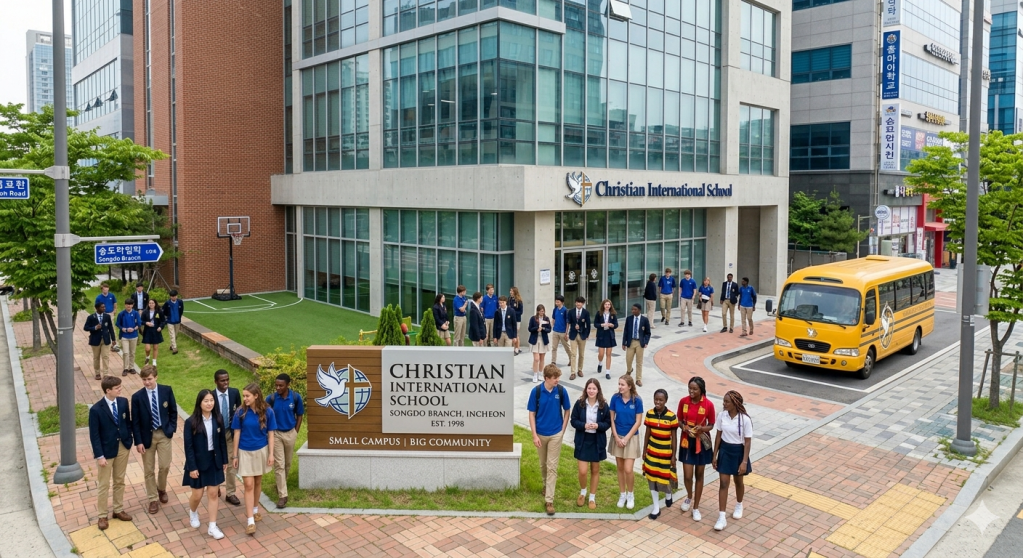
While I was deeply contemplating how to simultaneously provide spirituality education grounded in Christian values and English education suited for the global era, I recently received the welcome news that a Christian educational institution had opened a new campus in Songdo. Consequently, my wife and I are having serious discussions about transferring our youngest child, who is currently attending a public school, to that institution. I remember feeling deep concern when I witnessed firsthand, during my time living in the United States, how societal values and educational policies shifted rapidly toward a more liberal direction following a change in administration; as a result, I cannot help but be cautious when choosing an educational environment.
Sure enough, amid the recent rapid shifts in the domestic political landscape and this period of constitutional upheaval, it is an undeniable reality that parents’ concerns are growing by the day regarding ideological bias and confusion over values in the educational arena. It is a perfectly reasonable concern that the neutrality of the public education curriculum could be compromised as those responsible for educational administration in major local governments lean toward specific ideological orientations. Compared to Western societies, South Korea has a high population density and a highly concentrated linguistic base, which means educational trends and policy changes occur much more rapidly, and public sentiment can become homogenized in the blink of an eye—a fact that further heightens this sense of crisis.
However, it seems my wife had viewed this Christian International School merely as an early English education institution aimed at admission to U.S. universities, or as an “International Christian School”—a name that merely subtly rearranges the order of the words. Furthermore, she expressed practical concerns about the Songdo campus’s initial facilities, which were lacking compared to existing public schools, and the fact that, as a newly established school, it still has a small student body with a high proportion of Korean students. To make matters worse, a current affairs program on public television happened to air a critical report on the operating conditions of unaccredited educational institutions, which seems to have somewhat shaken her trust in the leaders of the alternative education movement. Fortunately, thanks to close communication with other parents in our community, we received the school’s official statement, which cleared up any institutional misunderstandings. However, it seems a trace of anxiety still lingers in the back of my wife’s mind regarding the gap between the vision presented at the information session and the reality she witnessed.
However, even as we view the same situation, perhaps because our priorities regarding values differ, my wife and I are carefully discussing our views on our child’s education. Above all, I am convinced that the ultimate essence of education is to instill biblical values and a firm foundation of faith in our child. This is because correctly understanding how all things in the universe were created, who I am as a created being within it, and what my life’s mission and purpose are—is the foundation of all knowledge. Thus, on the foundation of a proper worldview rooted in the Bible, we must cultivate through reading the logical reasoning and critical thinking skills necessary to critically evaluate the world’s knowledge. In this process, the ability to speak English as fluently as one’s native language—overcoming the language barrier of Korean—becomes an immense asset. This is because the vast majority of the cutting-edge knowledge and information accumulated by humanity is recorded in English, and it is disseminated through translation into languages around the world.
Not long ago, my eldest child, a college student, had the valuable opportunity to provide academic mentoring to high school students in the Ulleungdo region. When my child asked me for advice on how to get off to a good start with the mentoring, I provided guidance along with concrete data, explaining it this way: “Currently, the total volume of information available in Korean versus English on the global internet is approximately 55 times greater for websites, 33 times greater for YouTube video content, 10 times greater for Wikipedia entries, and a staggering 100 times greater in the realm of cutting-edge scientific and academic papers. Therefore, mastering English is a way to infinitely expand the territory of knowledge. Especially in the era of generative AI, simply by acquiring the ability to use prompts (commands), one can transcend the geographical limitations of Ulleungdo and communicate and compete in real time with talented individuals from around the world.”
On the journey of raising my children, I place the right spiritual faith as my top priority, and on top of that, I earnestly pray that they will grow into “exceptional talents the world cannot contain”—individuals who can demonstrate leadership within a global culture by building upon that foundation with outstanding English communication skills. Furthermore, I believe that an attitude of relying solely on specific educational institutions, teachers, or environments for this holistic education misses the point entirely. When parents rise early in the holy dawn to center their day through God’s Word and prayer, and do not neglect the intellectual effort of constantly reading to gain insight into the trends of the world, children naturally learn the principles of life by observing their parents’ faithful example. That is why, even today, I build my dawn altar to meditate on the Word and leave a record on this blog with a heart of prayer. I hope that these small footsteps of faith will serve as precious spiritual nourishment for the life journeys of my beloved children in the distant future.


Leave a Reply