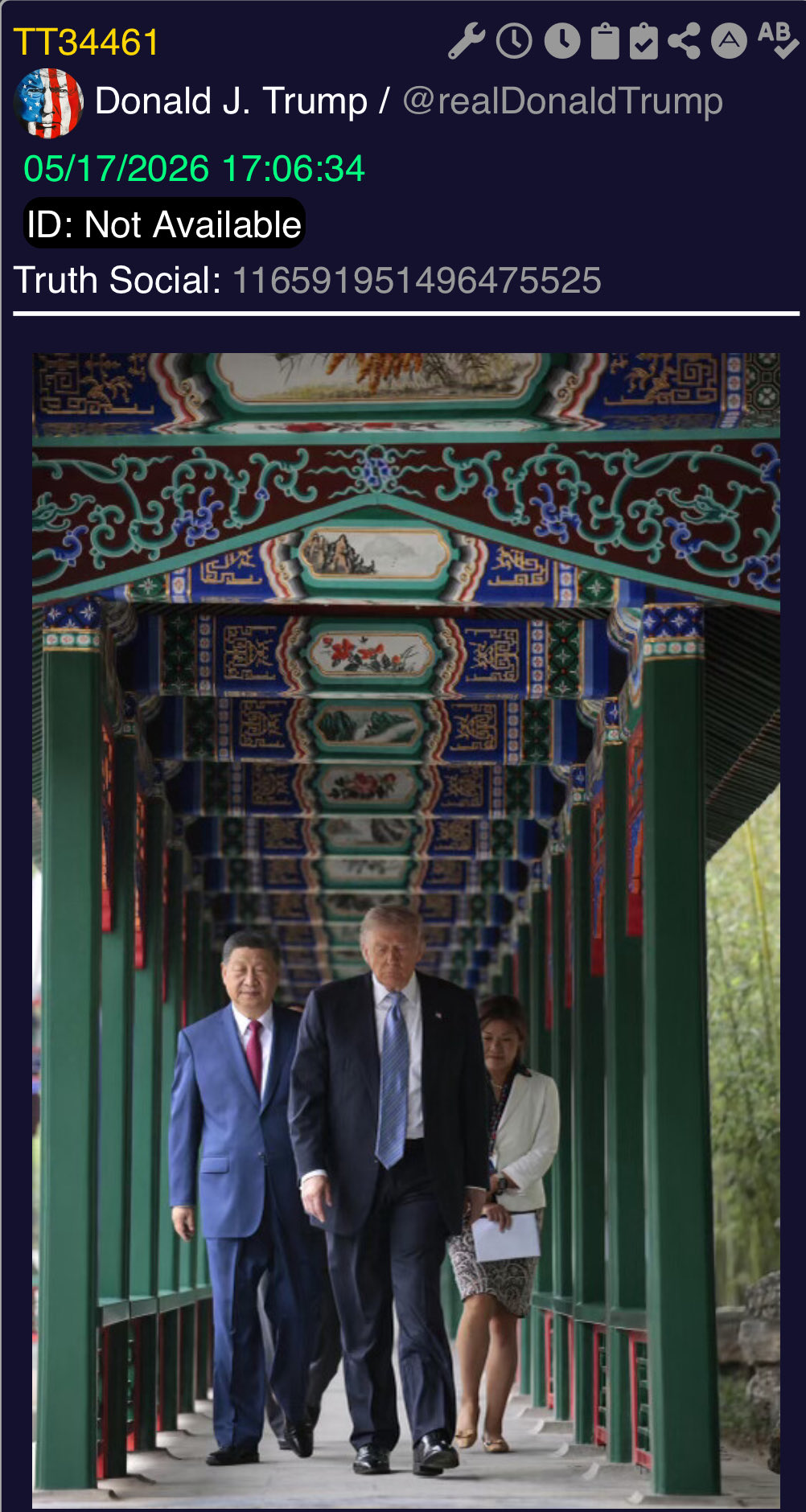
One of the symbolic moments that the mainstream media in South Korea has not covered in depth was the scene of U.S. President Trump walking out with a confident stride, leaving President Xi Jinping behind, during his visit to China. Accompanied by the heads of the world’s leading companies, he effectively ramped up economic pressure on China to its peak. Much like the firm warning messages that appeared on the White House’s social media in the past, he demanded that China’s leadership fully open its markets while also applying strong political pressure to compel Iran to completely abandon its nuclear program. Indeed, observing the current situation where voices criticizing China’s diplomatic moves are emerging in parts of the Middle East, one realizes that the fate of those who abandon their principles in the international community is always similar.
In particular, seeing that practical macroeconomic consultations with South Korea are not proceeding smoothly and that safety nets such as currency swaps have not been put in place, I felt deep concern about how South Korea will weather this critical period as the won-dollar exchange rate continues to soar. Observing the bizarre polarization in the financial markets—where the driving force behind asset values is concentrated solely on certain cutting-edge semiconductor companies, while the benefits fail to reach the real economy of ordinary citizens—I was once again struck by just how heavily South Korea’s economic structure relies on external factors. The sight of global capital selling off stocks on a massive scale, while domestic institutions and individual investors buy them up—thereby amplifying market volatility—evoked images of a perilous asset bubble. Moreover, the sight of individual investors entering the market by raising funds recklessly appeared downright precarious. Amid all this, I could not shake a bitter feeling upon seeing certain biased perspectives that gloss over the risks of a rising exchange rate with optimism.
Furthermore, with local elections approaching, the back-and-forth over allegations of unfair election administration and controversies regarding candidates’ qualifications seems to have pushed the public’s fatigue to its limit. Nevertheless, I would like to offer my wholehearted encouragement to the passionate patriotic citizens taking to the streets to defend the value of suffrage, as well as to the leaders and officials who are sparing no effort in their desperate efforts to ensure stability in their local communities. According to expert analyses, the existing election management system has consistently been criticized for the potential for data tampering due to network security vulnerabilities, concerns about unauthorized interference via backdoor programs, and an opaque voter management system.
There is deep concern that forces suspected of attempting to distort national sovereignty by exploiting these vulnerabilities in the election system are still trying to undermine a culture of fair elections, even under the watchful eyes of countless citizens and the scrutiny of the international community. While it is unclear whether the U.S.’s message of pressure on China includes specific demands regarding ensuring the fairness of South Korea’s elections, the possibility that external forces will resort to underhanded tactics to exert influence in some way remains ever-present. Beyond past controversies over illegal hacking attempts, it is now imperative to maintain thorough, constant monitoring to ensure that the security networks of technology companies involved in building the election system—as well as those of the regulatory authorities—are not vulnerable to infiltration by external hacking groups.
However, with foreign actors accused of undue election interference and global organizations suspected of technical manipulation already facing intense pressure—and with even the Middle Eastern energy routes, which served as their funding sources and channels for illicit transactions, now cut off—their options within the international community do not appear to be numerous. The fact that North Korea—which has routinely carried out missile provocations during every election season—is maintaining an unusually quiet stance may also serve as evidence that it has reached a point where it can no longer act freely in the face of the strong deterrence exerted by free allied nations. Just as the United States, during past presidential elections, blocked external hacking attempts using advanced satellite network technology and other means to ensure that the true will of the people was reflected, I hope that South Korea, too, will hold fair elections with all concerns of systemic distortion completely eliminated, thereby restoring the true values of liberal democracy. Therefore, from my position, I will quietly fulfill my duty by casting my vote on election day, and I earnestly pray that even one more person will awaken to help safeguard the Republic of Korea’s precious freedom and sovereignty.


Leave a Reply