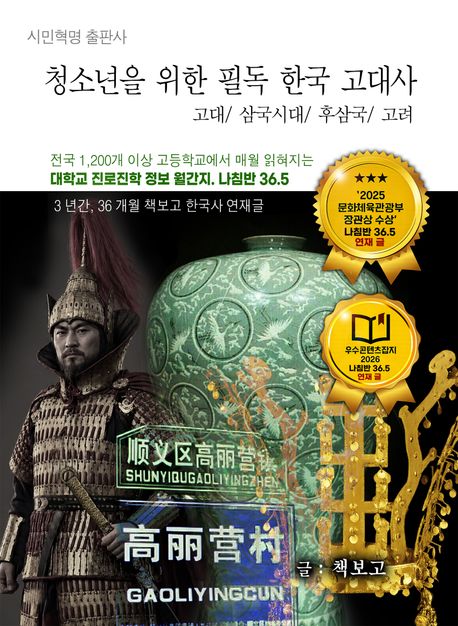
I stumbled upon “Booksbogo”—known for its YouTube channel and publishing house—on the social media platform X. This led me to purchase and read a must-read book on ancient history for teenagers, which marked a major turning point in my understanding of history—a perspective I had previously taken for granted. I came to deeply realize the possibility that the ancient history of the Korean Peninsula—which we have been taught since childhood—may have been largely distorted or downplayed as it progressed from the Goryeo Dynasty through the Joseon Dynasty, and especially as it passed through the colonial historical perspective of the Japanese occupation. The observation that aspects of the historical legitimacy and territorial boundaries of previous dynasties were denied or obscured during periods of dynastic transition or colonial rule struck me as a very fresh perspective.
Whereas in the past, searching for historical records and cross-verifying sources was the exclusive domain of a select few experts and historians, we now live in an era where the general public can easily access such materials using AI tools and digital archives. Thanks to these technological advancements, it seems that popular historical research—where people can directly search for and verify historical records or ancient place names from abroad—has become possible. The historical evidence suggesting that the main theaters of operations for Goguryeo, Baekje, and Silla extended beyond the Korean Peninsula and were closely connected to mainland China—and that the capitals of the Three Kingdoms moved multiple times over periods ranging from several hundred to a thousand years, rather than remaining in a single location—seemed highly plausible. In particular, I felt a strong need to critically question the conventional wisdom that Gyeongju was the sole capital throughout Silla’s thousand-year history.
A close examination of various war records and accounts of territorial expansion lends credibility to the interpretation that the main stage of ancient history was not limited to the Korean Peninsula but extended widely to include Manchuria and the Shandong Peninsula. In particular, according to verification by the “Book Report” channel, the analysis of historical records indicating that the locations of battles such as Maeso Fortress and Sichuan—which served as major battlegrounds between the Silla and Tang armies during the Silla-Tang War—were not within the Korean Peninsula but in present-day Hebei Province and the vicinity of Beijing, China, left a deep impression and came as a fresh revelation. Furthermore, material evidence that complements existing historical perspectives has been confirmed through archaeological artifacts. The fact that armor and weapons very similar in form to those from the Goryeo Dynasty have been excavated and are held in collections in regions such as Primorsky Krai—which is now part of Russia—enables a new interpretation suggesting that the influence of ancient Goryeo extended deep into the northern part of the Korean Peninsula and the Eurasian continent. Furthermore, the claim that records of resistance on Ganghwa Island during the Mongol invasion actually refer to a specific location on the Chinese mainland—rather than the present-day Ganghwa Island in Incheon—was highly compelling within the context of the historical sources.
Above all, evidence that Jang Bogo, the hero of maritime trade, operated with the Shandong Peninsula—including Qingdao (Qingdao)—as his de facto base rather than the rural village of Wando on the South Sea is substantiated by specific historical documents. A detailed analysis of *The Record of a Pilgrimage to the Tang Dynasty to Seek the Dharma*—a record left by the Japanese monk Ennin, who personally visited the Tang Dynasty in the 9th century—reveals that while Ennin was staying in the Tang Dynasty, he received full support from the Jiksan Beophwa Temple founded by Jang Bogo. The text explicitly describes how the entire Shandong Peninsula at that time was, in effect, a vast autonomous territory of Silla and the stronghold of Jang Bogo’s maritime empire. The locations of the shrines and ruins related to Silla’s Jang Bogo found near Qingdao also strongly support this “Cheonghaejin Continental Theory.”
Furthermore, records regarding the origins of merchants from Gaeseong—who engaged in active trade with Middle Eastern merchants—traces of direct exchanges between Middle Eastern royal families and Silla, as well as the historical genealogy indicating that Baekje royalty crossed the sea to lay the foundation for the Japanese archipelago, were all particularly intriguing points. In particular, the claim—verified through historical source analysis—that the “Wa-guk (倭國)” mentioned in records from the Three Kingdoms period in the vicinity of Baekje and Silla, and the “Japan (日本)” that later took root in the archipelago, were originally distinct nations with different geographical locations and genealogies, was also fully corroborated by historical texts and old maps.
I am determined to widely share these new historical facts and historical source analyses with the many people who have become accustomed to the distorted history resulting from the influence of the “colonial historiography” that has dominated mainstream academia for decades, China’s “Northeast Project,” and certain exaggerated or embellished historical perspectives. Hoping to contribute to awakening a correct historical identity, I rise at 5:30 a.m. today as well and begin my day vigorously with a solemn prayer.


Leave a Reply