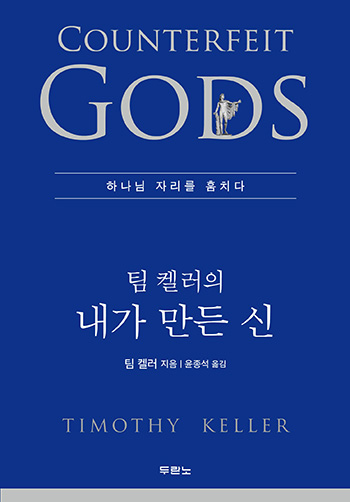
The title of this book, *Counterfeit Gods*, conveys a warning and explanation regarding idols. Idols have existed in various forms from the Old Testament era to the present day, and it is clear from the Ten Commandments that God detests idolatry above all else. The commandment, “You shall have no other gods before me,” is precisely that. It struck me that this is an act in which a creature denies its Creator—no different from a child turning its back on its parents.
Idols exist in far more diverse forms than one might imagine. While I was already familiar with the practice of creating and worshiping graven images, as in Old Testament times, this book helped me realize anew that even invisible values or desires can become idols. Even love between a man and a woman, or love for one’s children, can become an idol if taken to extremes. Faced with the reality that anything I love more than God—anything that captures my heart—is an idol and a sin, I was led to examine myself. Perhaps for me, the approval of others and worldly success had become idols. Another interesting point was that idolatry extends beyond the individual level to take on collective forms. Through various examples, I saw that not only cults and heretical religions but even Christian pastors can degenerate into idols. Knowing and believing in God may, in fact, be a process of constantly discerning among these countless false gods.
The examples of idolatry that the author, Pastor Tim Keller, unpacked through the stories of his congregation and those around him provided me with great insight. I came to understand that idolatry is not limited to carving wooden idols or bowing down to the sun and moon—it can manifest in even the most trivial aspects of daily life. Viewed through this lens, South Korean politics began to feel like one giant false god. The belief system known as “democratization” functions like a religion; the delusion of self-righteousness under the pretext of opposing unjust vested interests; and the way like-minded groups blindly trust one another to create a massive movement—all of this ultimately seemed no different from the worship of a false god they themselves had created. Otherwise, it would be difficult to explain the National Election Commission’s systematic cover-up of election fraud, the anti-national behavior of the Korean Confederation of Trade Unions, and the actions of certain religious leaders in Gwanghwamun who sought political gain in the name of God. They all appeared to be under the control of the false god they had created themselves.
The theme of this Vacation Bible School was “True North.” Just as magnetic north—which a compass points to—differs from true north in actual geography, this meant that we must follow “True North”—God’s Word—rather than the trends of the world. I resolved to always rely on God’s Word—just as I rely on a GPS when driving on a dark night road—to determine where my life is truly headed and to move toward True North. And I became convinced that as long as even a small number of Christians remain, God’s plan will surely be fulfilled in the Republic of Korea—a nation miraculously established in 1948, spanning from the Gojoseon era through the Three Kingdoms, Goryeo, and Joseon periods. That is why I came to the early morning prayer meeting today as well, calling out the names of each and every brother and sister in our community, and prayed for a Korea that will rise again and for the new generation.
 Deliveryman's Blog
Leave a comment