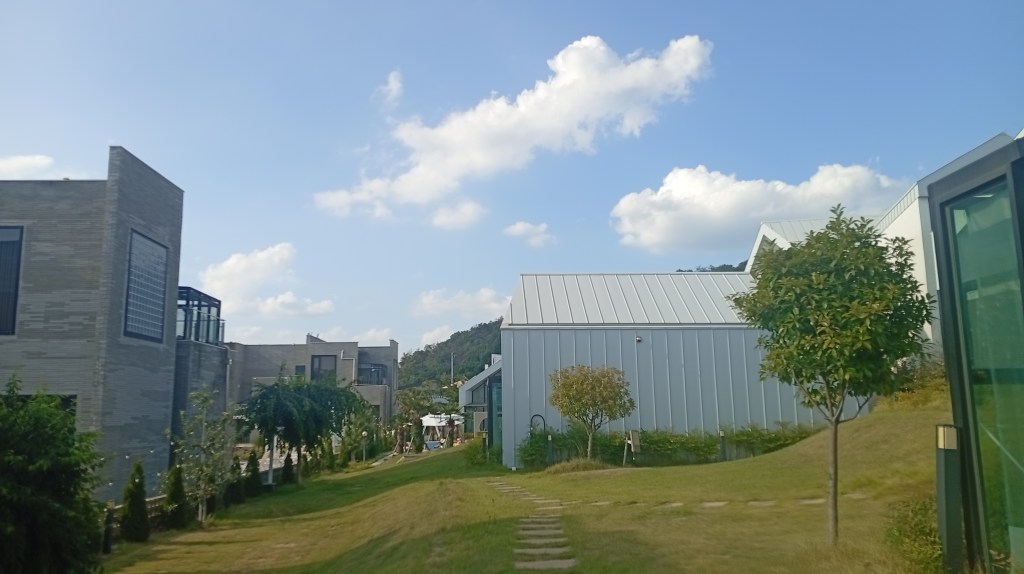
We came to Gyeongju for our summer vacation this year. Since our second son plans to participate in Handong University’s high school camp again this year—just like last year—the whole family stopped at a guesthouse in Gyeongju on our way to Pohang. Amid my busy work schedule, my personal business, and various church events and volunteer work, it feels like a break from the daily grind. As long as I have my laptop and cell phone, I can handle most of my work and even prepare for the special lecture I’m giving next week, so while my body is on vacation, my mind seems to be working just as busily as usual. In fact, the time I spend writing in this journal is when I feel most at ease and truly relaxed.
Meanwhile, it occurred to me that these peaceful moments are made possible by someone’s sacrifice and protection. I reflected on the soldiers guarding the front lines along the Demilitarized Zone, the police maintaining public safety in the city, the various national systems that keep the financial and economic sectors running, and the laws that govern all of this—as well as the Constitution and national ideology that form their foundation. The Republic of Korea is the only Christian nation in Asia, founded on the ideals of liberal democracy and Christian values, and it has become an economic powerhouse capable of freely importing and exporting goods based on the ROK-U.S. military alliance.
However, I became concerned as I witnessed various political movements that could undermine this everyday freedom and peace—namely, the impeachment proceedings involving everyone from the President to cabinet ministers, attempts to amend the Constitution, and controversial government policies that restrict citizens’ property rights. My concern stemmed not merely from the overheated stock market’s repeated wild swings that turned it into a speculative arena, nor was it solely due to the controversy surrounding the President’s trial. The real crisis was the silence of the Korean Church, where prayer and worship had vanished. I believed the crisis facing this nation lay in the fact that the Church’s early-morning prayer meetings and corporate prayers had disappeared, the sounds of praise from Wednesday services and Friday all-night vigils were no longer heard, and the voices of those receiving grace and shouting “Amen” during Sunday sermons had dwindled.
As I watched Christian values and the spirit of the Constitution—which was established based on those values—being shaken, and as controversial bills continued to be passed despite public opposition, I sensed that South Korea was gradually disappearing and transforming into a “hidden nation.” It was also disheartening to see people who remain ignorant of international affairs—such as those who still believe that U.S. President Trump invaded another country and started a war, or that claims of international election fraud are just conspiracy theories—as well as those who stubbornly cling to outdated ways of doing work. US had reestablished the international order and normalized trade with the rest of the world; as a result, massive amounts of investment were flowing into the country, ushering in a golden age. Furthermore, AI technology was transforming every aspect of work, and Elon Musk had warned that the traditional labor-intensive work model would disappear within the next three years. Ultimately, I came to believe that those unable to read these trends might suffer financial losses or face disadvantages, such as difficulties obtaining U.S. visas.
On the national level, amid concerns that South Korea had been implicated in the controversies surrounding the 2020 U.S. presidential election, the possibility of trade pressure from the Trump administration was being raised. If the “Super 301 Clause” were invoked following the expiration of the 10% tariff on July 24, triggering a tariff bomb, it seemed the South Korean economy would face a major crisis. Amid the government-led stock market rally, there were grim stories of people who sold their homes and went all-in on the stock market, only to lose both their homes and their money because real estate regulations cut off their access to loans. Coupled with news of the powerful elite disposing of their assets in controversial ways, a sense of bitterness seemed to be spreading across the entire nation. Unlike President Yoon Suk-yeol, who declared martial law to appeal to the public about a national crisis, I found myself imagining what it would look like if martial law were to be declared again under the current circumstances. Amid concerns that power is becoming concentrated in the legislative, judicial, and executive branches, the addition of martial law and military involvement would create an extremely alarming situation; hearing recent news about North Korean military movements also made me feel unnecessarily anxious.
So, while participating in an online service hosted by a church that holds services at Olympic Park and listening to Ambassador Moss Tan’s sermon, I prayed for God’s intervention. I also resolved to resist by writing, so that even the remaining freedoms of the individual would not be taken away. It occurred to me that God is present right there among the vulnerable citizens worshiping in humble places, because I recalled the words of former Handong University President Choi Do-sung: “History is never made by a handful of politicians, but by the majority of ordinary people who faithfully hold their ground.” Although it is expected that during this holiday season, South Korea will be hit by a tariff bomb as devastating as a typhoon, the stock market will crash, and many people will be thrown into turmoil, my family and I were grateful to be able to enjoy a peaceful holiday.


Leave a Reply