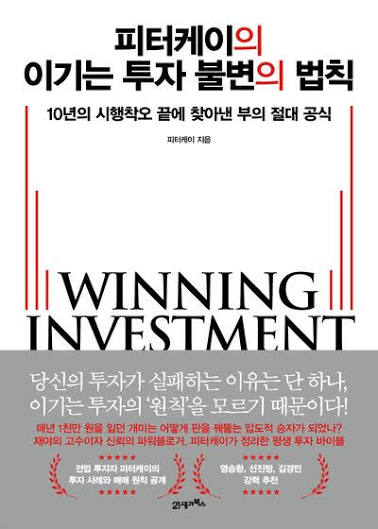
This was an excellent guidebook that left me wondering: if people had known what life as a full-time investor was really like, would so many have readily taken up investing? The author, Peter K., served as a great role model through his investment philosophy, his perspective on the world, and his consistent self-improvement and dedication. At the same time, it was a book that made me reflect on why I haven’t yet become an investor like him. Even though he had already established himself as a full-time investor, his routine—waking up at 5 a.m. for physical training, arriving at the office at 6 a.m., and continuing his morning work—demonstrated just how important the fundamentals of life are.
His insight—connecting visible phenomena and the underlying principles to stock investing to form his own hypotheses, and then personally seeking out and piecing together relevant news and evidence—is something anyone can try, but few can sustain. As described in the book, I was particularly struck by the passage describing how it was part of his daily routine to visit the toy section of a large supermarket and ask a staff member about inventory just to verify a single news item—that a toy company named Son O-gong was selling toys based on the popular animated series *Turning Mecard* well. The fact that he took note of a news story about a rookie group from JYP climbing to the top of Japan’s Oricon charts—and that the group went on to become a hit a few months later—was all thanks to the power derived from his habit of taking notes and his reading comprehension skills, honed by reading more than seven newspapers a day.
When he pointed out that understanding the semiconductor and rechargeable battery industries requires studying to the point where one could teach a course on the subject, I felt ashamed as a shareholder of Samsung Electronics and LG Energy Solution. Korea Zinc, which I had invested in out of patriotism, also revealed my own limitations—I had almost no understanding of the industry. I realized that a full-time investor like Peter K would have studied the subject himself, explained it in study groups, and consistently built up his position through regular, systematic investments—even when investing in so-called blue-chip stocks. He emphasized that, in addition to understanding the industry, it’s crucial to develop your own narrative and maintain the mental resilience to weather stock price declines. I, too, had my own narrative when I made a profit investing in Ripple’s XRP in the past—one based on my own understanding of the coin’s development goals, growth potential, and the legal battle with the U.S. SEC. That’s why I remember viewing the suspension of trading on Coinbase and the subsequent sharp drop in price as an opportunity.
The reason this book resonated with me so deeply and was so engaging is that it didn’t just showcase success stories; it also candidly described failures and the lessons learned from them. His advice—that one must train for at least three years, repeatedly experiencing both success and failure to build up the necessary experience before dreaming of becoming a full-time investor—also aligned with my own experience. Through that process, I developed a new perspective on the world through stocks, and I was able to examine my own psychology within the investment process. I was surprised to discover that fear and greed were at work within me, reacting in real time to changes in the world. The “winning investment” he speaks of ultimately means overcoming oneself, sustaining those habits to cultivate the mindset of a full-time investor, and putting the principles and values one has set for oneself into practice through investing. Reflecting on that, I wake up at dawn again today to start my day by writing on my blog.


Leave a comment