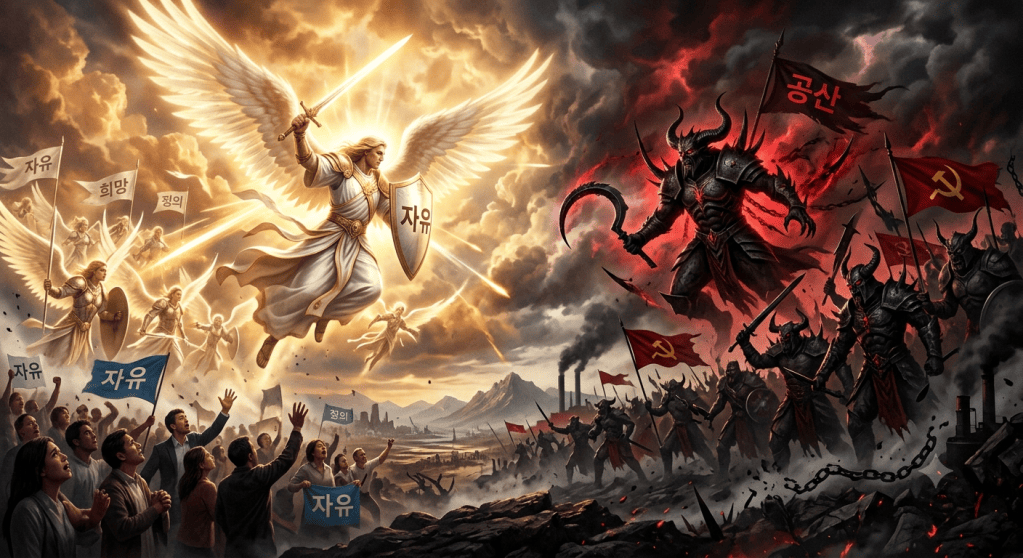
While reading the book Park Chung-hee Is History, which is based on historical records detailing President Park Chung-hee’s achievements in successfully modernizing South Korea, his vision, and his strong leadership, I found myself thinking: Distorting and destroying the history of Park Chung-hee is tantamount to distorting and destroying the history of the Republic of Korea. If that is the case, why would anyone seek to distort and destroy the history of the Republic of Korea? I came to believe it is because they are not citizens of a liberal democracy, but rather adherents of “people’s democracy”—that is, communist ideology. Although Karl Marx laid the ideological foundation for communist thought, there are records indicating that his own life was a shambles and that a dark spirit dominated his mind. His belief that an ideal society could be created through violence and destruction was difficult to imagine given his upbringing in a Jewish family, but it struck me as a case study demonstrating what happens when God leaves humanity to its own sin.
In 2026, I got the impression that the Republic of Korea—a free democracy—continues to be shaken by communist policies, inexplicable large-scale fires, and military provocations from North Korea. The Democratic Party was relentlessly pushing for the passage of a comprehensive anti-discrimination law that could shake the very foundations of the family system rooted in Christian values. It was also encouraging free vaccinations against COVID-19—which some claim was created at the Wuhan Institute—alongside flu shots, and was promoting a pilot program that would allow the state to manage the assets of elderly people with dementia. It is also suspicious that three major fires have occurred at the factory of Korea Zinc—a leading pro-U.S. company—in the past six months, and I was filled with rage when the explosion of a North Korean wooden box landmine in the DMZ resulted in the amputation of the legs of the Republic of Korea’s sons.
During the recent Brazilian presidential election, allegations surfaced that a corrupt judge extended voting hours and manipulated vote counts through electronic voting to secure Lula’s election as president, but citizens were powerless to act. It felt similar to the suspicions in South Korea that, over the past several decades, the legislative, judicial, and executive branches have been gradually taken over to perfect a system of electoral fraud. Just as former President Jair Bolsonaro was sentenced to 27 years and placed under house arrest, there were reports that his son, Flávio Bolsonaro—who was a presidential candidate—was also targeted for arrest immediately after the election but was granted political asylum with the help of Argentine President Javier and the United States. Through this, I came to realize that the truth always comes to light and ultimately prevails over time.
While reading the book The Spy Who Became President, I encountered the claim that spies infiltrating South Korea were present in every sphere—political, economic, social, and cultural—far more extensively than we could have imagined. The book argued that they were constantly on the lookout for opportunities, mobilizing media incitement, historical distortion, and even left-wing religious figures to destroy South Korea from within. What sets this apart from the past is that, while operating legally, they provided policy-level aid to North Korea to sustain its regime, undermined South Korea’s economy through anti-market policies, and—amid allegations of colluding with the enemy to leak state secrets—have now gone so far as to unhesitatingly use false witnesses and fabricated evidence to orchestrate a legislative coup that led to the impeachment of a sitting president.
Recently, while watching a conversation between Pastor Kim Young-hyun of FTNER and Dr. Lee Chun-geun, a scholar of international politics, I was able to grasp both the spiritual crisis and the geopolitical crisis facing South Korea. Furthermore, upon encountering claims that a dark spiritual entity lies behind the antichristian symbols and inhumane rituals hidden in some K-Pop content, I realized that the war against communism is ultimately a spiritual war. For example, there were claims that it was no coincidence that the presidential inauguration ceremony—which evoked a sense of a bizarre sacrificial ritual—took place, followed by a purple-lit memorial ceremony on the fourth anniversary of the suspicious Itaewon tragedy, and that on that very same day, the National Election Commission seized ballots that had been stored at Olympic Park.
So, as I looked upon the citizens who had been tragically deprived of their electoral sovereignty, I first prayed for spiritual awakening and repentance. Just like Zacchaeus in the sycamore tree, who longed to meet Jesus sincerely during worship, I began my day with vigor by writing this blog post, hoping that even one more person might awaken today.


Leave a Reply