News of an extramarital affair involving Jensen Huang, CEO of NVIDIA—the company that manufactures the GPU graphics cards central to the AI era—has shocked the world. This is because the woman with whom he is alleged to have had an inappropriate relationship is suspected of being a Chinese spy, and allegations have surfaced that a large number of chips—which had disappeared from the company’s books—were illegally funneled to a Chinese company through the firm where she served as an executive. The U.S. government had imposed export restrictions on NVIDIA’s high-performance GPU chips, and concerns arose that if these allegations were confirmed, the issue could escalate beyond a personal matter for Jensen Huang to become a corporate governance issue.
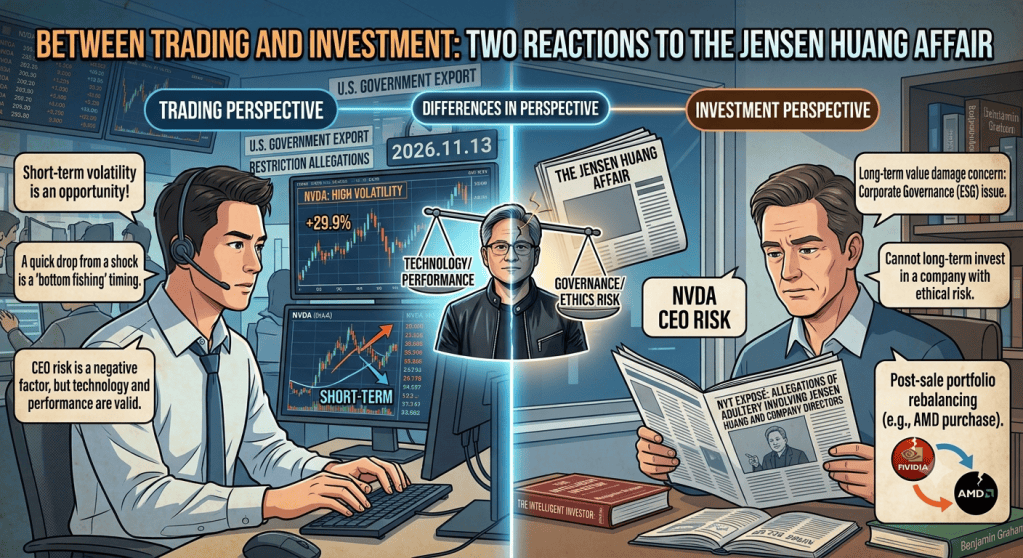
One reason I couldn’t help but pay closer attention to this issue was that I had made a small investment in NVIDIA stock, and another was that, based on the perspective presented in the book Trading, Not Investing that I had recently read, I was curious to see how professional traders would respond to such an incident. In a news interview, a U.S. fund manager stated that since this was a personal matter for Mr. Huang, it would be resolved soon, and he expected the stock price to rise again around the time of the company’s earnings announcement, so he planned to buy at the low point. I thought it was possible that he also held some short positions. This is because he might have already set up a strategy that allows him to profit regardless of whether the stock price rises or falls.
I did’t have a short position, and based on my personal values—which include my desire to avoid long-term investment in a company led by a CEO I consider unethical, as well as the anticipated prolonged political uncertainty following the U.S. midterm elections—I sold all my NVIDIA shares while taking some profits. Subsequently, The New York Times published an exposé revealing that CEO Jensen Huang had also been having an affair with a female board member, and the market was once again shaken. Seeing the stock drop nearly 10% in pre-market trading, I felt I had timed my exit well. An emergency board meeting was hastily convened, and following the news of Jensen Huang’s resignation and the CFO’s appointment as interim CEO, the market regained some stability, closing down about 5%. Curious about the opinions of Korean investors in U.S. stocks, I cautiously shared my thoughts in writer Lee Ji-sung’s group chat. Several people replied, and one person, believing this was an opportunity, even posted a screenshot confirming the purchase of tens of millions of won worth of NVIDIA stock. It was interesting to see the different perspectives on the same event, and by comparing the short-term trading perspective with the long-term investment perspective, I was able to reaffirm my own investment principles and criteria.
Another issue with NVIDIA goes beyond CEO Jensen Huang’s personal extramarital affair and allegations related to China—it extends to the company’s business dealings with AI firms. I saw reports that NVIDIA offered extraordinary terms to clients who found it difficult to purchase large quantities of graphics cards equipped with high-end AI chips, such as providing investments or loans, or even repurchasing unused products. For example, startups have emerged that build AI data centers using graphics cards equipped with SK Hynix’s HBM memory and NVIDIA’s high-performance GPU chipsets, then run AI agent services by deploying foundation models and large language models (LLMs) on top of them. When NVIDIA invests in such startups, other venture capital firms follow with larger investments, and those startups then use that money to purchase more NVIDIA products—creating a self-perpetuating cycle. While this circular financing model may not be a problem as long as demand for AI chips continues to grow, I felt it carries a structural risk: if demand declines and AI data center usage stops increasing, NVIDIA’s losses could rise significantly.
It was precisely this aggressive sales approach—driven by this circular financing model—that created an oversupply of AI chips and ultimately led to the AI bubble. Even at first glance, it seemed odd that a senior finance executive within the company would approve such a risky strategy, but observing this incident, it seemed to boil down to a governance issue. CFO Corrett, who has now become interim CEO, is said to have opposed this sales approach, so I imagine everyone is curious to see what decisions she will make once she officially becomes CEO. Watching this NVIDIA incident unfold, I realized once again why corporate governance is so important and saw how it affects stock prices. So, I’ve been thinking about what criteria I should use when buying and selling stocks in the future.
Of course, thanks to the organizational resilience of a large corporation and its stable revenue and profit structure, the company isn’t likely to be easily shaken by the CEO’s misconduct. However, as a Christian, I found myself wondering whether it is truly right to invest my finances or trade in such a company. I prayed for Jensen Huang’s wife and children, who must be suffering the most at this time. And today, I started the day with vigor by participating in early morning prayer online and praying for my church and South Korea.


Leave a Reply