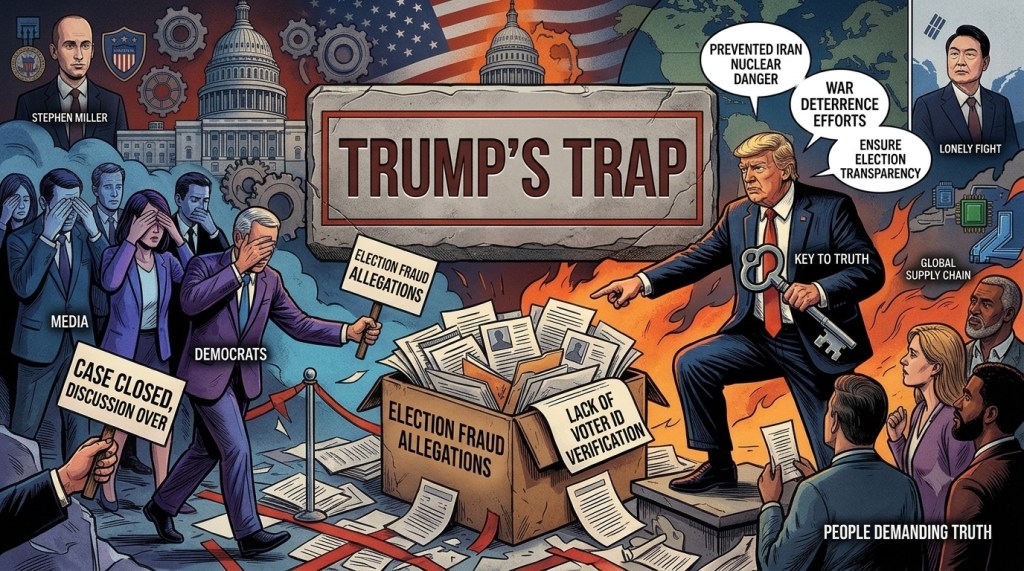
As I listened to President Trump’s press conference live following the U.S. midterm elections, I got the impression that he was not a failed president who had lost majorities in both the Senate and the House to the Democrats, but rather a president who still wields significant influence. He cited the response to Iran’s nuclear program as one of his major achievements, explaining that if the response had been delayed, the risks could have been even greater. He had previously claimed in the White House that he had prevented several wars, which made me reflect once again on the fact that the risk of war does not disappear on its own but can be reduced through someone’s efforts and judgment.
Trump also addressed the election results by citing the case of a candidate with the same name in Alaska, alluding to the Democrats’ allegations regarding the election. Amid reports of statistical anomalies and allegations concerning voting procedures in the U.S., the Democrats’ relatively muted response seemed suspicious. Some left-leaning media outlets in the U.S. appeared to be avoiding active coverage of these allegations, and the South Korean media was simply repeating those reports.
After seeing reports that 20 million new, unidentified votes had been added to the Democratic tally—with approximately 3 million of those coming from Texas—my curiosity was satisfied. Furthermore, as reports emerged that Republican candidates had won the majority of seats in states that implemented voter ID checks, I understood why the Democratic Party strongly opposes the passage of the “Save America Act,” which would strengthen voter identification requirements. Upon hearing President Trump’s remarks—that he is aware of allegations of vote rigging involving the identities of undocumented immigrants or permanent residents, and that those involved may face investigation or disciplinary action as time goes on—I realized that the election fraud cartel has been caught in a massive trap.
Amid these developments, it appears that more people in American society are taking an interest in the allegations of election fraud. While it seems possible that methods similar to those used in past election controversies in various countries were attempted this time as well, some observers note that the situation is different this time around. Reports indicate that while the Trump camp requested verification of voter rolls, some states refused, and that investigations or actions regarding allegations of illegal voting are underway through agencies such as the Department of Homeland Security. Following the appointment of Stephen Miller—who has taken a hardline stance on immigration policy and border security—as Chief of Staff, the discussion appears to be shifting toward the notion that a significant portion of the election fraud allegations is linked to illegal immigration. Coinciding with this, revelations about the personal life of NVIDIA Chairman Jensen Huang and allegations of ties to China have emerged, creating an atmosphere that seems to be sending a strong message to China.
South Korean President Yoon Suk-yeol is also continuing his lonely battle amid these international trends, and there is speculation that he may have been coordinating with the U.S. to some extent even before the declaration of martial law. It struck me that the global election fraud cartel has all fallen into Trump’s trap, and I became convinced that dawn is just around the corner.


Leave a Reply