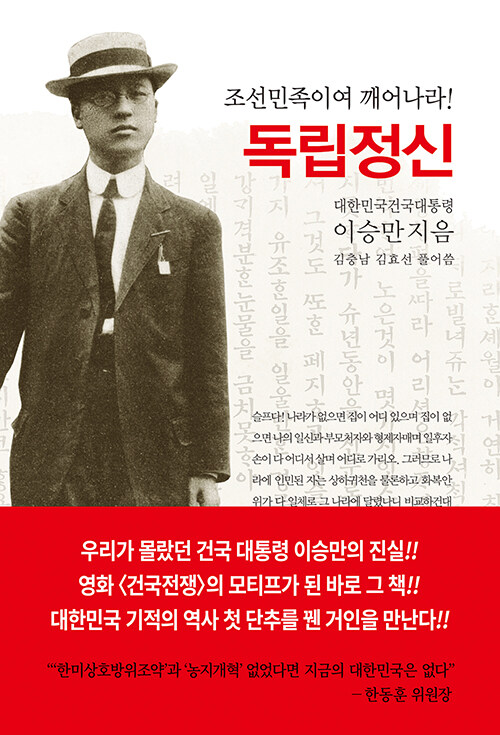
I have finally read President Syngman Rhee’s book *The Spirit of Independence* in depth. Imagining the young Syngman Rhee—who, even in the grim circumstances of awaiting his execution in the dark, cold confines of Hanseong Prison, wrote word by word with a heart-wrenching determination, concerned only for the fate of his nation and its ignorant people—I couldn’t help but feel a deep sense of reverence and shame for myself. I could not help but marvel at how, at the young age of his mid-twenties, he was able to so accurately grasp the macro-level international situation, and how—by proposing a path to civilizational enlightenment based on the spirit of human freedom and Christian thought—he was able to lay the ideological foundation for the democratic nation that the Korean Empire was to become.
Within a spiritual worldview that acknowledged God as the Ruler of the universe, he expounded on the principles governing all things in the world and sharply pointed out how the superstitious idolatry of the time—which involved the blind worship of created beings such as the sun and moon—was devastating the human spirit. I was forced to confront the dark underbelly of late Joseon, where the slave system—which ruthlessly trampled upon human inherent rights and dignity—persisted despite the benefits of science, technology, and civilization, and where missionaries from the civilized world were rejected and persecuted. I felt a deep sense of dismay as I read about the incompetence of the highest echelons of power and the corruption of government officials. In particular, as I gained a multidimensional understanding of the behind-the-scenes details of historical events—such as the Imo Military Rebellion, the Gapsin Coup, and the Eulmi Incident—which I had previously encountered only in school textbooks, I came to realize all too painfully that the Joseon Dynasty did not collapse merely due to foreign invasion, but rather crumbled under its own weight due to internal systemic contradictions and moral bankruptcy.
Moreover, that tragic landscape seemed strikingly similar to the current crisis in South Korea—a crisis marked by a ruling elite that undermines the nation’s fundamental values amid debates over the legitimacy of our constitutional order, by greedy politicians blinded by self-interest who have abandoned public justice, and by a corrupt bureaucratic system. The young man’s cry, written over 100 years ago, seemed to hold up a mirror to the very situation we face today, sending a shiver down my spine. If this were not the case, it would be proof that, from the late Joseon Dynasty to the present, the history of this nation remains entangled in the ignorance of the masses, intellectual darkness, and totalitarian forces of evil seeking to suppress human freedom. It felt as though a massive spiritual war, waged since the dawn of time, has been raging unceasingly from that era to the present day.
I turned the pages in repeated amazement, wondering how President Syngman Rhee could have analyzed the urgent international situation—including Japan’s rapid modernization, the Qing Dynasty’s structural decline, and Russia’s eastward expansion and plans for aggression—with such precision while confined in a prison cut off from the outside world. For example, how could he have so clearly grasped, back then, the historical fact that Peter the Great of Russia had entrusted his sister with regency duties while disguising himself as a commoner to travel through Western Europe, where he acquired advanced culture and technology before returning to carry out sweeping national reforms? and how he so keenly discerned that Russia harbored geopolitical ambitions to dominate the Asian continent by constructing the Trans-Siberian Railway all the way to Vladivostok—it was truly astonishing. This must have been a miracle made possible by his ability to see the rise and fall of major nations around the world as clearly as the palm of his hand, and by his deep understanding of the spiritual essence of the human heart.
I realized that his *The Spirit of Independence* was not merely a guidebook intended to enlighten a select few national leaders, but a great manifesto designed to encourage every ordinary person in this land to establish an autonomous spirit of freedom—and that this represented the intellectual essence of an outstanding reformer and thinker who was far ahead of his time. As mentioned in the book, while he was already in a life-or-death situation—having been arrested and imprisoned for leading the reform movement—arguing for a fundamental overhaul of the absolutist monarchy was a perilous act that risked hastening his own death. Yet, even if his body were to be reduced to dust, he never ceased his spiritual march toward freedom and justice. Just as the early Christians of the Roman era overcame their fear of death and confessed Christ while gazing up at the heavens, even when facing the fate of becoming prey to a starving lion, he, too, was like a great prophet who, in the midst of an extreme crisis where he could vanish like dew on the execution ground, looked up to the heavens and prayed with tears for the independence of Joseon and the spiritual awakening of its ignorant people. Today, in 2026, as we face a period of upheaval in the history of civilization, the legacy of this great young man was deeply awakening yet another soul.


Leave a Reply