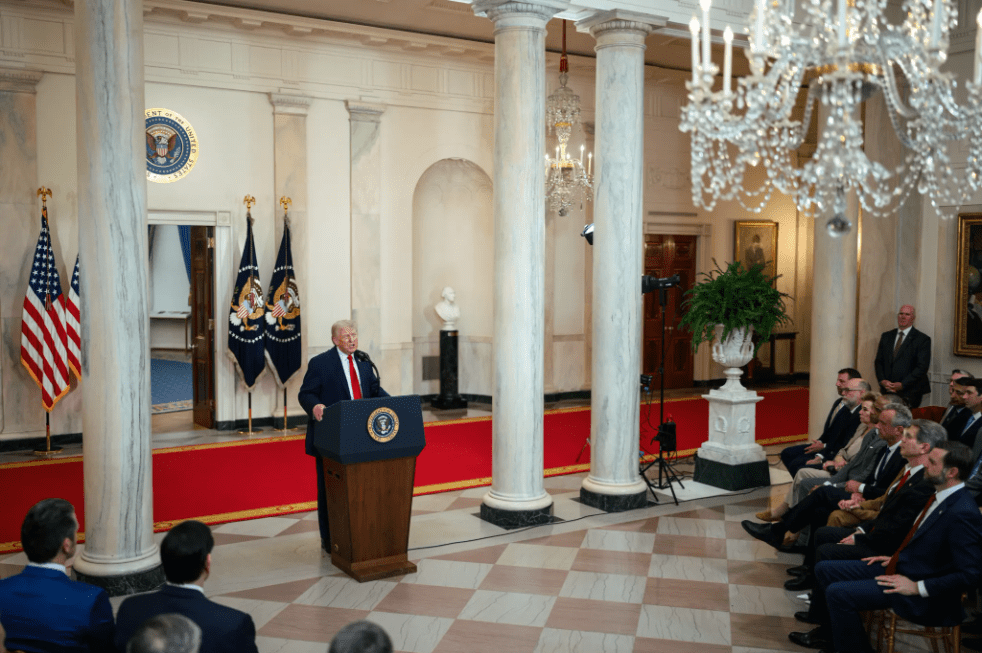
At 10 a.m. on Constitution Day—the anniversary of the adoption of the Constitution of the Republic of Korea—I watched U.S. President Trump’s address to the nation via a live broadcast. Although I had already learned through social media several days earlier that the speech would concern the 2020 U.S. presidential election, hearing the content directly in the president’s own voice was truly shocking. Since it was an election in which President Trump had failed to win re-election—and there had even been an incident where a small group of citizens who refused to accept the results stormed the U.S. Capitol—I had criticized President Trump at the time. Since it was a time when the entire world was under lockdown due to the COVID-19 pandemic, people weren’t particularly interested in such events; perhaps they simply thought it was a farce orchestrated by a stubborn old man who had lost the election and incited a few ignorant citizens. At the time, I was struggling to make ends meet day by day working as a delivery driver, so honestly, I viewed the U.S. president’s claims of election fraud as a political spectacle that had nothing to do with me.
The president’s address to the nation centered on three main points: allegations that external forces had systematically interfered in the 2020 U.S. presidential election to negatively influence the outcome; claims that certain intelligence agencies, despite being aware of this, attempted to cover it up; and the key message that the “SAVE AMERICA ACT” must be passed to prevent such incidents in the future. Surprisingly, among these points, he mentioned the “Deep State”—a concept often dismissed by the public as a conspiracy theory. It was highly unusual for a sitting president to personally expose allegations of a shadow government within the United States, and President Trump’s efforts to reveal this truth—despite repeatedly putting his personal safety at risk—seemed truly remarkable. Moreover, even as this important news was being reported, major U.S. broadcasters either responded passively or refused to cover it, seemingly admitting whose side they were on. It appeared to expose the true nature of the media—as if, even though a truth that needed to be clarified had come to light, they were failing to report it and instead defending a specific side.
Watching how former Vice President Kamala Harris of the Democratic Party was selected as the presidential nominee—starting from the primary process leading up to the U.S. presidential election—I came to understand what it means when “the tail wags the dog.” Furthermore, seeing even outstanding Democratic politicians like Robert F. Kennedy Jr. unable to participate in the primaries led me to question the democratic system within the Democratic Party. Instead, I saw the unsettling suspicion that there were forces pulling the strings behind the scenes. Observing the judicial and financial pressure directed at President Trump—and the attempts to undermine him during the campaign—I realized that American democracy was in crisis.
Although there were suspicions that they attempted to prevent Trump’s reelection in 2024—just as they had in 2020—by exploiting vulnerabilities in the electoral system, thanks to Charlie Kirk’s efforts to mobilize young people, cybersecurity defenses utilizing Elon Musk’s Starlink, and the efforts of many vigilant citizens, we were able to create a “Too Big to Rig” margin of victory and safeguard the fairness of the election. Trump has been singling out the key figures involved in these allegations one by one, gathering evidence, and finally exposed them to the world yesterday. This was the first attack in U.S. history on the electoral system—the very core of American democracy—and it laid bare the complex web of the Deep State, including vote-rigging systems linked to foreign powers and the illegal funds used to finance these international operations.
I wanted to celebrate this victory for justice, the defense of liberal democracy, and the restoration of Christians centered on the United States, and to give all the glory for this victory to God. This is because the normalization of the United States was linked to the normalization of South Korea, and the restoration of American Christians is also connected to the restoration of South Korean Christians. The United States and South Korea have been military allies and are closely connected economically and socially, but they have also been spiritually one since President Syngman Rhee founded the Republic of Korea. That is why the first session of the National Assembly began with prayer, and why, at the moment of South Korea’s impending defeat during the Korean War, General MacArthur saved the nation from crisis through the Incheon Landing Operation. Just as the friendship between President Syngman Rhee—a man of God—and General MacArthur ultimately saved South Korea from crisis, the various analyses and reports on election fraud presented by the Yoon Suk-yeol administration served as a driving force that helped President Trump win re-election and save the United States from the threat of socialism. We now look forward to seeing how President Trump will save President Yoon and South Korea and how he will repay that debt. Yoon Again!


Leave a Reply