Lately, I’ve been using Claude AI frequently to draft proposals and personalized emails for work. I use it to frame the proposal in the direction and tone I intend, and to create the content based on summaries of past business meetings with that client. The entire process takes less than five minutes, and the results are far cleaner and more professional than the emails or proposals I’ve painstakingly written myself—I’m amazed every time I generate new materials.
Moreover, since it retains a history of our chat logs, even when I give new instructions, it crafts content that’s well-suited to the client based on our past conversations. In short, the more I use the AI, the smarter it gets. Not long ago, I gave a lecture on optimizing startup IR. At my request, the AI created presentation materials titled “Optimizing IR: Products That Sell” by referencing the list of participating companies I provided, my existing lecture materials, and the contents of a book I’d recently read. It even included hands-on exercises, producing excellent materials that allowed me to deliver a two-hour lecture.
What I’ve realized while using AI tools is that they don’t replace human work; rather, they enhance human capabilities and value, enabling us to work more efficiently and effectively. While there are some concerns and worries—such as the idea that AI will replace existing workers or that people will have nothing left to do in the future—these are the same questions that were repeatedly raised when smartphones were introduced, during the dot-com boom, and when high-speed internet was rolled out. Each time, those fears failed to materialize. In fact, I’ve even gone so far as to suspect that this herd mentality might be being exploited to prevent the public from embracing new technologies. Of course, as time passes, everyone will forget all about it—to the point where they’ll wonder if they ever asked such foolish questions in the first place.
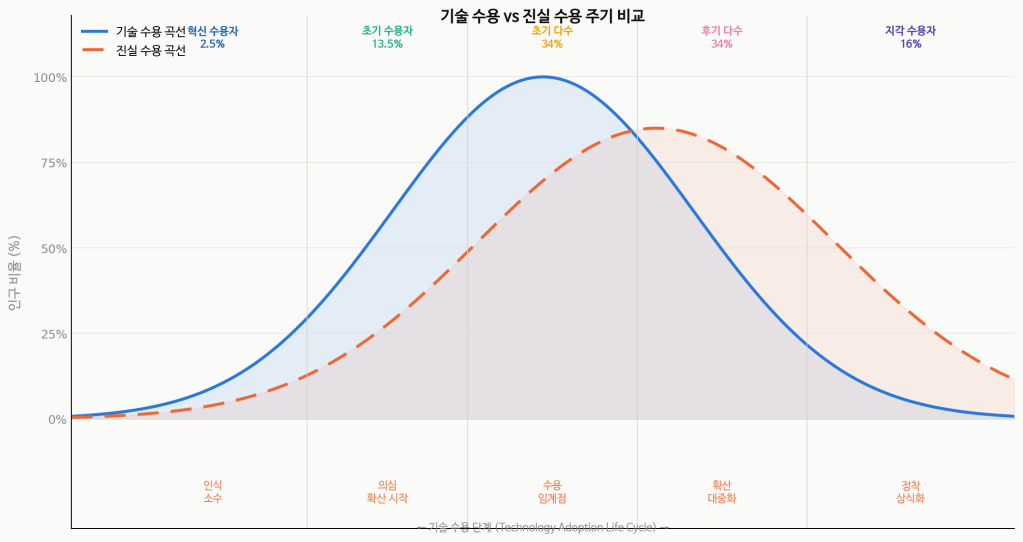
Furthermore, it seemed as though the elite were adopting a strategy to monopolize or exclusively enjoy new technologies and work methods, while delaying their disclosure to the general public as long as possible or slowing down the pace at which the public adapts to them. Reflecting on this trend, as if observing the Technology Adoption Life Cycle, I pondered where I might stand in this process. A frightening thought occurred to me: it’s like a video game where, while some are amassing greater wealth through technology, the majority are reduced to mere NPCs.
However, I sensed that human history has been shaped by a small number of God’s people, and that South Korea is positioned at a crucial inflection point. What’s interesting is that just as the process of adopting new technology follows the Technology Adoption Life Cycle, the process of accepting the truth bears a striking resemblance to it. There were a small number of early adopters and early majority who recognized the reality of election fraud from the very beginning, and it now appears that an increasing number of citizens are moving into the “early majority” stage of accepting that truth. However, by the time the majority of the public comes to realize the underlying currents, it seems they will hide behind yet another curtain and set about orchestrating a new scheme. Nevertheless, today, too, I begin my day by writing, hoping that God’s truth and justice will awaken even one more person in this land.
 Deliveryman's Blog
Leave a comment