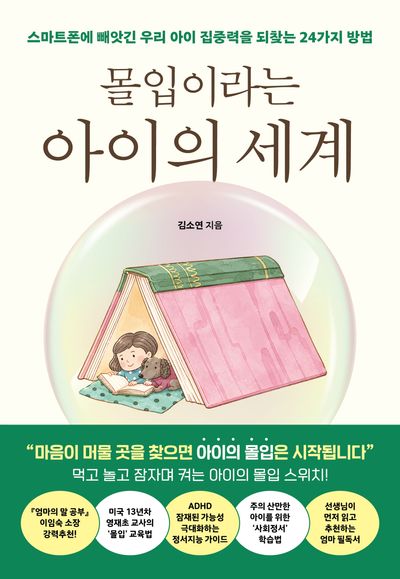
This book was written by a Korean teacher working at a gifted school in Seattle, and I found myself even more engrossed in it when I happened to see my youngest child’s name appear in the text. While many books on children’s education tend to introduce various cognitive science theories and learning methods, this book offered very practical methods and real-life examples to help children truly engage with their learning. At the same time, it warned about the harmful effects of media and smart devices that disrupt that engagement, as well as how Korean parents often unwittingly expose their children to such harmful environments.
I also realized just how different the concepts and goals pursued by gifted schools in Korea and the U.S. are, and how Korean parents are raising their children in a distorted way. For example, I was struck by an anecdote about a Korean mother in Seattle who, during a playdate, asked the other child’s mother what workbook her child was using and how she had done on the last pop quiz, leaving the other mother flustered. In American culture, such questions are considered overly personal and can be perceived as instilling a sense of comparison among children, which is why they are often taken very negatively.
The book also explained how flawed the Korean educational approach is, which involves reducing physical activity as students advance to higher grades. It was interesting to learn that, from a cognitive science perspective, regular exercise provides positive stimulation to the brain and offers tangible benefits for academic performance. It was also new to me that sufficient sleep allows the brain to organize the knowledge learned during the day into long-term memory. Furthermore, while learning specific methods for fostering a habit of reading, I realized that asking questions—such as inquiring about the plot or questioning as if checking homework—actually diminishes children’s interest in reading.
The observations regarding children with ADHD tendencies and the study methods tailored to them were also fascinating. I was also impressed by the story of a scholar who devised a study method—studying for 25 minutes followed by a 10-minute break—that leverages their short attention span. It made me realize that while children with ADHD tendencies are easily distracted, they can demonstrate remarkable concentration in areas that interest them. I learned that rather than blaming media or smartphones solely for their lack of focus, it’s more important to create an environment where even children with these tendencies can immerse themselves in learning. And when I read the part about how what a child really needs most is the ability to bounce back and refocus after going through many failures, I was reminded of my own past failures and moments of challenge.
Throughout the book, I kept thinking that it was not so much about children’s education as it was about parents’ education. Ultimately, I realized that when I, as a parent, first embrace reading and writing and gradually change my life, my children naturally follow suit. I was also reminded once again that children continue to learn by immersing themselves in subjects they enjoy, and it was a time for me to reflect on how I can stimulate their curiosity and foster their spirit of inquiry, leading them to develop habits of reading and writing. So today, too, I read a book and wrote a blog post to organize my thoughts, and I resolved to strengthen my body and mind so I can navigate these turbulent times wisely. Hoping that my children will also live with such habits, I prayed about the issue of my youngest child transferring to a Christian alternative school.


Leave a Reply