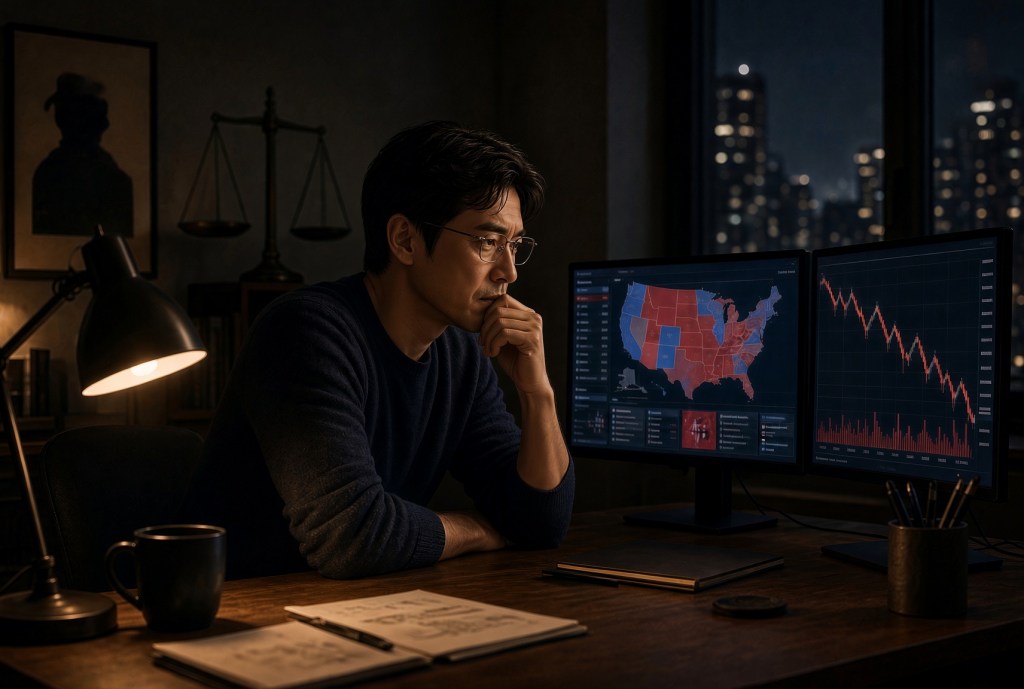
I couldn’t help but laugh when I saw how South Korean media covered the news of the Democrats’ landslide victory in the U.S. midterm elections and the stock market’s reaction—with headlines suggesting a “referendum on a second Trump term,” reports that the Republicans’ Texas stronghold had crumbled, and references to a “lame duck” presidency. Fortunately, having listened to Dr. Lee Chun-geun’s lecture at the Esther Prayer Meeting—where he explained that there have only been two instances in U.S. history where the ruling party held both the presidency and a congressional majority simultaneously—I felt this outcome was somewhat predictable. I also knew that Wall Street actually prefers political gridlock, and I got the sense that, with uncertainty diminishing, Trump’s policies might continue throughout his remaining two years in office.
On the other hand, the Republican Party’s defeat in Texas was a bit puzzling, but as I saw evidence of election fraud allegations begin to surface on X, it felt as though the pieces of the puzzle were falling into place one by one. As I viewed posts raising various suspicions—such as videos showing people casting votes without ID verification, power outages at polling stations, individuals voting multiple times, and bundles of ballots that appeared to be fake—it occurred to me that similar methods had been mentioned in South Korea and Brazil as well. I wondered how American citizens were reacting to the fact that Michigan had elected the first Muslim U.S. Senator in American history.
Coincidentally, I was reading the book Trading, Not Investing at the time, and the author—Ocean Drive, a former asset manager—helped me reexamine the current situation. Unlike investing, which involves analyzing companies and holding stocks for the long term, trading—making profits by buying and selling stocks in the short term—is like a game of betting on how people react amid fear and greed. I also realized that it’s important to first understand your own playing style and your strengths and weaknesses before analyzing the market. After all, the winner in this game is the one who survives to the end by avoiding major losses.
The stock market plummeted following the results of the U.S. midterm elections, a departure from past patterns where the market typically stabilizes once uncertainty subsides. And, coincidentally, reports that the Republican Party won only in states where voter IDs were verified, along with a telling post on the White House’s X account and speculation that the military may have already been mobilized to secure evidence of election fraud, led me to wonder if something was going on behind the scenes. Furthermore, a major explosion was reported not far from Mar-a-Lago, and with analysis suggesting it might have been a missile attack rather than a jet, I wondered if an invisible conflict was unfolding surrounding the midterm elections. Seeing how rumors of war between nations are intensifying, as described in the Bible, and observing ongoing protests in various European countries, I also wondered if the war had perhaps already begun.
Just as the President of South Korea explained in a national address that modern warfare is “hybrid warfare,” it occurred to me that the powerful tactic of election fraud is becoming a point of controversy in elections across many countries. As a result, people are confused, and it seemed to me that these emotions were reflected in the stock market—which I could understand. Ultimately, it seemed that the truth behind the allegations of election fraud—which many vigilant citizens and young people in South Korea have been following closely—was gradually coming to light. I also got the impression that the invisible forces long referred to as the “deep state” were beginning to come into view. I wondered if they might be a small religious cult, a corrupt faction within the financial establishment, or perhaps a group that had infiltrated the military. I found myself pondering whether they were under the influence of some great evil spirit or, without even realizing it, playing a role in dismantling God’s order.
Amid ongoing conflicts in South Korea, I sensed that God’s judgment is not far off, and I resolved to prepare for trading, anticipating a soon-to-come rebound in the stock market.


Leave a Reply