In the past, I used to look forward to election days because they were holidays, and I would often go on family outings. To enjoy a relaxing day off, I would either vote early or cast my ballot first thing in the morning on election day, then go out with my family in the afternoon. When I was stationed in the U.S., I would go to the temporary polling station set up by the consulate to cast my precious vote. I fulfilled my rights and responsibilities as a democratic citizen, praying that a great leader would be elected. Especially when voting abroad, seeing the small number of patriots who took half a day off or made time specifically to vote overseas—even though it wasn’t a holiday like in Korea—I felt a sense of pride knowing that I was one of them.
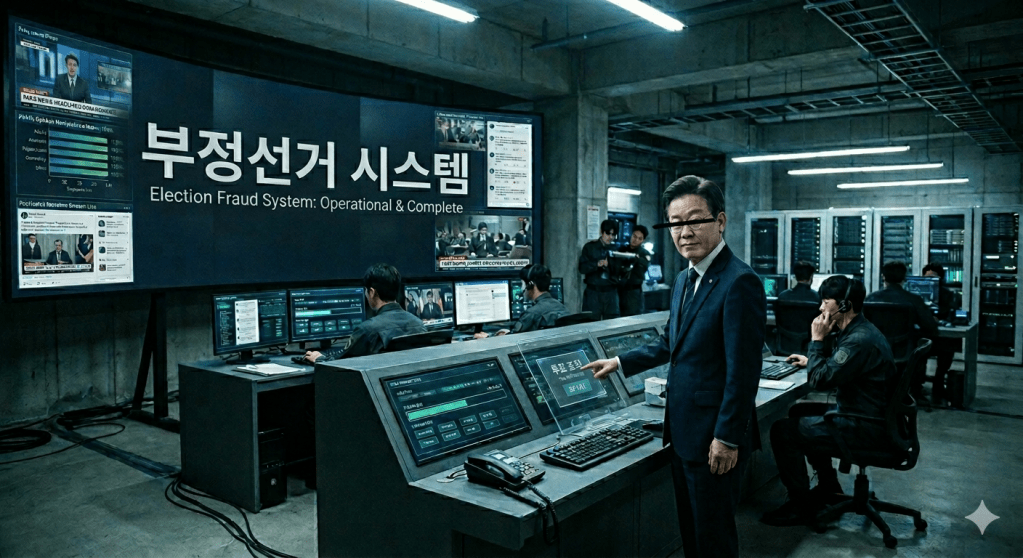
However, I never dreamed that all my efforts would turn out to be meaningless. As expected, I learned that in this June 3 local election as well, early voting rates were manipulated. To meet the fabricated numbers, fake ballots were systematically transported via postal services or illegal vehicles, and pre-programmed electronic vote-counting machines were used to tally stiff, unused ballots. Furthermore, Election Commission staff—who have been systematically engaging in these illegal activities for a very long time—were caught on CCTV during this election doing what they always do: breaking the seals and secretly inserting fake ballots at night. What is astonishing is that these individuals, seemingly desensitized by their actions, appeared unaware that these routine practices were wrong, and they did not seem to care even when election monitors captured evidence on camera. Although there is a wealth of video evidence and documentation available on X, they continued to commit these malicious acts without hesitation.
Former U.S. Ambassador for International Criminal Justice Morse Tan and Dr. Frank, who entered South Korea as part of the U.S.-Korea Joint Election Fraud Investigation Team, visited the offices of A-WEB—an international criminal organization located in Songdo, Incheon—and the Seongnam postal sorting center, where hundreds of thousands of absentee ballots pass through without external oversight, to monitor election fraud. In particular, according to Dr. Frank’s analysis, statistics proved that, just as in the U.S., the number of registered voters in South Korea had been inflated beyond the actual population, and that this began precisely when electronic vote-counting machines were introduced. He even attempted to enter an early voting counting site with the National Election Commission’s permission, only to be blocked by a flustered on-site manager. After early voting, Kim Min-soo, a senior member of the People Power Party, visited the National Election Commission at midnight and found someone putting ballots into a ballot box. When he called the police to inquire, the Commission responded that they were inserting overseas ballots—a fact that, given there were no overseas ballots in this local election, further demonstrated that this election was also being conducted fraudulently.
Many citizens have now realized that President Yoon Suk-yeol was already aware of the reality of this election fraud last year and declared martial law to awaken the public, but it seems it was already too late. This is because they were all part of a massive election fraud cartel: the Association of World Election Bodies (A-WEB), linked to USAID; the Central Election Management Committee, whose chairmanship rotates among former Supreme Court justices; the judiciary, effectively controlled by members of the Our Law Research Association—the group that impeached the president twice; and political parties filled with fake lawmakers elected through fraud. For over 20 years, they have manipulated the electoral system using electronic vote-counting machines—which are essentially devices for electronic manipulation—destroyed evidence by incinerating or shredding ballots, and perfected this massive fraudulent system by adjusting the settings using fake ballots. It seemed as though they had perfected the crime through the efforts of Smartmatic—the mastermind behind Venezuela’s election rigging—Chinese hackers who hid the “Follow the Party” code mentioned in CEO Kim Mi-young’s book, and companies like Miru Systems in Pangyo, Gyeonggi Province, which exports this election fraud equipment worldwide.
However, the public was rallying around a small group of patriots, including whistleblowers like Han Seong-cheon, the former head of the National Election Commission’s labor union, who risked his life to speak out; Hwang Kyo-ahn, the leader of the Liberty and Innovation Party, who is fighting against election fraud; and Kim Jeong-hyun, the head of the Becsus Policy Institute, who was recently appointed to the U.S. State Department’s East-West Center. Just as they had deceived the public by presenting the June 3, 2025, early presidential election as a foregone conclusion, they were now committing an even greater deception in the June 3 local elections to cover up their lies—going so far as to stage a “shortage of ballots” incident in Gangnam-gu, a stronghold of the conservative right. What was astonishing was that they were no longer even trying to hide their lies; instead, they were acting with even greater audacity and brazenness. It seemed as if, just as it says in Romans 1:28, God had abandoned people to their depraved minds, allowing them to do what they ought not to do. In short, it seemed as if in South Korea, the normal had become abnormal and the abnormal had become normal, and it seemed we had reached a point of no return.
Meanwhile, when martial law was declared last year, I witnessed cryptocurrency prices plummet by 50% in the market, which made me realize this was reality. I am now curious to see how the market will react following these local elections. The current administration has manipulated the real estate market to drive up prices in the Gangnam area, astronomically increased government debt to shower citizens with subsidies, and inflated the stock market—all while creating a speculative playground for foreign capital forces and intentionally encouraging citizens to invest with borrowed money. Given this situation, I was worried about the chaos that would ensue in South Korea if the stock market were to crash after the local elections. This is because it is obvious that capital forces, having already sold off over 100 trillion won to secure cash, will sweep away Korea’s national wealth like shearing sheep, just as they did during the IMF crisis. By the time the public realizes that this government is a group of traitors who have corrupted the electoral system to surrender national sovereignty and sell off the nation’s wealth to globalists, South Korea will likely have vanished, and the “Hidden Republic”—the title of Representative Kim Mi-young’s book—will emerge from the darkness.
So, today I rose at dawn once again to seek the light of God’s truth, praying that even one more person might awaken to this reality, and I resolved to devote myself wholeheartedly to archery and writing—the things I can do. I have also recovered my principal from the overheated stock market and prepared to reinvest it in a Republic of Korea that is soon to be laid waste. For a Republic of Korea that will rise again!
“Since they did not see fit to acknowledge God, God gave them over to a depraved mind, to do what ought not to be done.” (Romans 1:28)


Leave a Reply